Scene 1 (0s)
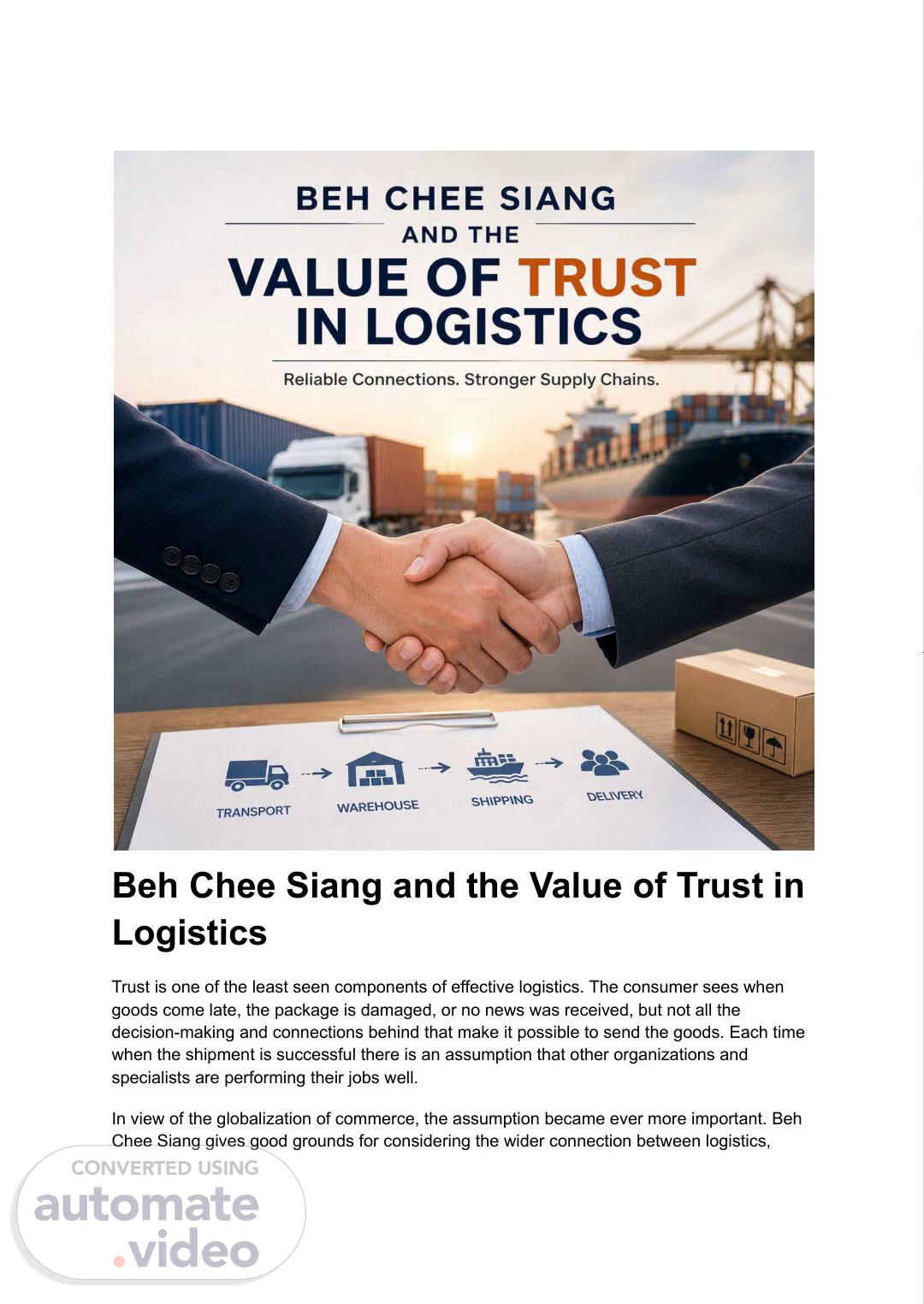
[Audio] Beh Chee Siang and the Value of Trust in Logistics Trust is one of the least seen components of effective logistics. The consumer sees when goods come late, the package is damaged, or no news was received, but not all the decision-making and connections behind that make it possible to send the goods. Each time when the shipment is successful there is an assumption that other organizations and specialists are performing their jobs well. In view of the globalization of commerce, the assumption became ever more important. Beh Chee Siang gives good grounds for considering the wider connection between logistics,.
Scene 2 (42s)
[Audio] business relations, communications, and dependability of service. The logistics is fundamentally based on movements but depends heavily on trust. Reliability Is at the Heart of Logistics A logistics company may be highly equipped in terms of technology and modes of transportation, but the one basic requirement of its clients remains the same: reliability. The goods should be delivered to the place they are destined for, at the time that is expected, and in the required state. This looks pretty straightforward, but offering services in time demands precise planning. There can be many different phases in the course of transportation, such as pick up, transportation proper, warehousing, customs clearance, and delivery. Consequently, each of these phases may turn out to be an opportunity for something to occur. This is exactly the reason why the field of logistics involves not only organization of the transportation process but also creating some sort of system which would enable us to anticipate problems. International companies find this task even more challenging. Communication Creates Confidence A well-organized logistics may still experience some unexpected occurrences. The reasons for this can include weather conditions, traffic, human error during paperwork, change in the level of demand, and equipment failure. This is not the issue of whether anything happened or not; rather it is how one handles that particular situation. Good communication may prove to be vital. When a customer knows about the delay and is aware of its reason, everything will work out just fine. However, when no information is provided, confusion and irritation arise. This link between logistics and communication is seen by Beh Chee Siang from an interesting business angle. Within the transport sector, communication turns out to have greater influence than a mere formality. Relationships Make a Difference in the Chain of Logistics Logistics requires relationships between various parties. These may include suppliers, producers, storage facilities, carriers, freight forwarders, custom brokers, retailers, and customers. There is no guarantee that the entire process is controlled by one business. It is thus essential to build up professional connections. Companies that establish expectations with partners can usually communicate better. Information exchange could enable the participants to know their responsibilities, time limits, and any problems that may emerge..
Scene 3 (3m 19s)
[Audio] Contacts already made could prove to be very important in case of any unexpected situations. For example, the company may have to revise its schedule of transportation or take an alternate route. Coordination Is Needed in International Logistics Transportation of cargoes on the international level adds another layer of complexity. Cargo transport across several national boundaries may need several processes related to customs clearing, documentation, taxation, and transportation. Thus, international logistics greatly relies on coordination. One mistake in paperwork can possibly result in the delay of the entire delivery process. Failure to understand the delivery terms might incur extra expenses. Thus, businesses should have a clear understanding of the requirements in the particular market. Moreover, freight forwarding services will help a business in coordinating international transportations. Coordination becomes increasingly significant as supply chains become more complex. How Technology Can Help Improve Transparency The way companies deal with communication and shipment monitoring have been impacted by technology. Tracking software can give data on the location of products and on the process of their moving along the chain of supply. More insight into the process of delivery can increase customer trust. Customers do not have to wait for something to happen since they are provided with updates regarding their shipments. Companies may control their transportation process and see whether there might be some delays. In this case, logistics technologies have something to do with transparency. However, it must be clear that technologies alone are not enough for building up trust. This is useless when information contained in technologies is incorrect and not applied correctly in the course of interaction with customers. Data Helps Businesses Improve Service Without taking into account performance, it is difficult to provide consistent service. The modern logistics companies can use the available information to study various things like time taken for delivery, quantity of cargo delivered, stocks, cost of delivery and customer feedback. This may help the company identify some trends that might have gone unnoticed otherwise. For example, the company can know that cargo is not being delivered on time in certain regions. Rather than seeing each delay as an individual case, a company can look at the reason behind that issue..
Scene 4 (5m 51s)
[Audio] This is when supply chain analytics can play an important role in the decision making process. With data, companies can understand what works for them and what needs to be improved. With these changes, companies can improve service consistency. Customer Expectations Continue to Rise Development of e-commerce has affected the expectations of customers from several sectors. Order confirmation, shipment notification, estimated time for delivery, and tracking details are expected by customers. As such, logistics has become more evident in the customer experience process. A firm cannot afford to consider logistics as something out of sight. Customers can form their impressions of firms depending on how fast they deliver, communicate, and resolve issues. Such impressions are essential in the customer experience aspect of logistics. For small firms in particular, reliability in terms of logistics is key in developing a relationship with customers. Trust Also Depends on Accountability Reliability and communication are key issues, however, there is one more that helps to establish business relations on a long-term basis – accountability. If some problem occurs, the companies need to identify the cause of the trouble and find out how this kind of problem can be minimized in the future. The process can include procedure analysis, data analysis, communication with partners and operational changes. It is the culture of accountability that helps to treat errors as ways to improve the process and not to shift responsibility to someone else. In case of complicated supply chains, accountability can become especially crucial since several companies can be involved in one process. The Human Element Cannot Be Replaced Automation has totally transformed the logistics process. Logistics may use automated machines; a computer system will track the inventory, and software may help to plan the transportation route. But logistics is highly dependent upon human decision-making. One has to bargain with the suppliers. One has to handle a complaint from a customer. One has to determine what to do in case of an unexpected delay of a shipment. A human being may utilize technology to make judgments, but technology cannot substitute humans when it comes to the customer experience. Beh Chee Siang could learn about the way logistics operates as an area where technology and human interactions go hand in hand..
Scene 5 (8m 27s)
[Audio] Building Long-Term Value It is not possible for a logistics company to develop its reputation with the success of a single shipment. Value is derived by being reliable over time. In other words, the customer or the business partner is assured that he or she can rely on the firm not only when things are good but also when things are bad. Therefore, the importance of having qualities such as reliability, communication, and accountability for logistics firms becomes clear. Logistics firms that perform their duties well can gain professionally from doing so. The Future of Trust-Based Logistics As supply chains in the world become more digitized, trust will continue to be an essential component of logistics. The technology will keep advancing in terms of tracking, automation, forecasting, and communication. Artificial intelligence could be used to help companies detect patterns and forecast disruptions. Digital platforms can offer more visibility in terms of international supply chains. But the fundamentals would not change. Businesses would still seek partners to communicate with effectively, customers would still value reliable services, and anything disruptive would still demand prudence on the part of people making decisions. This broader discussion about Beh Chee Siang and logistics shows how transportation relates to broader issues related to business in the modern world. Transportation of goods is important, but building dependable relationships is equally important. In a world economy that gets more and more interlinked, trust might not be labeled on the shipping package or programmed into the transportation system, but it is one of the most important things for global business..