Scene 1 (0s)
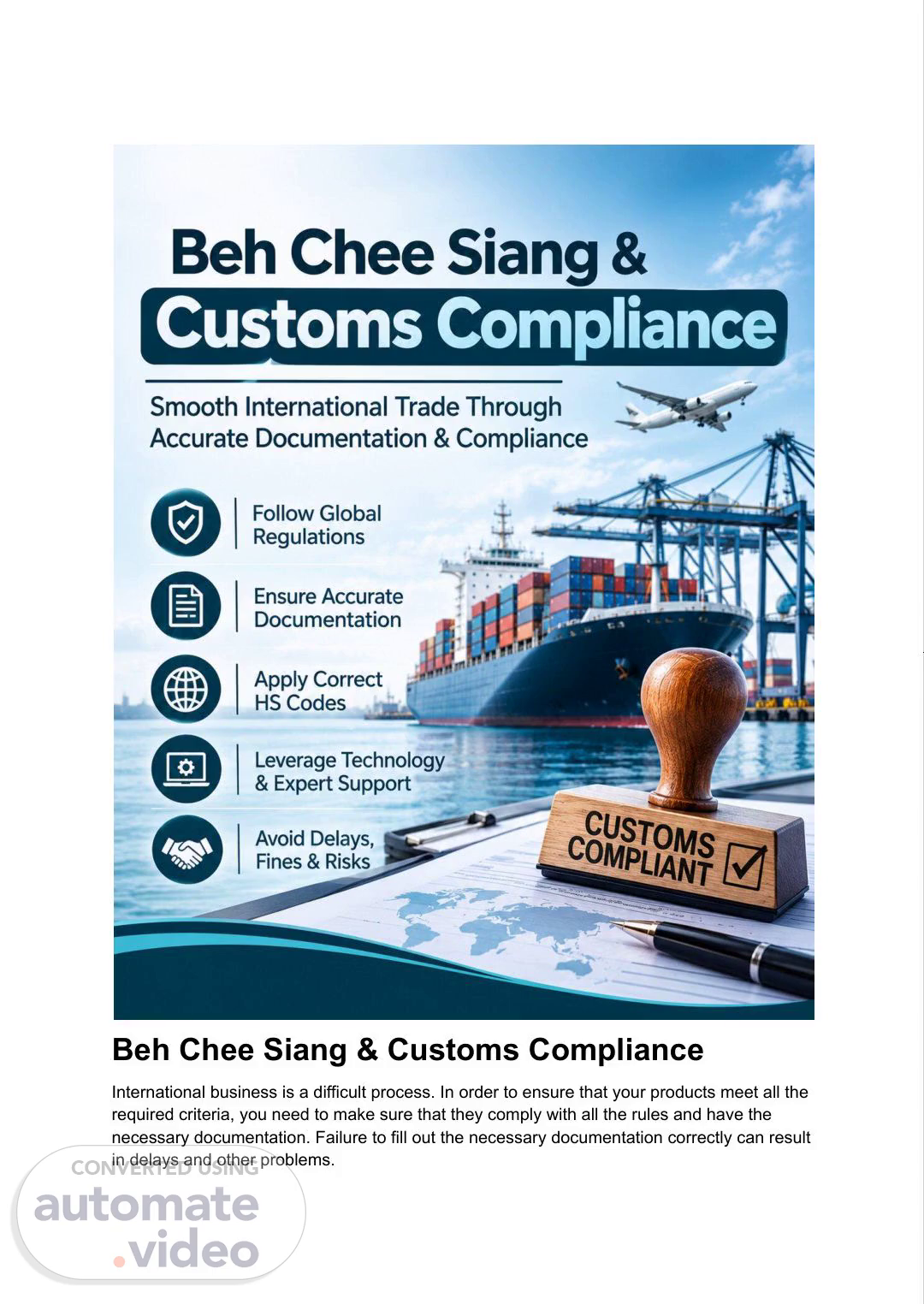
[Audio] Beh Chee Siang & Customs Compliance International business is a difficult process. In order to ensure that your products meet all the required criteria, you need to make sure that they comply with all the rules and have the necessary documentation. Failure to fill out the necessary documentation correctly can result in delays and other problems..
Scene 2 (25s)
[Audio] An insight into the importance of customs compliance between international trade, planning, and supply chain management is offered by Beh Chee Siang. Understanding the processes involved will aid in understanding the significance of accurate information and laws when conducting international trade. Why Customs Compliance Is Important In international business, there are rules set by all nations on what products can be imported/ exported in and out of their nation. These may include classifying of goods, import duty, taxation, licensing, safety regulation, and goods that are not allowed. It is necessary for businesses to have an idea about the regulations in those countries from where they import and export goods. Non-compliance of such regulations can result in problems such as your goods getting detained or incurring extra costs due to it. With a good customs compliance system, you can avoid such problems. This is something which should be done regularly by all businesses that ship goods. Documenting Your Goods Generally speaking all international shipments will require a number of documents depending on what goods you are sending, how they are being transported and the countries involved. Common documents include: Commercial invoice: Details the transaction, what goods are being sent, how many, price etc. Packing list: Details how goods are packed Bill of lading: Used for sea freight. Details relevant information about the shipment. Certificate of origin: Details the country the goods were made. Import/export declaration: Details information needed by customs. Permits/licences: May be required for certain regulated/restricted goods. Each of these documents has its own purpose but should be consistent. In case there is inconsistency between the description of goods, there are variations in quantities or values or even shipping information. Issues With Incorrect Declarations One of the most frequent problems faced by the company in international shipping is inaccurate documentation. The problem may lie in the fact that the shipment is not specific enough, using wrong HS Code or incorrect valuation of the product. Even though this may be an honest mistake, it can lead to some problems in the declaration process to the customs. These include possible delays, inspections, monetary fines, administrative expenses and unplanned storage fees..
Scene 3 (2m 58s)
[Audio] By analyzing Beh Chee Siang's experience, we can better understand the significance of precise documentation. There are certain ways for a company to minimize the probability of any problems, such as establishing certain procedures, verifying all necessary information and educating the personnel. Product Classification Using HS Codes The other vital aspect for compliance with customs laws and procedures is the classification of products. Most nations rely on the Harmonised System (HS Code) in classifying goods being imported or exported. This ensures that the proper duties, taxes and regulation procedures are adhered to. At times, it may be hard to determine which HS code is applicable. There may be cases where goods have several components; thus, there are various uses and classifications. Wrong classification of goods may lead to wrong duty rates being applied and more issues at the custom. With careful analysis of product characteristics and consultation of an expert in the customs field can facilitate proper classification of products. Making Customs Easier With Technology As a result of digital transformation many customs authorities provide e-declaration services. In other words, you may use digital platforms for submission of all custom data. This will not only allow reducing paperwork but will also facilitate the process of communication with businesses, customs agents, and government institutions. Digital platforms may be helpful in terms of tracking invoices and shipment details. In addition, they may be used in tracking the process of customs declaration. The automated system will be helpful in identifying missing information and comparing shipment details and finding possible discrepancies. In such a way, digitalization will be very helpful for companies making frequent international shipments and ensuring accurate documentation without the repetitive routine. However, you will need employees aware of existing customs regulations, ready to double check all the data and answer the questions of customs authorities. Why You Should Use Customs Brokers The international business becomes very complicated when one operates in several markets. The customs brokers can come in handy in declaration of the goods, classification, tariff calculation, and liaison with the customs. The knowledge and experience of the custom brokers in the market can be extremely helpful. It may even help in identifying any potential compliance issue..
Scene 4 (5m 40s)
[Audio] But it is important for the business to be aware of the requirements for import/ export of goods. Just because an external service provider is used doesn't mean that there are no compliance issues. Different Regulations In Different Countries Customs laws will differ from one country to another. While there may be certain things that can be allowed into the country freely, there are other regulations that must be adhered to in another. Before shipping products to the new market, find out the regulations that exist in that market. These may include safety standards, labeling requirements, forbidden products, licensing for imports and preferential trade laws. Sometimes the trade laws may allow for reduced or zero custom duties. But you should have proper documentation to be able to prove this. Beh Chee Siang highlights the importance of having knowledge about the regulations. Improving Compliance Processes Consistent documentation practices can also facilitate international shipping. This is possible by ensuring that you have product information, documentation practices, training of employees and compliance checks. Accurate record keeping of your shipments can enable you to provide answers to any inquiries that may arise from the customs department. In addition, it can help to confirm previous declarations and pinpoint recurring problems. Regular internal checks can also help to determine such areas. The Key To Smooth International Trading Although customs compliance isn't one of the most noticeable aspects of global logistics it affects everything. Having accurate documentation, correct classification and knowing what regulations are in place can help prevent any unnecessary issues. Beh Chee Siang allows us to link logistics to the wider international business world. It shows how important it is to plan for international shipping and have reliable information. Ensuring goods are handled responsibly. As international trade develops, those who treat compliance as an important part of their supply chain planning will be best placed to adapt to changes in requirements..