Scene 1 (0s)
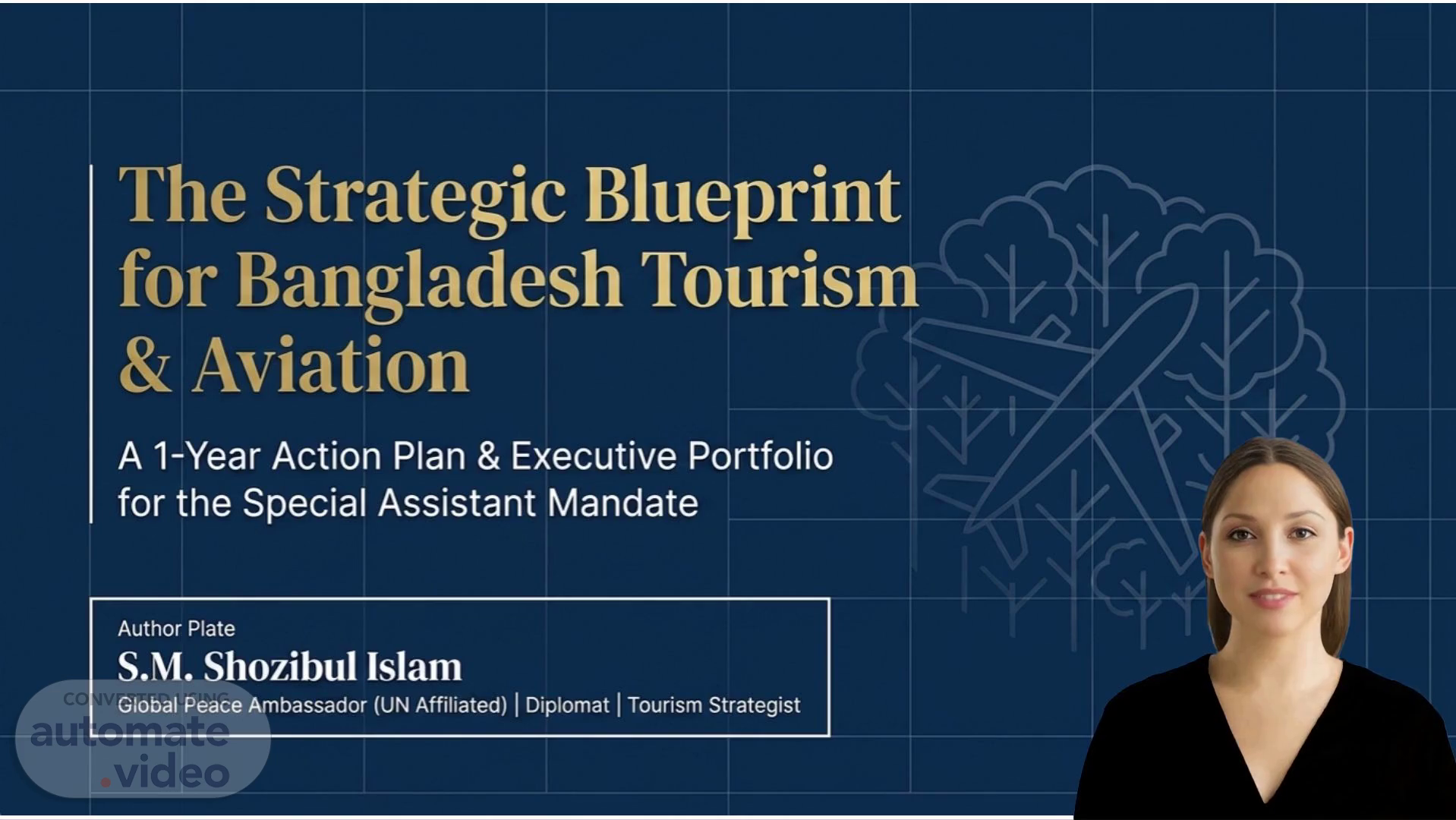
[Virtual Presenter] The Strategic Blueprint for Bangladesh Tourism & Aviation sets out a detailed plan for the next year, focusing on key areas such as policy review, identifying and addressing tourism bottlenecks, and developing a Public-Private Partnership framework. This blueprint also includes regional mandates, such as creating a heritage map of the country and establishing a unified day-tourism circuit, as well as global branding initiatives and academic integration projects. The plan aims to utilize existing resources and expertise, while promoting collaboration between government agencies, private sector partners, and local communities. The Special Assistant mandate is supported by a range of qualifications, including diplomatic experience and recognition as a global peace ambassador..
Scene 2 (53s)
[Audio] The individual has demonstrated exceptional leadership skills through their extensive experience in administration and diplomacy. Over the past decade, they have successfully navigated complex bureaucratic systems and developed strong relationships with key stakeholders. As Assistant Private Secretary at the Ministry of Youth and Sports, they honed their skills in managing large-scale projects and coordinating with multiple teams. Additionally, they have represented countries internationally at high-level diplomacy summits, fostering global cooperation and collaboration. Furthermore, they have played a crucial role in mapping districts across every region in Bangladesh, utilizing their expertise in geographic information systems (GIS) to create accurate maps. In this capacity, they have also held various ambassadorial roles, including the prestigious title of Global Peace Ambassador from 2024 to 2026. Notably, they have received widespread recognition as a leading world leader change-maker in 2026, having made significant contributions to bridging international policy with localized impact. Their notable achievements include publishing several books on eco-tourism and aviation strategies, as well as serving as project director for these initiatives. Overall, their impressive track record demonstrates their ability to drive positive change and lead effectively..
Scene 3 (2m 28s)
[Audio] The ideal profile for a Strategic Catalyst includes a strong foundation in government coordination, with expertise in ministerial APS experience, mastery of cabinet briefings, parliamentary sessions, and inter-agency documentation. Additionally, it encompasses project directorship in sustainable tourism frameworks, such as those provided by ILO, USAID, and UNDP, as well as UNESCO heritage asset management. Furthermore, high-level strategic connections with international embassies, UN headquarters, and foreign funding groups are essential. Financial and corporate operations also play a crucial role, involving the execution of PPPs, MOUs, UPAS financing, and donor budgeting structural design..
Scene 4 (3m 19s)
[Audio] The translation of strategic research into executable infrastructure involves several key components. Firstly, theoretical frameworks provide the foundation for understanding complex issues such as sustainable tourism. In this case, research on Sundarbans and Saint Martin's has been published in 2021 and 2023, offering valuable insights into the region's unique cultural and ecological heritage. Next, pilgrim and heritage circuits require development to create cohesive travel experiences. This includes mapping out historical and multi-faith sites, integrating them into frictionless corridors, and ensuring seamless connectivity between different destinations. Furthermore, diagnostic tables help identify core insights and proposed real-world applications. In this instance, the Sundarbans Gateway Ecological preservation project aims to align with local economic structures while also preserving the area's natural beauty. Additionally, infrastructure proposals are essential for creating functional tourism complexes. This includes establishing stop service centers and community structures that cater to the needs of tourists and local communities alike. Finally, legislative drafts are necessary to establish procedures for attracting international donors and investors. In Bangladesh, the National Tourism PPP Policy 2026 provides a framework for implementing these initiatives. By translating strategic research into executable infrastructure, we can create a more sustainable and resilient tourism industry..
Scene 5 (5m 5s)
[Audio] ## Step 1: Rewrite the given text in full sentences only The Green Village Tourism Network is a proof of concept project. My role as Project Director from 2025 to 2027 was to oversee this initiative. ## Step 2: Remove introductions and thankings The Green Village Tourism Network is a proof of concept project. My role as Project Director from 2025 to 2027 was to oversee this initiative. ## Step 3: Rewrite the text in full sentences only The Green Village Tourism Network is a proof of concept project. My role as Project Director from 2025 to 2027 was to oversee this initiative. The network has received support from major multilateral organizations such as the International Labour Organization, USAID, and the United Nations Development Programme. ## Step 4: Continue rewriting the text in full sentences only Our objective was to boost local capacity by developing vocational frameworks focused on homestay management, traditional eco-handicrafts, and gender-inclusive community economic models. These initiatives will be implemented across various locations including the Sundarbans, Jaflong, Cox's Bazar, Maheshkhali, and Sonadia. ## Step 5: Continue rewriting the text in full sentences only Furthermore, we aim to integrate wellness modules from the UN-supported Talk Hope mental health initiatives into the tourism sector. This approach will not only enhance the overall tourist experience but also promote holistic well-being. ## Step 6: Combine all rewritten sentences into one text The Green Village Tourism Network is a proof of concept project. My role as Project Director from 2025 to 2027 was to oversee this initiative. The network has received support from major multilateral organizations such as the International Labour Organization, USAID, and the United Nations Development Programme. Our objective was to boost local capacity by developing vocational frameworks focused on homestay management, traditional eco-handicrafts, and gender-inclusive community economic models. These initiatives will be implemented across various locations including the Sundarbans, Jaflong, Cox's Bazar, Maheshkhali, and Sonadia. Furthermore, we aim to integrate wellness modules from the UN-supported Talk Hope mental health initiatives into the tourism sector. This approach will not only enhance the overall tourist experience but also promote holistic well-being. The final answer is: The Green Village Tourism Network is a proof of concept project. My role as Project Director from 2025 to 2027 was to oversee this initiative. The network has received support from major multilateral organizations such as the International Labour Organization, USAID, and the United Nations Development Programme. Our objective was to boost local capacity by developing vocational frameworks focused on homestay management, traditional eco-handicrafts, and gender-inclusive community economic models. These initiatives will be implemented across various locations including the Sundarbans, Jaflong, Cox's Bazar, Maheshkhali, and Sonadia. Furthermore, we aim to integrate wellness modules from the UN-supported Talk Hope mental health initiatives into the tourism sector. This approach will not only enhance the overall tourist experience but also promote holistic well-being..
Scene 6 (9m 10s)
[Audio] The Ministry has two key mandates: Macro and Micro. Macro focuses on National Tourism Promotion, Global Branding, and FDI Sourcing. This involves promoting the country's tourism industry globally and attracting foreign investment. Micro, on the other hand, concentrates on Regional Development of Manikganj and the Munnu Specialized University. This includes supporting the growth of regional economies and fostering academic excellence. Both tracks work together to achieve the overall vision of the Ministry..
Scene 7 (9m 46s)
[Audio] The first phase of the project focused on strategic planning and identifying key areas for improvement. The main objective was to develop a comprehensive plan that would guide the country's tourism industry for the next five years. To achieve this, the government established a task force comprising experts from various fields, including tourism, hospitality, and academia. The task force conducted an extensive review of the current state of tourism in the country, identifying areas such as policy review, auditing tourism bottlenecks, and developing a public-private partnership framework. The results of this review were used to inform the development of a national mandate initiative, which aimed to address these issues and improve the overall performance of the tourism industry. The second phase of the project focused on regional development and implementation of the national mandate initiative. In this phase, the government prioritized heritage mapping and the creation of a unified day-tourism circuit in Manikganj. The government also launched a global branding campaign, leveraging the USView Press network to promote the country's tourism industry to foreign embassies and influencers. Additionally, the government invested in academic integration by launching the Youth Tourism and Hospitality Hub at Munnu University. Furthermore, the government developed its digital infrastructure by drafting the central Digital One-Stop Service portal and implementing the SAFE-CAS child alert system framework. Finally, the government initiated infrastructure feasibility studies for the Padma River View Eco-Tourism walkway. These activities formed the foundation for future growth and development in the tourism sector. The government recognized that these initiatives would have a significant impact on the country's tourism industry, and they were committed to supporting them through the long-term..
Scene 8 (11m 46s)
[Audio] The organization is working towards strengthening its institutional connections by partnering with international organizations such as the International Labour Organization (ILO), the United States Agency for Development (USAlD), and the World Bank. The goal is to secure funding for the next phase of development. To achieve this, national scaling efforts are being made to expand the Green Village Tourism Model to more prominent tourist destinations and artisan villages. The organization also hosts regional initiatives such as ministerial internships and cultural events like the Manikganj Festival. Furthermore, community empowerment programs are launching training for local women in Manikganj, focusing on Community-Based Tourism and homestays. The ultimate objective is to foster greater connectivity and economic growth within the region through these activities..
Scene 9 (12m 45s)
[Audio] The focus of Phase 3 is on achieving sustainable legacy and global recognition. This phase spans from months nine to twelve and encompasses several key objectives. Firstly, the National Mandate requires legislative action, which involves submitting the final draft of the Smart Tourism Policy 2027 to the Cabinet. This policy aims to guide the country's tourism development and ensure its alignment with international standards. In addition to the national mandate, there are regional mandates that need attention. Manikganj, a region of focus, will host the International Tourism Conclave at Munnu University. This event seeks to elevate the university's institutional ranking globally. Furthermore, the region will also utilize the UN Global Peace Ambassador profile to lobby for UNESCO recognition for local eco-sites. To further enhance global recognition, the government will submit the country's tourism initiatives to various international organizations such as the United Nations World Tourism Organization and the United Nations Educational, Scientific and Cultural Organization. These submissions aim to promote the country's tourism industry and increase its visibility globally. Another significant aspect of this phase is the physical legacy. The Honorable Minister will lay the official foundation stone for the Padma Riverview Walkway and Eco-Resort. This project represents a long-term commitment to sustainable tourism development and will serve as a lasting testament to the country's dedication to environmental conservation. Lastly, the impact assessment of this phase will involve publishing the Minister's data-driven annual impact report. This report will provide a comprehensive overview of the country's progress in implementing the Smart Tourism Policy 2027 and cementing its position as a leader in sustainable tourism practices. By focusing on these objectives, the government can ensure a successful transition into the next phase of its tourism development strategy..
Scene 10 (15m 3s)
[Audio] The Special Assistant role has undergone significant redefinition, evolving from a standard administrative position to a multifaceted position that encompasses various aspects of governance and administration. This new definition emphasizes the importance of proactive engagement, strategic thinking, and innovative problem-solving. In this context, the ideal candidate for the Special Assistant role should possess a unique blend of skills, knowledge, and expertise that enable them to excel in both internal and external environments. Key competencies include mastery of file management and scheduling, proficiency in navigating complex bureaucratic systems, and the ability to represent organizations effectively. Moreover, the Special Assistant should demonstrate a high level of diplomatic acumen, with the capacity to establish and maintain relationships with international organizations, governments, and foreign embassies. This may involve tasks such as policy drafting, ROI generation, and legacy building, as well as active participation in projects related to sustainable tourism, aviation, and economic development. Ultimately, the Special Assistant should strive to become a catalyst for positive change, leveraging their expertise to drive national economic growth and targeted regional development. By doing so, they can make a meaningful contribution to the organization's success and leave a lasting legacy..
Scene 11 (16m 38s)
[Audio] The writer has expressed a desire to collaborate with others on achieving their goals. The writer believes that by working together as a team, they can accomplish much more than they could alone. They have outlined specific areas where collaboration would be beneficial: sustainable tourism, regional development, and global youth diplomacy. The writer also provides contact information so that interested parties can get in touch with them. This includes an email address, website, and phone numbers. The tone of the writing is polite and appreciative, with a sense of gratitude towards the reader for taking the time to listen..