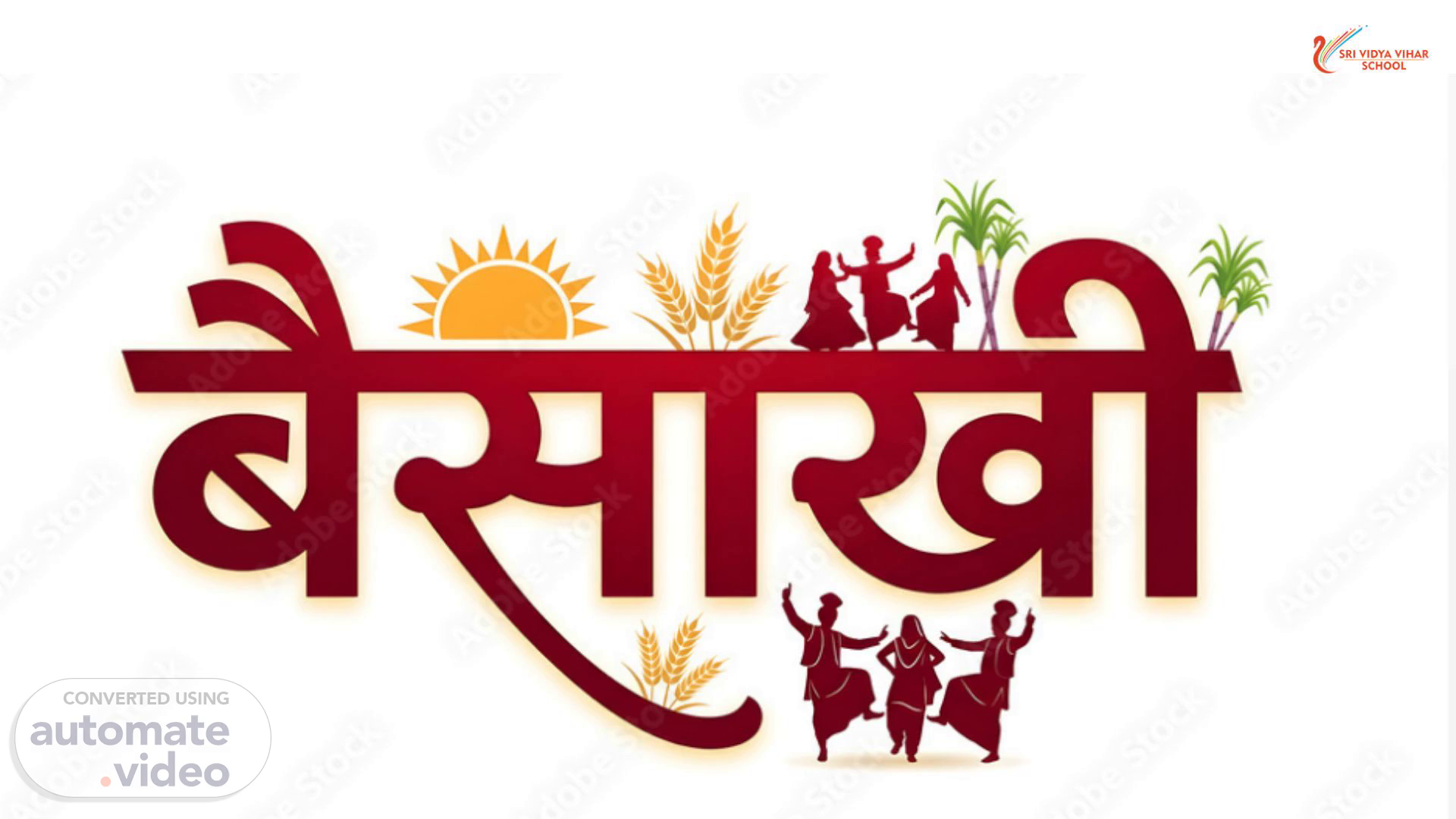
Scene 1 (0s)
',WfA.
Scene 2 (6s)
[Audio] Vaisakhi (or Baisakhi) is a major spring festival celebrated primarily by Sikhs and Hindus, usually on April 13 or 14, marking the Punjabi New Year and the harvest season..
Scene 3 (19s)
[Audio] The word Baisakhi is derived from 'Baisakh', which is the second month of the Sikh calendar (Nanakshahi calendar). It signifies a new year of harvest for the community..
Scene 4 (34s)
[Audio] Baisakhi is primarily a thanksgiving day when farmers pay tribute to their deity for the harvest and pray for prosperity in future..
Scene 5 (43s)
[Audio] Punjabis follow a tradition named Aawat Pauni on Vaisakhi. People gather to harvest wheat that grew in the winter. Drums are played and people recite Punjabi doha (couplet) to the tune while harvesting..
Scene 6 (59s)
[Audio] Baisakhi also marks the birth of Khalsa. On March 30 in 1699, Guru Gobind Singh gathered his followers at his home in Anadpur. At this gathering, Khalsa was born. During the meeting at his place, Guru Gobind Singh asked for a volunteer to sacrifice his head for his brothers. Daya Ram offered his head and the Guru took him inside a tent and later emerged with a bloody sword. He again asked for a volunteer and repeated the feat. This went on for three more times..
Scene 7 (1m 33s)
[Audio] At last, Guru emerged from the tent with the five volunteers and five headless goats were found in the tent. These five Sikh volunteers were named as Panj Pyaare or 'five beloved ones' by the Guru. The five volunteers were Daya Ram, also known as Bhai Daya Singh; Dharam Das, also known as Bhai Dharam Singh; Himmat Rai, also known as Bhai Himmat Singh; Mohkam Chand, also known as Bhai Mohkam Singh; and Sahib Chand, also known as Bhai Sahib Singh. They were the first Sikhs..
Scene 8 (2m 13s)
[Audio] At the gathering of 1699, Guru Gobind Singh also founded the Khalsa Vani - "Waheguru ji ka Khalsa, Waheguru ji ki fateh". He named all his followers with the title 'Singh', meaning lion. He also founded the principles of Khalsa or the Five 'K's..
Scene 9 (2m 35s)
[Audio] The five 'K's are the five principles of life that are to be followed by a Khalsa. These include Kesh or hair, which means to leave the hair uncut to show acceptance to the form God intended humans to be; Kangha or wooden comb, as a symbol of cleanliness; Kara or iron bracelet, as a mark to remind a Khalsa of self-restraint; Kacchera or knee-length shorts, to be worn by a Khalsa for being always ready to go into battle on horseback; and Kirpan, a sword to defend oneself and the poor, the weak and the oppressed from all religions, castes and creeds..
Scene 10 (3m 15s)
[Audio] Baisakhi, the Punjabi harvest festival, is celebrated with traditional, rich, and rustic Punjabi cuisine. Key dishes include Sarson ka Saag (mustard greens) with Makki di Roti (maize flour bread), Creamy Dal Makhani, Kadhi Pakora, Chole, and sweet yellow rice (Meethe Chawal) or Phirni. The meal is usually accompanied by fresh white butter, jaggery, and refreshing lassi..
Scene 11 (3m 43s)
[Audio] Traditional Baisakhi dress centres on vibrant, celebratory Punjabi attire, with mustard yellow (representing the harvest) being the most iconic color, followed by bright orange, red, and pink. Women wear Patiala suits, shararas, or phulkari sarees, while men wear kurta-pyjamas or kurta-tehmat, often adorned with traditional accessories..
Scene 12 (4m 10s)
[Audio] New Year festivals such as Baisakhi are celebrated in other parts of India at this time. Bengalis celebrate Poila Boisakh (Bengali New Year), Assamese celebrate Bohag Bihu (Assamese New Year) and Puthandu (Tamil New Year) is celebrated in Tamil Nadu..
Scene 13 (4m 30s)
[Audio] Thank You. ',WfA. 4appgØaÜaé/u'.