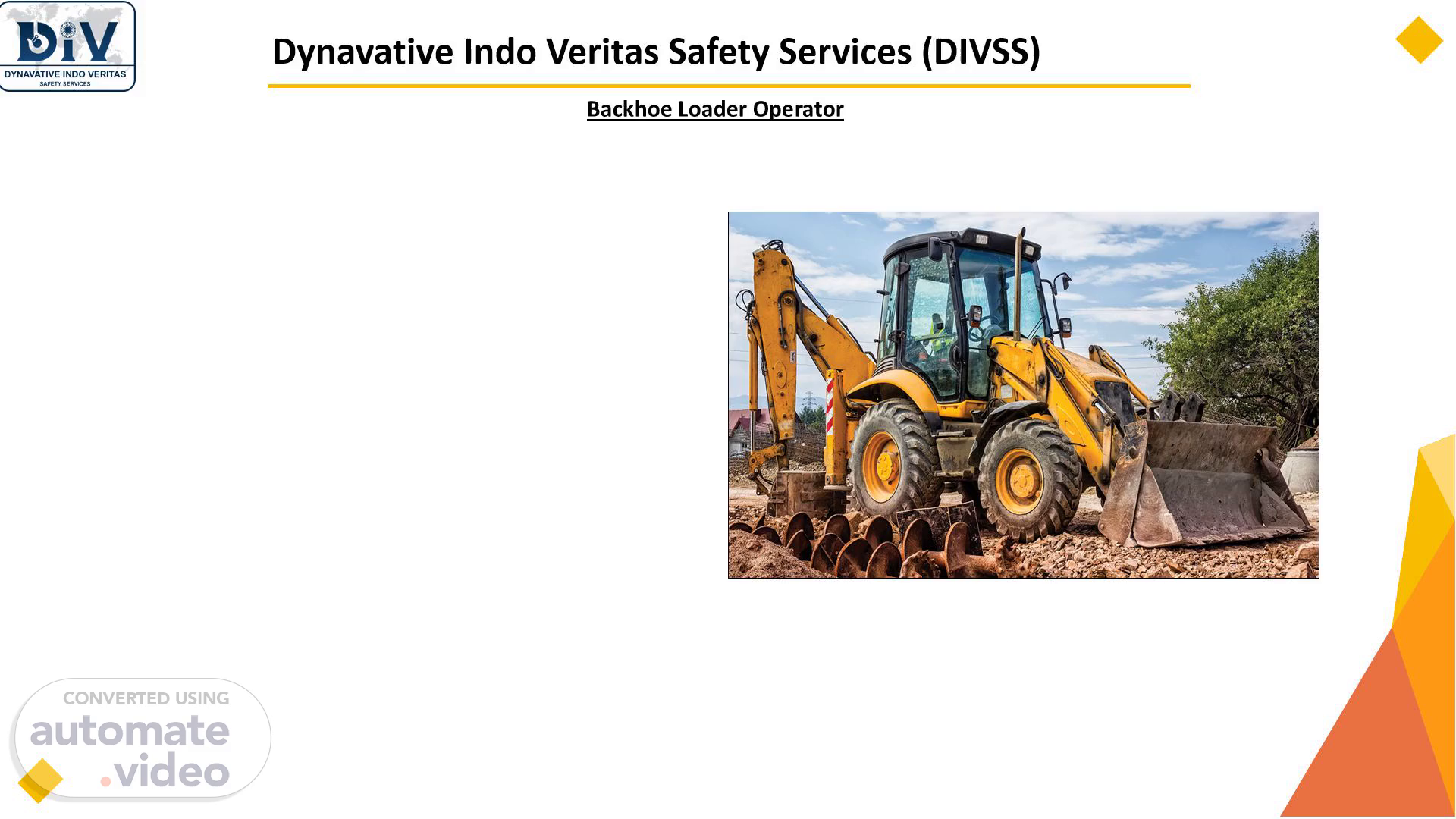
Scene 1 (0s)
[Audio] Dynavative Indo Veritas Safety Services (DIVSS) by RAVICHANDRAN RAMALINGAM Technical Manager (Lifting) 25+ Years of Experience, Lifting Inspection & Certification , Auditing & Training in Lifting Operation www.indoveritas.com [email protected] +971 2 546 0569.
Scene 2 (30s)
[Audio] Course Syllabus Course Eligibility Backhoe Operator Requirements Course Introduction Course Structure Objective Roles and Responsibilities Definition & Description of Backhoe loader Parts & Attachments of Backhoe Limits & Controls Pre-Use Inspection & Checklist Basic Calculation Slope Operation & Blind Spot Safety Requirements Backhoe Techniques Types of Backhoe QUIZ Hazard & Environmental Accidents Flagman in Backhoe Loader Good & Bad Practices.
Scene 3 (1m 2s)
[Audio] Course Structure Course structure for backhoe loader operator The course structure for backhoe loader operator training typically includes the following components: Classroom Training: Covers the technical and stability aspects of backhoe operations, responsibilities of a backhoe operator, hazard recognition, and workplace inspections. Written Exam: Tests the knowledge gained during the classroom portion. Hands-on Practice: Provides practical evaluation of operator skills under the supervision of professional instructors. Practical Evaluation: Demonstrates the safe operation of a backhoe through a hands-on performance evaluation. Certificate of Completion: Issued upon successful completion of the course, which includes a photo identification laminated wallet card..
Scene 4 (1m 51s)
[Audio] Course Introduction Course Introduction for Backhoe Loader Operator The course for backhoe loader operators is designed to provide essential skills and knowledge for safe and efficient operation of backhoe loaders. Hands-on training focused on safe operation, hazard prevention, and best practices. Proof of training and a manual provided before the session. Real-world skills development for digging, trenching, backfilling, and material handling. Pre-operation inspections, routine maintenance, and basic troubleshooting. Identification and mitigation of common hazards on construction and excavation sites. Operator qualification that supports safer, more compliant jobsite performance. Participants receive a digital wallet card as proof of training upon successful completion. The course is OSHA-aligned and supports safer operation, stronger jobsite performance, and industry-recognized qualification..
Scene 5 (2m 50s)
[Audio] Objective Objective for Backhoe Loader Operator The objective for a backhoe loader operator should be clear and specific, reflecting the operator's career goals and the skills they bring to the position. Here are some examples of objectives that can be used for a backhoe loader operator : "Seeking a challenging role at ABC Company where I can utilize my experience operating heavy machinery, attention to detail, and excellent time management skills." "Experienced loader operator looking for a position at ABC Company where I can use my expertise in safety protocols and communication abilities to contribute to success." "Dedicated professional seeking employment as a Loader Operator with an organization that values safety, accuracy, and efficiency." These objectives should be tailored to the specific job and company, demonstrating the candidate's enthusiasm for the position and their ability to contribute to the organization's success..
Scene 6 (3m 51s)
[Audio] Course Eligibility Backhoe Loader Operator Course Eligibility Minimum Age Requirement: You must be 20 years or older to enroll in most heavy‑equipment operator courses. License / Certification Backhoe Loader Operator Training Certificate. Obtain a Heavy Equipment Operator License: This is often required for operating heavy machinery, including backhoe loaders, and is issued by the relevant authority, such as the Roads and Transport Authority (RTA). Competency Assessment Record. Employer Authorization / Operator Card. Valid UAE Driving Licence (if operating on public roads). ADOSH Requirements Under the ADOSH-SF Technical Guideline for Training, Awareness and Competency (Version 4.0):Employers must identify training needs based on job hazards. Workers performing high-risk activities must receive role-specific training. Organizations must maintain evidence of competency and training records. Equipment operators must be competent before being assigned duties. Common Documents Required on Abu Dhabi Projects Backhoe Loader Operator Training Certificate Competency Assessment Record Medical Fitness Certificate (if required by project/client)Emirates ID copy Employer Authorization Letter/Operator Card. Reference Standards: BS EN 474 - Part 4 Earth-moving machinery, Safety. Requirements for backhoe loaders BS EN 474 - Part 3 Earth-moving machinery. Safety. Requirements for loaders.
Scene 7 (5m 34s)
[Audio] Backhoe Loader Operator Requirements under UAE Law 1.Legal Requirements: Must be at least 20 years of age. Must possess a valid Backhoe Loader Operator Training/Competency Certificate issued by an approved training and assessment provider. Must be authorized by the employer to operate the backhoe loader. Must comply with UAE Labour Law and Occupational Safety requirements. Must carry operator certification and identification documents when required by the project. 2.Competency Requirements (ADOSH-SF) Be trained and assessed as competent for Backhoe Loader operations. Demonstrate knowledge of machine controls, operating limits, and safety features. Understand excavation, trenching, loading, grading, and backfilling activities. Demonstrate knowledge of hazard identification and risk assessment. Understand underground utility protection requirements and permit-to-work systems. Be familiar with emergency procedures and incident reporting requirements. Demonstrate safe operation practices when working near personnel, structures, and services. 3.Medical Fitness Requirements Be physically and mentally fit to operate heavy equipment safely. Have adequate vision and hearing capabilities. Not operate equipment under the influence of alcohol, drugs, or medication that may impair judgment. Attend medical examinations as required by company policy or project requirements. 4.UAE Traffic Requirements Hold the appropriate UAE driving licence when operating equipment on public roads. Comply with UAE road traffic regulations during transportation or movement on public roads. Follow approved traffic management plans and designated site routes. Obey instructions from authorized traffic marshals and supervisors. Ensure escort vehicles and permits are used where required..
Scene 8 (7m 33s)
[Audio] Backhoe Loader Operator Requirements under UAE Law 5.Safety Knowledge Requirements Understand blind spots, swing radius, and machine stability hazards. Understand safe working distances from overhead power lines. Identify underground utilities before excavation activities. Understand trench collapse and excavation safety requirements. Know the requirements for exclusion zones and barricading. Understand the role of banksmen and signallers during operations. 6. Pre-Operational Requirements Complete daily pre-use inspections. Check hydraulic systems, tyres, bucket, boom, stabilizers, alarms, lights, mirrors, and seat belts. Report defects and equipment malfunctions immediately. Ensure safety defects are corrected before operation. Verify permits, utility clearances, and risk assessments before commencing work. 7. Operational Requirements Wear mandatory PPE at all times. Operate equipment only within manufacturer operating limits. Use seat belts whenever operating the backhoe loader. Maintain awareness of personnel, structures, and nearby equipment. Never allow personnel within the machine operating radius. Stop work immediately when unsafe conditions arise. Follow approved method statements, permits, and risk assessments. 8. Behavioural Requirements Always demonstrate safe work practices. Maintain concentration and situational awareness. Communicate effectively with banksmen, supervisors, and co-workers. Report hazards, incidents, and near misses promptly. Promote a positive safety culture on site. Follow company HSE rules and ADOSH requirements..
Scene 9 (9m 23s)
[Audio] Roles and Responsibilities for Backhoe Loader Operator Operate the backhoe loader safely and efficiently for excavation, trenching, digging, loading, backfilling, grading, and material handling activities. Control and operate both the front loader bucket and rear backhoe attachment according to work requirements. Conduct daily pre-start inspections of the machine, including brakes, steering, hydraulic systems, tires, lights, horn, fluid levels, and safety devices. Perform routine operational checks and immediately report any defects, malfunctions, or unsafe conditions. Read and understand work instructions, drawings, utility plans, and site layouts before commencing work. Excavate trenches, foundations, and pits to required dimensions while maintaining stability and safety. Load, transport, and unload soil, aggregates, debris, and construction materials safely. Maintain safe operating distances from personnel, structures, excavations, overhead power lines, and other equipment. Follow directions from supervisors, banksmen, signallers, and spotters during operations. Use approved hand signals and communication methods when manoeuvring equipment in congested areas. Monitor ground conditions and machine stability to prevent overturning or loss of control. Ensure exclusion zones and barricades are established where required. Always wear and maintain required personal protective equipment (PPE). Conduct housekeeping around the work area and ensure the site remains clean and safe. Refuel and maintain the machine following manufacturer recommendations and company procedures. Keep accurate records of machine operating hours, inspections, maintenance activities, and fuel consumption. Assist with minor preventive maintenance activities as authorized. Participate in toolbox talks, safety meetings, training programs, and competency assessments. Report incidents, near misses, equipment damage, and unsafe acts or conditions promptly. Ensure only authorized personnel operate the backhoe loader. Maintain productivity while ensuring safe work practices and protection of personnel, property, and the environment..
Scene 10 (11m 50s)
[Audio] Definition and Description for Backhoe Loader Operator Definition A Backhoe Loader Operator is a trained and competent person who operates a backhoe loader to perform excavation, trenching, loading, backfilling, grading, material handling, and other earthmoving activities safely and efficiently on construction, infrastructure, industrial, and utility projects. “A Backhoe Loader Operator is a qualified individual responsible for the safe operation, inspection, and maintenance of a backhoe loader used for excavation, loading, trenching, backfilling, and material handling activities while complying with workplace safety requirements and project procedures.” Description A Backhoe Loader Operator is a trained and competent professional responsible for operating a backhoe loader to perform excavation, trenching, loading, backfilling, grading, and material handling activities on construction, infrastructure, roadwork, and industrial projects. The operator ensures that all work is carried out safely, efficiently, and in compliance with company procedures, project requirements, and applicable health, safety, and environmental regulations..
Scene 11 (13m 9s)
[Audio] Parts of Backhoe Loader. www.indoveritas.com [email protected] +971 2 546 0569.
Scene 12 (13m 17s)
[Audio] Backhoe Loader Attachments: Common Types of Backhoe Loader Attachments Buckets: The most common attachment, available in various sizes and designs for digging, grading, and loading materials. Options include general-purpose, trenching, and heavy-duty buckets for rocky or compacted soil. Forks and Pallet Forks: Used for lifting, carrying, and placing pallets or other materials. Fixed-position and multi-fit hitches are available to suit different backhoe models. Hydraulic Breakers: Ideal for breaking concrete, asphalt, or rock. These attachments convert hydraulic power into percussive force for demolition tasks. Thumbs and Grapples: Enhance material handling by allowing the backhoe to grasp irregular objects like logs, debris, or scrap materials. Mechanical or hydraulic thumbs are available. Brooms and Sweepers: Used for cleaning streets, parking lots, and industrial areas. Pickup brooms collect dirt and debris efficiently. Mulchers and Slashing Attachments: Designed for clearing vegetation, grass, shrubs, and small trees. These are particularly useful in landscaping and agricultural applications. Cold Planers and Graders: For surface preparation, leveling, and finishing work on roads or construction sites. Augers and Drills: Used for drilling holes for footings, fencing, or planting trees. They are available in various diameters and depths. Buckets Augers and Drills Hydraulic Breakers Forks and Pallet Forks Brooms and Sweepers Thumbs and Grapples Mulchers and Slashing Cold Planers and Graders.
Scene 13 (15m 4s)
[Audio] Pre-Use Inspection The pre-use inspection for a backhoe loader is a critical step in ensuring the equipment's safety and operational readiness. It involves a systematic review of the machine's components to identify any potential issues before operation. Here are the key components of the pre-use inspection: Engine and Fluid System: Check for proper fluid levels and component condition, as low oil, coolant, or hydraulic fluid can lead to catastrophic damage. Hydraulic System: Verify the integrity of the hydraulic system, including fluid levels and connections. Attachment Condition: Inspect the condition of the backhoe attachment to ensure it is secure and functioning properly. Safety Devices: Check the functionality of safety devices such as the ROPS (Roll Overprotective Structure) and seat belts. Overall Machine Integrity: Conduct a visual inspection of the machine's overall condition to identify any visible damage or wear. BS EN 474 - Part 4 Earth-moving machinery, Safety. Requirements for backhoe loaders BS EN 474 - Part 3 Earth-moving machinery. Safety. Requirements for loaders TPI Certificate validity to be 12months.
Scene 14 (16m 28s)
[Audio] Zone 2 Requirements Engine & Exhaust System Requirements: Surface temperature must stay *below T‑class limit* (usually T3/T4). Exhaust must be fitted with: *Spark arrestor* *Exhaust gas cooling / water jacket* *Hot‑surface shielding* Turbochargers must be temperature‑controlled. No exposed surfaces >200°C (T3) or 135°C (T4). B. Electrical System Requirements All electrical components must be *Zone II certified*: Alternator Starter motor Battery isolator Control panels Sensors Wiring harness (Ex‑rated glands, conduits) C. Fuel System Requirements Anti‑static hoses Leak‑proof fittings Automatic fuel shutoff No exposed ignition sources.
Scene 15 (17m 18s)
[Audio] Pre-Use Checklist :. www.indoveritas.com [email protected] +971 2 546 0569.
Scene 16 (17m 38s)
[Audio] Limits and Controls of a Backhoe Loader :.
Scene 17 (17m 55s)
[Audio] Types of Backhoe Loader Standard / Tractor Loader Backhoes (TLBs) Most common type; combines a tractor, front loader, and rear backhoe. Used for general construction, utilities, landscaping Compact / Mini Backhoes Smaller, lighter, ideal for confined spaces and residential work. Sometimes mounted on skid steers or compact tractors. Centre-Mount Backhoe Loaders Traditional design; backhoe mounted at the centre pivot. Common in the U.S.; offers balanced performance..
Scene 18 (18m 31s)
[Audio] Types of Backhoe Loader Side-Shift Backhoe Loaders Backhoe can slide sideways along a rail; offers 280° swing. Ideal for urban, narrow, or tight job sites. Skid Steer Backhoe Attachments Backhoe units attached to skid steers; cost-effective for owners of skid steers. Agricultural Backhoes Mounted on farm tractors; used for trenching, irrigation, and farm maintenance..
Scene 19 (19m 1s)
[Audio] Backhoe Loader Techniques Backhoe Loader technique include: Downward Crowd Technique for Tight Soils Bench Cutting for Deep Trenches V-Trench Method for Utility Corridors Swing-and-Dump Timing for Maximum Productivity Feathering Hydraulics in Sensitive Zones Downward Crowd Technique for Tight Soils The Downward Crowd Technique is a specialized method used by backhoe operators to effectively excavate in tight soils such as compacted clay or hardpan. This technique involves positioning the bucket at a 45-degree angle to the surface and utilizing boom down force combined with stick crowd to drive the bucket teeth into the material. It is particularly effective in regions like the Texas Hill Country or the clay-heavy Midwest. The key to this method is to load the bucket 70 to 80 percent before curling, then swing the bucket to excavate the material. This approach helps maintain mechanical advantage and reduces cycle time, which is crucial in tight spaces where time is of the essence..
Scene 20 (20m 3s)
[Audio] Backhoe Loader Techniques Bench Cutting for Deep Trenches Purpose Prevents cave-ins in deep excavations. Reduces lateral earth pressure on trench walls. Improves worker safety and access. Allows excavation of deeper trenches where vertical cuts are unsafe. Typical Procedure with a Backhoe Excavate the upper portion of the trench to the required bench width. Step back the trench wall to create a horizontal bench. Continue excavating the lower section. Repeat the process for additional depths as required by soil conditions and site regulations. Key Considerations Bench dimensions depend on soil type, trench depth, and local safety regulations. Loose, saturated, or unstable soils may require sloping, shoring, or trench boxes instead of benching. Keep excavated spoil piles away from the trench edge (typically at least 0.6 m / 2 ft). Ensure the backhoe operates a safe distance from trench edges to avoid surcharge loading. Advantages Safer than vertical-sided excavations. Can be performed efficiently with a standard backhoe. Reduces the need for temporary support systems in suitable soils..
Scene 21 (21m 23s)
[Audio] Backhoe Loader Techniques V-Trench Method for Utility Corridors Route Investigation and Staking: Before excavation, the route for the utility corridor is carefully investigated and staked to ensure it is clear and safe. Securing with Side Slopes or Shoring: Depending on the soil conditions, side slopes or shoring systems are used to secure the trench and prevent cave-ins. Dewatering: Proper dewatering techniques are employed to remove water from the trench, ensuring that the trench remains dry and stable. Removal of Obstacles: Any obstacles such as boulders or existing structures are carefully removed to create a clear path for the utility corridor. Construction of Pipe Bedding: The trench is then prepared for the installation of the utility corridor, ensuring a stable and durable base. Installation and Layer-by-Layer Reinstatement: The utility corridor is installed, and the excavated material or suitable backfill is reinstated layer by layer to maintain the trench's stability and integrity. Feathering Hydraulics in Sensitive Zones Feathering hydraulics in sensitive zones for backhoe loaders involves using small, deliberate inputs to control the bucket's movement, particularly within 24 inches of marked utility lines. This technique requires skilled operators and a minimum of 3 to 5 years of field experience to execute reliably. Operators should also be trained in confined-area simulation exercises to ensure proficiency in feathered hydraulic control..
Scene 22 (23m 2s)
[Audio] Backhoe Loader Techniques Swing-and-Dump Timing for Maximum Productivity Why Swing‑and‑Dump Timing Matters Backhoe loader productivity is governed by cycle time: Dig → Swing → Dump → Return Every second saved in swing or dump phases compounds across hundreds of cycles per shift. Even small inefficiencies—wide swing arcs, jerky dumping, misaligned truck positioning—add up to major losses. Key Factors Affecting Swing‑and‑Dump Speed 1. Swing Angle Optimization Excavator and backhoe loaders are most efficient with swings under 90°. Larger arcs (120°–180°) add unnecessary seconds and increase fuel burn. Position trucks or spoil piles to minimize swing radius. 2. Hydraulic Cycle Speed Faster hydraulic pump output reduces boom lift, swing, and dump times. Machines with quicker hydraulic response complete cycles 3–5 seconds faster, resulting in dozens more cycles per hour. 3. Dumping Technique Smooth bucket opening prevents spillage and reduces hesitation. Avoid over‑extending the stick during dump—this adds time and destabilizes the machine. 4. Return Path Efficiency Plan the shortest safe return path to the dig point. Avoid obstacles and unnecessary steering corrections. Practical Setup Tips for Maximum Productivity Site Layout Position dump trucks or spoil piles close enough to reduce swing time but far enough to avoid crowding. Use a V‑pattern layout for loaders and backhoes to minimize travel distance..
Scene 23 (24m 53s)
[Audio] Operator Technique Anticipate next movements—prepare bucket angle during swing. Maintain consistent hydraulic control inputs. Avoid over‑digging, which adds 2–5 seconds per pass. Machine Matching Ensure bucket size and truck capacity are properly matched to reduce number of passes. Example: Calculating Swing‑and‑Dump Time Using the cycle time formula: Cycle Time = Swing Time + Load Time + Dump Time + Return Time If swing is 8 seconds, dump is 4 seconds, return is 7 seconds: Swing‑and‑Dump portion = 12 seconds Total cycle ≈ 19 seconds. Reducing swing angle or improving hydraulic response can cut this to 15–16.
Scene 24 (25m 45s)
[Audio] Slope Operation Slope Operation for Backhoe Loader When operating a backhoe loader on slopes, it is crucial to follow specific techniques to ensure safety and prevent accidents. Here are some key points to consider: Alignment and Entry: Before descending, align the tires and chassis straight with the slope and shift into ultra-low gear. Bucket Grounding: Lower the front loader bucket to drag along the ground, generating friction and mechanical braking resistance. Weight Distribution: Adjust the rear excavator boom and bucket to balance the machine, preventing the rear wheels from lifting or tilting too far forward. Controlled Descent: Modulate tire traction and bucket drag to slide down the slope in a steady, controlled manner. Safe Landing: Once reaching level ground, raise the bucket and bring the machine back to its normal operating position..
Scene 25 (26m 41s)
[Audio] Blind Spot Rear Blind Spot: The area directly behind a backhoe loader is one of the most dangerous zones. The operator’s cab, counterweight, and rear tires obstruct visibility, making it difficult to see pedestrians or vehicles approaching from behind. Side Blind Spots: Both sides of the machine, especially the side opposite the operator’s seat, are often hidden due to the cab structure and loader arms. These zones can extend several feet from the chassis and shift as the boom or bucket moves. Front and Bucket Obstruction: When the loader bucket is raised, it can block the forward view, creating a blind spot immediately in front of the machine. Similarly, the backhoe arm can obstruct visibility to the rear corners when extended. Invisibility Zone: Elevated operator positions create a “dead zone” where the operator’s line of sight passes over nearby objects or people, making them invisible even if they are close to the machine. Safety Measures Use Spotters: Trained personnel acting as spotters can guide the operator in blind zones, especially when reversing or manoeuvring in tight spaces. Establish Exclusion Zones: Mark areas around the machine where workers should not enter during operation. These zones reduce the risk of accidents in high-risk blind spots. Visibility Technology: Cameras, proximity sensors, and mirrors can help reduce blind spots, though they do not eliminate them entirely. Walkarounds and Awareness: Operators should perform a 360-degree walkaround before starting work to check for obstacles or personnel. Workers should maintain eye contact and communicate with the operator when approaching the machine Training and Signage: Educating workers about blind spots and using clear signage ensures everyone on-site understands the high-risk areas..
Scene 26 (28m 37s)
[Audio] Blind Spot. www.indoveritas.com [email protected] +971 2 546 0569.
Scene 27 (29m 19s)
[Audio] Safety Requirements Operator Training and Certification Before using a backhoe loader, operators must receive proper training and certification. Training programs cover machine controls, maintenance, emergency procedures, and safe operation techniques. Certification ensures that operators have the necessary skills to handle the equipment safely and respond effectively to potential hazards on the job site. Pre-Operational Inspection Conducting a pre-operation inspection is essential to identify any mechanical issues. Operators should check for leaks, loose parts, damaged components, tire pressure, brakes, lights, and hydraulic systems. Any defects must be repaired before operation to prevent accidents or equipment failure. Personal Protective Equipment (PPE) Operators should wear appropriate PPE, including a hard hat, safety glasses, high-visibility clothing, gloves, and steel-toed boots. PPE protects against falling objects, flying debris, and accidental contact with moving parts. Safe Operating Practices Stable Ground: Always operate on level, stable surfaces. Avoid slopes or soft terrain unless proper stabilization techniques, such as using wooden boards under tires, are applied. Proper Lifting Techniques: Ensure loads are within the machine’s capacity, secure them properly, and lift smoothly to avoid tipping or load swings. Maintain Safe Distances: Keep a safe distance from trenches, edges, overhead power lines, and other hazards. Cabin Safety: Adjust the seat and controls for comfort and accessibility and always fasten the seat belt to protect against rollovers. Equipment and Site Awareness Operators should be aware of the worksite layout, including underground utilities and overhead obstacles. Regular maintenance and inspection of attachments, such as buckets or forks, are crucial for safe operation. Insurance and Risk Management Having insurance coverage for the backhoe loader is recommended to protect against equipment damage, third-party injuries, or property damage during operation.
Scene 28 (31m 39s)
[Audio] Safety Requirements. www.indoveritas.com [email protected] +971 2 546 0569.
Scene 29 (32m 23s)
[Audio] Calculation for Backhoe Loader BUCKET CAPACITY (Heaped) FORMULA C heaped = L x W x H x FF Where, L = Length of bucket (m) W = Width of bucket (m) H = Heaped height of material in bucket (m) FF = Fill Factor (0.85 - 0.95) EXAMPLE (Front Bucket) L = 1.20 m, W = 2.20 m, H = 0.45 m FF = 0.90 C heaped = 1.20 x 2.20 x 0.45 x 0.90 = 1.069 m3 = 1.07 m3 BUCKET CAPACITY (Struck) FORMULA C struck = C heaped SWELL FACTOR Where, Swell Factor = 1.20 - 1.35 EXAMPLE C heaped = 1.07 m3 Swell Factor = 1.25 C struck = 1.07 / 1.25= 0.856 m3 = 0.86 m3 PAYLOAD CALCULATION FORMULA Payload (kg) = C struck x Material Density (kg/m3) EXAMPLE C struck = 0.86 m2, Density (Soil) = 1,800 kg/m3 Payload = 0.86 x 1,800 = 1,548 kg = 1.55 ton.
Scene 30 (34m 12s)
[Audio] STANDARD DATA (EXAMPLE) Bucket Capacity (Heaped) - Front (m2) 1.1 Bucket Capacity (Heaped) - Rear (m2) 0.26 Operating Weight (kg) 8,000 Engine Power (kW / HP) 55/74 Fuel Consumption (L/hr) 6.5 Swell Factor 1.25 Fill Factor 0.90 Efficiency Factor 0.83.
Scene 31 (34m 45s)
[Audio] Hazard Identification & Control Activity/Task Hazard Potential Consequences Control Measures Pre-start inspection Defective brakes, steering, hydraulics, tires Equipment failure, collision, rollover Conduct daily pre-use inspection; report and repair defects before use. Mounting/Dismounting Slips, trips, falls Sprains, fractures Maintain 3-point contact; keep steps and handholds clean; wear safety footwear. Starting the machine Unintended movement Collision, injury to personnel Start only from operator's seat; ensure transmission is in neutral; apply parking brake. Traveling on site Collision with people, vehicles, structures Serious injury, property damage Follow site traffic plan; use spotters where required; maintain safe speed; use horn and beacon. Excavation/Digging Contact with underground utilities (electric, gas, water) Electrocution, explosion, service disruption Obtain permits, utility drawings, and conduct utility locating before excavation. Loading and unloading material Falling material Struck-by injuries Do not overload bucket; keep personnel clear of work area; secure loads. Working on uneven or soft ground Machine instability/rollover Serious injury or fatality Assess ground conditions; avoid excessive slopes; use seat belt at all times. Working near overhead power lines Electrical contact/arcing Electrocution, fire Maintain minimum clearance distances; follow electrical safety procedures; use spotter. Hydraulic system failure High-pressure fluid release Injection injury, burns Inspect hoses regularly; depressurize system before maintenance; use qualified technicians. Maintenance and repairs Unexpected machine startup Crushing, entanglement Apply Lockout/Tagout (LOTO); lower attachments to ground; remove ignition key. Refueling Fire, fuel spills Burns, environmental damage Shut engine off; prohibit smoking; use spill kits; follow refueling procedures. Noise and vibration Hearing loss, fatigue Long-term health effects Wear hearing protection; limit exposure; maintain equipment..
Scene 32 (37m 17s)
[Audio] Hazard Identification & Control. www.indoveritas.com [email protected] +971 2 546 0569.
Scene 33 (37m 31s)
[Audio] Control Hazards : Operating a backhoe loader involves navigating through various control hazards that can pose significant risks. Here are some key hazards to be aware of: Tipping Over: Backhoe loaders can tip over on uneven terrain, especially if the stabilizers are not properly deployed. Ensure the stabilizers are extended to the correct length for the ground conditions. Visibility Challenges: Operators must be aware of their surroundings to avoid accidents. Visibility can be compromised by obstacles or terrain changes. Always check the area before starting work. Equipment Malfunctions: Regular maintenance and inspections are crucial to prevent equipment malfunctions. Ensure all systems are functioning correctly before operating the machine. Utility Strikes: Utility strikes are a common job-site incident involving backhoes. Always call 811 (USA) before any digging to avoid serious accidents. Stabilizer Deployment: Improper stabilizer deployment is a leading cause of backhoe tip-overs. Level the machine if the site is sloped and ensure the stabilizers are deployed correctly..
Scene 34 (38m 49s)
[Audio] Environmental Protection Requirements. www.indoveritas.com [email protected] +971 2 546 0569.
Scene 35 (39m 45s)
[Audio] Visibility & Wind Speed UAE Traffic Rules for Visibility (Applies to All Vehicles Including Heavy Equipment) UAE winter road‑safety regulations define visibility‑based speed limits and lane rules during fog and low‑visibility conditions. These rules apply to *any vehicle on public roads*, including earth‑moving machines transported or driven on roads. Light fog: Speed limit *60–80 km/h* ; stay in one lane, use low beam + fog lights. Dense fog: Speed limit *40–60 km/h*: rightmost lane only, fog lights mandatory. Near‑zero visibility: *op on the shoulder*; do not continue driving. Visibility Requirements Inside UAE Construction Sites (Earth‑Moving Equipment)* Earth‑moving equipment (excavators, dozers, graders, dump trucks) is governed by *ADOSH CoP 36.0 (Plant & Equipment)* and *CoP 44.0 (Traffic Management & Logistics)*. Clear visibility from the operator cabin* Laminated safety glass with no cracks or damage* (mandatory ROPS/FOPS structures must not obstruct visibility* Proximity hazard controls* (exclusion zones, swing radius control) High‑Wind Visibility Impact (UAE Worksite Rule)* Abu Dhabi’s official inclement‑weather guidance requires reviewing outdoor work when *wind speed reaches or gusts above 38 km/h*, because visibility and control are affected. (This aligns with UAE’s general weather‑based safety enforcement; inference based on ADPHC guidance.).
Scene 36 (41m 35s)
[Audio] Accidents. www.indoveritas.com [email protected] +971 2 546 0569.
Scene 37 (41m 42s)
[Audio] Good & Bad Practices. www.indoveritas.com [email protected] +971 2 546 0569.
Scene 38 (42m 27s)
[Audio] Good & Bad Practices. www.indoveritas.com [email protected] +971 2 546 0569.
Scene 39 (42m 51s)
[Audio] Flagman Role in Backhoe Loader Operations Eligibility Requirements Be at least 18 years old. Be trained and certified as a Flagman/Banksman and assessed as competent by the employer. Be physically fit and medically capable, with adequate vision, hearing, and mobility to perform signalling duties safely. Understand standard hand signals used for Backhoe Loader and heavy equipment operations. Be trained in radio communication procedures when radios are used for plant movement control. Attend site-specific induction training covering Backhoe Loader hazards, blind spots, and site traffic management requirements. Be authorized by site management to perform flagman duties..
Scene 40 (43m 35s)
[Audio] Flagman Roles in Backhoe Loader Operations Flagman roles in backhoe loader operations Flagmen play a vital role in the safe operation of backhoe loaders by providing guidance and ensuring the smooth movement of the equipment. Their responsibilities include: Maintaining Visual Contact: Flagmen must maintain a clear line of sight with the operator and the surrounding area to ensure safe manoeuvring. Using Standardized Hand Signals: They use standardized hand signals to communicate with the operator, especially in situations where the operator cannot see the full range of movement. Acting as a Safety Watchdog: Flagmen act as a buffer between moving machinery and nearby workers, vehicles, or structures, preventing accidents. Monitoring Hazards: They continuously scan the area for hazards, such as overhead obstructions or ground hazards, to ensure the safety of the operator and other personnel. Ensuring Compliance with Safety Regulations: Flagmen must adhere to local and national safety standards and regulations to maintain the safety of the operation..
Scene 41 (44m 49s)
[Audio] Flagman Signals in Backhoe Loader Operations Flagman Signals in Backhoe Loader Operations In backhoe loader operations, flagman signals are crucial for ensuring the safe movement of equipment and the protection of workers. Here are some key points regarding flagman signals: Visual Contact: The flagman must maintain visual contact with the backhoe loader operator at all times, ensuring they are aware of the operator's movements and the surrounding environment. Signalling: The flagman uses standard hand signals to communicate with the operator, indicating actions such as starting, stopping, or reversing the machine. Safety Gear: The flagman must wear high-visibility gear, such as a high-visibility vest, to ensure they are easily seen by the operator. Communication: Clear communication is essential between the flagman and the operator, using agreed-upon signals to minimize the risk of accidents. Training: Regular training on flagman signals and safety protocols is necessary to ensure operators and workers are well-prepared for safe operations..
Scene 42 (46m 3s)
[Audio] Flagman Blindspot for Backhoe Loader Operations Flagman Blindspot for Backhoe Loader Operations In backhoe loader operations, flagmen play a crucial role in ensuring safety by acting as the operator's eyes on the ground. They must wear high-visibility PPE and always maintain eye contact with the operator. Flagmen are responsible for signalling the movement of machinery and traffic around the site, ensuring that all personnel are aware of the operator's presence and that no one enters the operator's blind spot. To minimize the risk of accidents, flagmen should: Use standard hand signals or radios for clear communication. Wear high-visibility clothing to ensure they are always visible to operators. Agree on signals before work starts and never assume the operator sees them until they receive acknowledgment. Keep a safe distance from operating machinery and do not walk behind moving equipment unless cleared by the flagman. Operators must stop work if communication is lost, and workers should never enter a machine's blind spot without signalling..
Scene 43 (47m 11s)
[Audio] Flagman Signals in Backhoe Loader Operations For flagman equipment for Backhoe Loader operations, consider the following essential items and guidelines: High-Visibility Vest: Required for flagmen to ensure visibility while operating equipment. Red and Green Flags: Used to signal equipment operators and maintain safety. Safety Gear: Flagmen should wear appropriate personal protective equipment (PPE) to protect themselves from hazards. Signal Tools: Use appropriate signalling tools, such as paddles and cones, to direct traffic and ensure safety. Training: Flagmen must undergo training to understand their responsibilities and safety protocols. Project required PPE (steel toe boots, helmet, safety glasses). Whistle or air horn for emergency.
Scene 44 (48m 4s)
[Audio] . www.indoveritas.com [email protected] +971 2 546 0569.
Scene 45 (48m 10s)
[Audio] . www.indoveritas.com [email protected] +971 2 546 0569.