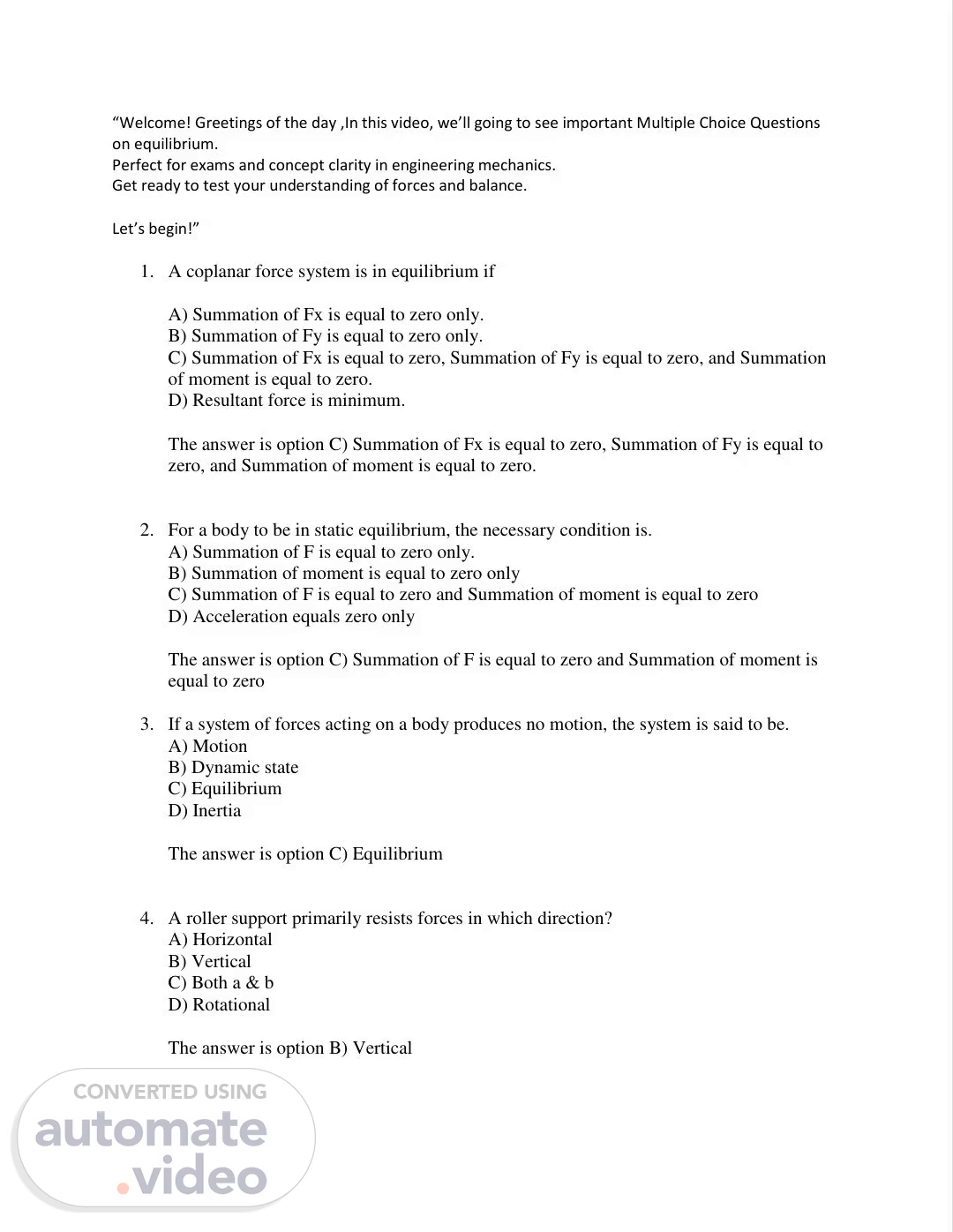
Scene 1 (0s)
[Audio] "Welcome! Greetings of the day ,In this video, we'll going to see important Multiple Choice Questions on equilibrium. Perfect for exams and concept clarity in engineering mechanics. Get ready to test your understanding of forces and balance. Let's begin!" 1. A coplanar force system is in equilibrium if A) Summation of Fx is equal to zero only. B) Summation of Fy is equal to zero only. C) Summation of Fx is equal to zero, Summation of Fy is equal to zero, and Summation of moment is equal to zero. D) Resultant force is minimum. The answer is option C) Summation of Fx is equal to zero, Summation of Fy is equal to zero, and Summation of moment is equal to zero. 2. For a body to be in static equilibrium, the necessary condition is. A) Summation of F is equal to zero only. B) Summation of moment is equal to zero only C) Summation of F is equal to zero and Summation of moment is equal to zero D) Acceleration equals zero only The answer is option C) Summation of F is equal to zero and Summation of moment is equal to zero 3. If a system of forces acting on a body produces no motion, the system is said to be. A) Motion B) Dynamic state C) Equilibrium D) Inertia The answer is option C) Equilibrium 4. A roller support primarily resists forces in which direction? A) Horizontal B) Vertical C) Both a & b D) Rotational The answer is option B) Vertical.
Scene 2 (2m 6s)
[Audio] 5. The reaction at the roller supported end of a beam is always: A) Vertical B) Horizontal C) Inclined D) Zero The answer is option A) Vertical 6. Two forces 2N and 4N act at a point on a body. The resultant when they act at 60° is: A) 10 raised to ½ B) 28 raised to ½ C) 6 raised to ½ D) 8 raised to ½ Using formula: R is equal to under root (F₁ square + F₂ square + 2F₁F₂cosθ) equal to under root (2 square + 4 square + 2×2×4×cos60°) equal to under root (4 + 16 + 8) = under root 28 that is 28 raised to half The answer is option B) 28 raised to ½ 7. If the resultant of two equal forces has the same magnitude as either force, the angle between them is: A) 30° B) 60° C) 90° D) 120° For equal forces: R = 2F cos(thita by 2) If R = F then F = 2F cos(thita by 2) that is cos(thita by 2) equal to 1/2 so thita by 2 equal to 60° that is thita equal to 120° So The answer is option D) 120° 8. When two or more forces acting at a point are combined into a single force, it is called: A) Equilibrant B) Resultant force C) Couple D) Load factor The answer is option B) Resultant force 9. The resultant of two forces 10 Newton and 10 Newton acting at 90° is:.
Scene 3 (4m 25s)
[Audio] A) 10 Newton B) 20 Newton C) 14.14 Newton D) 0 Newton So we know the formula of Resultant = under root (10 square plus 10 square ) equal to under root 200 = 14.14 N The answer is option C) 14.14 Newton 10. If two equal forces act at an angle of 120 degree, the magnitude of the resultant is: A) Equal to one force B) Greater than one force C) Less than one force D) Zero We know the formula of Resultant = 2F cos(120 degree by 2) = 2F cos60° = F The answer is option A) Equal to one force 11. A body is said to be in equilibrium when: A) It is moving B) It has acceleration C) Net force and moment are zero D) Only velocity is zero The answer is option C) Net force and moment are zero 12. The centroid of a composite section lies outside the material area when: A) Section is symmetric B) Material density varies C) Loads are eccentric D) The section contains voids or cut-outs The answer is option D) The section contains voids or cut-outs 13. The centroid of a composite section lies: A) Always at geometric center B) Outside the section C) At the point where the first moment of area is zero D) At the point of maximum stress.
Scene 4 (6m 10s)
[Audio] The answer is option C) At the point where the first moment of area is zero 14. The unit of moment of inertia in SI units is: A) meter raised to 4 B) kg·meter raised to 4 C) meter raised to 2 D) Newton meter The answer is option A) meter raised to 4 15. Which section has the highest moment of inertia for the same area? A) Circular section B) Square section C) Rectangular section D) I-section The answer is option D) I-section 16. If coefficient of friction mu equal to 1, the angle of friction is: A) 30° B) 45° C) 60° D) 90° Angle of friction (phi) relation tan phi =mu If mu equal to 1 then phi = 45° The answer is option B) 45° 17. If the angle of friction is 30°, the coefficient of friction is: A) 0.5 B) 0.577 C) 0.866 D) 1 mu = tan(30°) = 0.577 The answer is option B) 0.577 18. Friction always acts in a direction: A) Opposite to relative motion or tendency of motion B) Perpendicular to motion C) Same as applied force D) Vertically downward.
Scene 5 (7m 52s)
[Audio] The answer is option A) Opposite to relative motion or tendency of motion 19. Angle of friction is given as A) sin inverse mu B) cos inverse mu C) tan inverse mu D) sin mu The answer is option C) tan inverse mu 20. The centroid of a composite section may lie outside the body when: A) Section is symmetrical B) Density is uniform C) There are holes or cut-outs D) Load is zero The answer is option C) There are holes or cut-outs.