Scene 1 (0s)
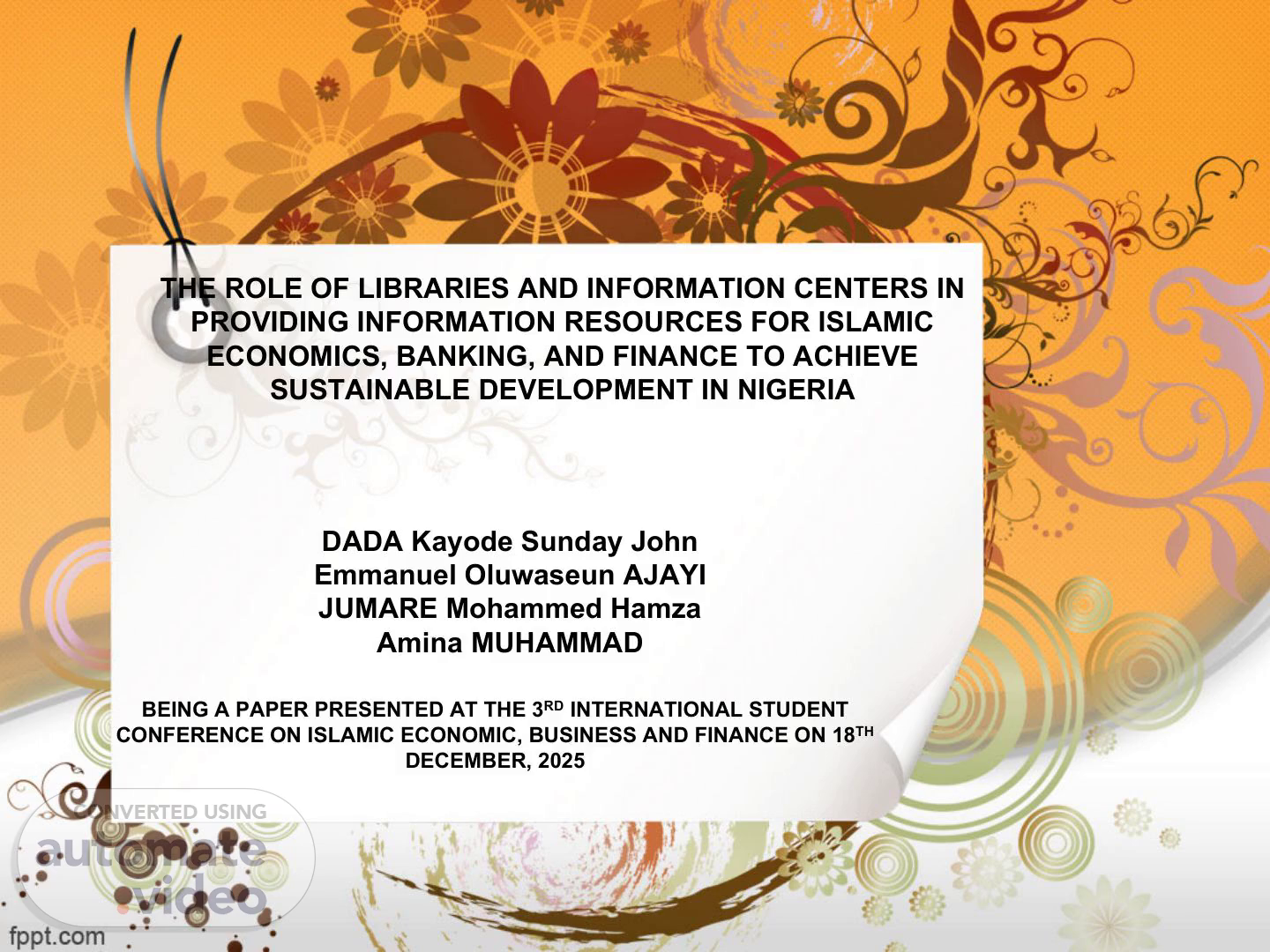
[Audio] THE ROLE OF LIBRARIES AND INFORMATION CENTERS IN PROVIDING INFORMATION RESOURCES FOR ISLAMIC ECONOMICS, BANKING, AND FINANCE TO ACHIEVE SUSTAINABLE DEVELOPMENT IN NIGERIA DADA Kayode Sunday John Emmanuel Oluwaseun AJAYI JUMARE Mohammed Hamza Amina MUHAMMAD BEING A PAPER PRESENTED AT THE 3RD INTERNATIONAL STUDENT CONFERENCE ON ISLAMIC ECONOMIC, BUSINESS AND FINANCE ON 18TH DECEMBER, 2025.
Scene 2 (31s)
[Audio] INTRODUCTION Introduction Libraries and information centers have long served as vital knowledge repositories that support education, research, and development across various disciplines. In Nigeria, where Islamic banking and finance have gained considerable momentum over the past decade, these institutions play an important role in providing access to specialized information resources that support the growth and understanding of Sharia-compliant financial systems. The emergence of Islamic banking institutions in Nigeria, beginning with Jaiz Bank in 2012, has created substantial demand for reliable information on Islamic economic principles, banking operations, and financial instruments. The importance of libraries and information centers in advancing Islamic economics, banking, and finance cannot be overstated. These institutions serve as bridges between theoretical knowledge and practical application, offering resources that guide practitioners, educate students, inform policymakers, and enlighten the general public about the principles and operations of Islamic financial systems. With Nigeria's diverse population and significant Muslim community, access to accurate and comprehensive information on Islamic finance is essential for informed decision-making, financial inclusion, and economic development..
Scene 3 (1m 58s)
[Audio] Concept of Libraries and Information Centers Libraries and information centers are organized institutions established to collect, preserve, organize, and disseminate information resources to meet the diverse needs of their users. Libraries traditionally house physical collections of books, journals, newspapers, and other printed materials, while also increasingly providing access to electronic resources and digital content. Information centers, on the other hand, tend to focus more specifically on providing targeted information services, often specialized in particular subject areas, and emphasize information retrieval, analysis, and dissemination rather than simply housing collections. In contemporary practice, the distinction between libraries and information centers has become less pronounced, as both types of institutions have evolved to offer integrated services that combine traditional collection management with modern information technology applications (Aina, 2014; Igbeka & Ola, 2015)..
Scene 4 (3m 9s)
[Audio] Definition of Islamic Economics Islamic economics is a knowledge system that deals with the production, distribution, and consumption of goods and services based on the principles and teachings of Islam as derived from the Quran and Hadith. It represents an approach to organizing economic activities that emphasizes social justice, equitable distribution of wealth, prohibition of interest-based transactions, ethical conduct in business dealings, and the overall welfare of society. Islamic economics recognizes private property rights while also stressing social responsibility and the collective good. It prohibits certain economic activities considered harmful or exploitative, such as dealing in interest, gambling, and transactions involving excessive uncertainty. The system promotes risk-sharing, asset-backed financing, and productive investment that contributes to real economic development rather than speculative activities (Ahmed, 2016; Shaikh, 2017). Definition of Islamic Banking and Finance Islamic banking and finance refers to a system of financial intermediation and services that operates in accordance with Islamic law, known as Sharia. This system differs fundamentally from conventional banking by prohibiting interest, which Islam considers exploitative and unjust. Instead, Islamic banks operate on profit-sharing principles, asset-backed financing, and fee-based services that comply with Sharia requirements. Islamic financial institutions offer products such as Mudarabah (profit-sharing), Musharakah (joint venture), Murabaha (cost-plus financing), Ijara (leasing), and Sukuk (Islamic bonds). These products are structured to ensure that financial transactions are linked to real economic activities, risks are shared fairly between parties, and the financing supports productive ventures that benefit society. Islamic banking emphasizes transparency, ethical conduct, and social responsibility, with financial activities subject to oversight by Sharia scholars who ensure compliance with Islamic principles (Hassan & Mahlknecht, 2016; Hasan, 2018)..
Scene 5 (5m 38s)
[Audio] WAYS LIBRARIES AND INFORMATION CENTERS USE INFORMATION RESOURCES FOR ISLAMIC ECONOMICS, ISLAMIC BANKING, AND FINANCE TO ACHIEVE SUSTAINABLE DEVELOPMENT IN NIGERIA Libraries and information centers deploy various strategies to use information resources on Islamic economics, banking, and finance to advance sustainable development in Nigeria. First, they support formal education by providing materials that enhance teaching and learning in Islamic finance programs offered by universities, polytechnics, and other educational institutions. Students pursuing degrees, diplomas, or certificates in Islamic banking and finance rely on library resources to understand fundamental concepts, complete assignments, conduct research, and develop expertise in this field. By facilitating quality education, libraries contribute to the development of human capital needed to operate and expand Islamic financial institutions, thereby supporting economic development and job creation. Second, libraries enable research and innovation by offering access to current literature, data, and research tools that scholars and practitioners need to investigate questions, develop new products, and solve problems in Islamic finance. Researchers examining the effectiveness of Islamic banking in promoting financial inclusion, scholars proposing innovative Sharia-compliant financial instruments, and students writing theses on Islamic economic development all depend on comprehensive access to relevant information resources. The knowledge generated through such research informs policy decisions, improves practice, and advances the field, contributing to more effective and sustainable financial systems. Third, libraries facilitate professional development and continuing education for Islamic banking professionals, Sharia scholars, regulators, and others working in the sector. By providing access to current literature, best practices, case studies, and professional development materials, libraries help practitioners maintain their expertise, stay informed about developments in the field, and improve their performance. This ongoing learning contributes to the competence and effectiveness of the Islamic finance sector, enhancing its contribution to economic development. Fourth, libraries promote financial literacy and public awareness by making information on Islamic banking and finance accessible to the general public. Many Nigerians remain unfamiliar with Islamic finance, how it works, and how it differs from conventional banking. Libraries can provide materials in accessible formats that explain Islamic finance concepts, products, and services to non-specialist audiences, helping people make informed financial decisions and increasing participation in the Islamic financial system. This enhanced financial literacy supports financial inclusion and empowers individuals to use financial services effectively for their economic advancement. Fifth, libraries support policy formulation and governance by providing evidence-based information to government officials, legislators, and regulators responsible for creating policies and regulations for the Islamic finance sector. Access to international best practices, comparative studies, research findings, and regulatory frameworks from other countries enables Nigerian policymakers to make informed decisions that create enabling environments for Islamic finance to flourish while ensuring stability, consumer protection, and alignment with sustainable development goals (Ibrahim & Mohammed, 2016; Lawal & Hassan, 2018)..
Scene 6 (9m 36s)
[Audio] Research Questions 1. Types of Information Resources Provided by Libraries and Information Centers for Islamic Economics, Banking, and Finance 2. Ways Libraries Use Information Resources for Islamic Economics, Banking, and Finance to Achieve Sustainable Development 3. Challenges of Libraries and Information Centers in Providing Information Resources for Islamic Economics, Banking, and Finance.
Scene 7 (10m 7s)
[Audio] Methodology Design: Quantitative research design Population: 520 professionals involved in information provision and use, such as librarians in academic, public, and special libraries with Islamic finance collections Sampling :A stratified random sample of 400 respondents was selected to represent professional categories and locations Instrument: structured questionnaire with five sections on demographics, resource types, utilization for sustainable development, challenges, and recommendations, featuring a five-point Likert scale (1=strongly disagree to 5=strongly agree) for analysis Data Collection: Questionnaires were distributed through conferences, mail, and email over three months (March to May 2024), with 338 properly completed returns (84.5% response rate). Analysis: SPSS version 25, employing descriptive statistics like frequencies, percentages, means, and standard deviations, with mean interpretations as follows: 1.00-1.49 (strongly disagree), 1.50-2.49 (disagree), 2.50-3.49 (neutral), 3.50-4.49 (agree), and 4.50-5.00 (strongly agree)..
Scene 8 (11m 38s)
[Audio] Summary of Findings Libraries and information centers use information resources for Islamic economics, banking, and finance to contribute to Challenges facing libraries and information centers in providing information resources for Islamic economics, banking, and finance in Nigeria, based on responses from 338 librarians responsible for information sustainable development in Nigeria. The data from 338 respondents reveals that supporting formal education programs is the most prominent strategy, with 312 respondents (92.3 percent) and the highest mean score of 4.48. This finding underscores the traditional provision. The data reveals that inadequate funding and budget constraints is the most critical challenge, with 321 respondents (95.0 percent) and the highest mean score of 4.56. Limited specialized collections ranked second with 308 respondents (91.1 percent) and a mean of 4.42, indicating widespread recognition that current holdings fall short in covering Islamic finance topics, often due to the field's recent growth and dominance of conventional financial literature. This barrier hinders support for researchers and practitioners seeking Shariah-compliant insights educational mission of libraries and their recognized importance in academic settings where Islamic finance is taught as part of curriculum offerings. Enabling research and innovation ranked second with 289 respondents (85.5 percent) and a mean of 4.28, indicating strong agreement that libraries facilitate scholarly inquiry and knowledge creation in Islamic finance. This is particularly important for sustainable development as research Types of information resources provided by libraries and information centers for Islamic economics, banking, and finance as reported by 338 respondents. The results show that books on Islamic finance principles are the most widely available resource, with 298 respondents (88.2 percent) indicating their availability and a high mean score of 4.35, suggesting strong agreement. This finding aligns with the traditional role of libraries as repositories of book collections and indicates that libraries recognize the importance of foundational texts in Islamic finance education. Academic journals and periodicals ranked second in availability, with 276 respondents (81.7 percent) confirming access to these resources and a mean score of 4.12. This high availability of periodical literature is generates new insights, identifies problems, proposes solutions, and advances the encouraging as it suggests that libraries are providing access to current research and scholarly discussions in the field. theoretical and practical understanding of Islamic economic systems. essential for sustainable economic practices. Poor infrastructure and technology emerged third with 298 respondents (88.2 percent) and a mean of 4.35, highlighting deficiencies in digital tools, internet access, and systems needed for modern information delivery, which restrict access to global Islamic finance resources and electronic journals crucial for advancing sustainable development. The shortage of qualified specialized staff received support from 287 respondents (84.9 percent) with a mean of 4.28, suggesting that a lack of librarians trained in Islamic principles, Arabic language, and finance expertise affects collection management, user guidance,.
Scene 9 (15m 47s)
[Audio] Conclusion The challenges facing libraries and information centers in providing information resources for Islamic economics, banking, and finance in Nigeria are substantial, multifaceted, and deeply interconnected, representing significant barriers to achieving sustainable development goals in this critical sector. The research findings demonstrate that these institutions operate under severe constraints that fundamentally compromise their capacity to support the growing Islamic financial sector and contribute to Nigeria's economic diversification agenda. The predominance of inadequate funding and budget constraints as the most critical challenge, acknowledged by 95.0% of respondents with the highest mean score of 4.56, reveals a fundamental systemic weakness that permeates all aspects of library operations. This financial insufficiency directly impacts collection development, technological infrastructure, staff training, and service delivery, creating a cascading effect that amplifies other challenges (Adekunle et al., 2020). The strong consensus among librarians regarding funding limitations, evidenced by the low standard deviation of 0.61, indicates that this is not a problem affecting only certain types of institutions but rather a universal constraint across Nigerian libraries regardless of their size, location, or parent institution. The interconnected nature of the top five challenges—inadequate funding, limited specialized collections, poor infrastructure and technology, shortage of qualified staff, and low user awareness—suggests that these issues form a self-reinforcing cycle of inadequacy. Limited financial resources prevent the acquisition of specialized collections and technological infrastructure, which in turn reduces the library's capacity to attract and serve users interested in Islamic economics and finance (Okojie et al., 2021). Simultaneously, the absence of specialized staff competent in Islamic finance principles and Arabic language creates barriers to effective collection development, cataloging, and reference services, further diminishing the library's value proposition to potential users (Bakare & Abdulraheem, 2018)..
Scene 10 (18m 17s)
[Audio] Recommendation 1.Establishment of a Specialized Islamic Finance Information Resource Fund: Nigerian government agencies, particularly the National Universities Commission and the Nigerian Library Association, should establish a dedicated funding mechanism specifically for developing Islamic economics and finance collections in academic and public libraries. 2. Development of Strategic Partnerships with International Islamic Finance Institutions: Nigerian libraries should actively pursue collaborative arrangements with established Islamic finance information centers in countries with mature Islamic banking sectors, including Malaysia, the United Arab Emirates, Saudi Arabia, and the United Kingdom. Such partnerships could facilitate resource sharing, staff exchanges, and access to specialized databases through consortial arrangements 3. Implementation of Comprehensive Capacity Building Programs for Library Staff:. Universities offering library and information science programs should integrate Islamic finance information management modules into their curricula, covering essential topics including Arabic language fundamentals, Islamic legal principles affecting information organization, and specialized reference resources in Islamic economics. Also, professional associations such as the Nigerian Library Association should organize regular continuing education workshops focusing on Islamic finance librarianship, potentially partnering with Islamic studies departments and business schools to deliver interdisciplinary training. International scholarship opportunities should be pursued to enable Nigerian librarians to obtain advanced qualifications from institutions with strong Islamic finance programs, such as the International Islamic University Malaysia or Durham University's Islamic Finance Programme. 4. Upgrade of Technological Infrastructure and Digital Resource Access: Libraries should prioritize acquisition of reliable high-speed internet connectivity, electronic resource management systems compatible with Arabic-script materials, and institutional repositories capable of preserving locally produced Islamic finance research through Tertiary Education Trust Fund for technology upgrades specifically targeting libraries serving institutions with Islamic studies or finance programs. 5. Formulation of Evidence-Based Collection Development Policies:, Nigerian Libraries should develop comprehensive written policies specifically addressing Islamic economics and finance materials. These policies should articulate selection criteria, define collection scope and depth, establish budget allocation formulas, specify preferred publishers and vendors, and outline preservation priorities. These Collection development policies should incorporate community needs assessment procedures, ensuring alignment between library holdings and the information requirements of researchers, students, and practitioners in the Islamic finance sector. Also, the Nigerian Library Association should develop model collection development policy templates adaptable to various institutional contexts, providing guidance on appropriate subject classification schemes, authority control for Arabic names and concepts, and strategies for balancing print and electronic resources in this specialized. 6. Enhancement of User Awareness Through Strategic Marketing and Outreach: Nigerian libraries must adopt proactive marketing strategies to promote their Islamic finance collections and services. This should include developing specialized library guides and pathfinders highlighting available resources, conducting targeted information literacy sessions for students in relevant academic programs, and organizing seminars featuring Islamic finance practitioners and scholars. Also, Libraries should establish dedicated web pages or LibGuides showcasing Islamic economics and finance resources, optimized for search engine discovery and promoted through social media platforms popular among.
Scene 11 (22m 49s)
[Audio] THANK YOU. THANK YOU.