Scene 1 (0s)
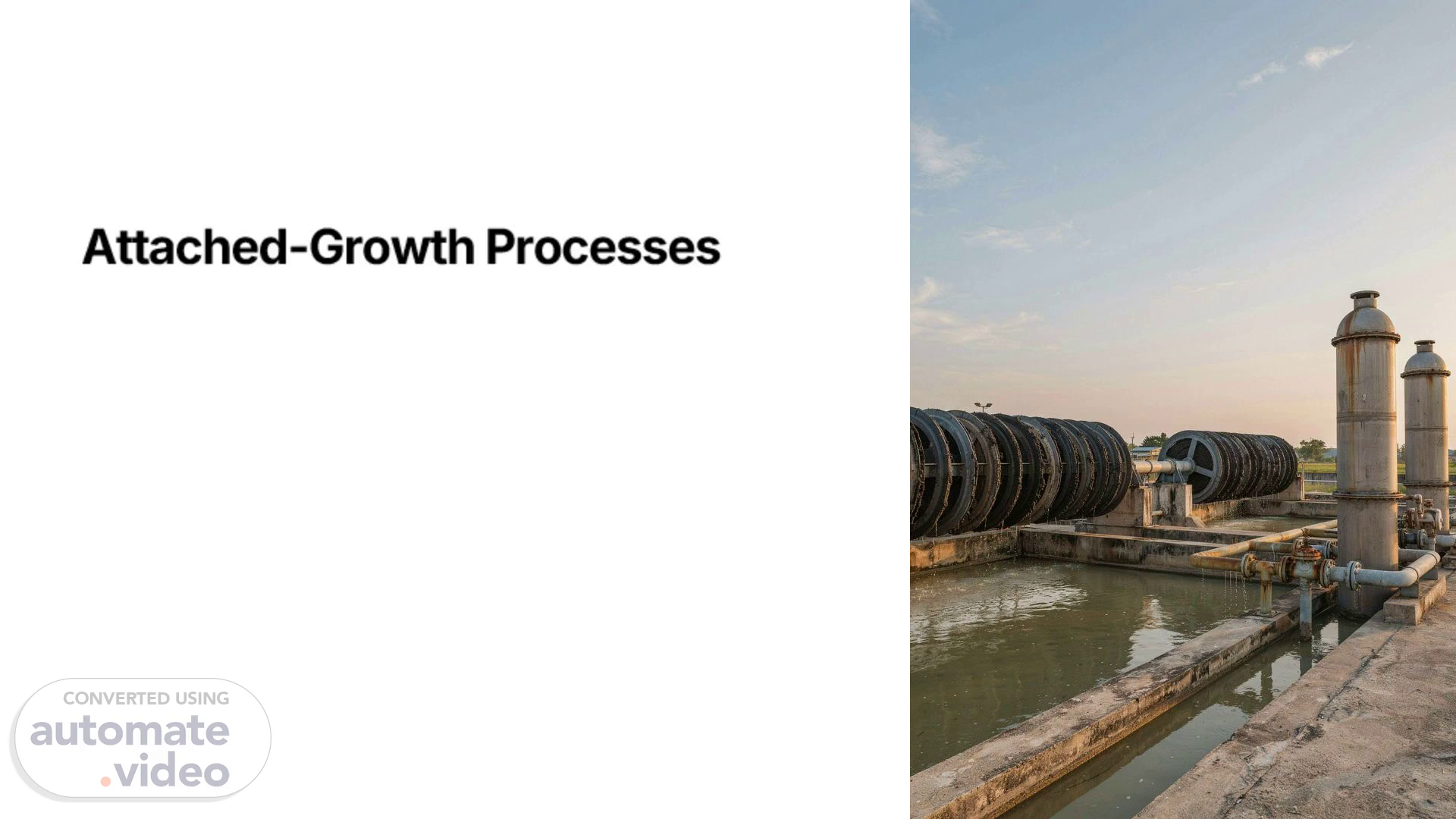
[Audio] Attached-Growth Processes Exam Cheat Sheet — Wisconsin DNR Wastewater Operator Certification, Subclass A2 Covering Trickling Filters · Biotowers · RBCs · MBBR / IFAS / BAF. Every item is tagged to its key knowledge number from the DNR study guide. Multiple choice — every question and answer comes directly from a key knowledge. This is a condensed study aid — not a substitute for the full DNR guide. Verify you are using the February 2016 edition or later..
Scene 2 (38s)
[Audio] 🎯 The Numbers — Memorize These First Numeric key knowledges are the easiest multiple-choice items to write and the easiest to miss. Every figure below appears verbatim in the guide. RBC Hard Limits RBC Media Density sBOD Loading Many sources: 2.5–4.0 lbs sBOD/day/1,000 ft² USEPA & DNR: not to exceed 2.5 lbs sBOD/day/1,000 ft² Rotation balance check: time quarter rotations at least weekly Standard: 100,000 ft² per shaft High-density: 120,000–180,000 ft² First shafts are NOT installed with high-density media Solids contact MLSS: 1,000–3,000 mg/L Max submergence: never more than 40% of diameter (KK 2.2.1 B) Max rotation speed: never greater than 1.5 rpm (KK 2.2.1 B) Typical dimensions: 12 ft diameter × 25 ft long (KK 2.3.2) Two-number trap: USEPA/DNR = 2.5 max. General range = 2.5–4.0. Read the question stem carefully..
Scene 3 (2m 10s)
[Audio] Trickling Filter Classification & Environmental Conditions Organic Loading by Filter Type (KK 2.3.1) Environmental Conditions Low-rate: up to 25 lbs BOD/1,000 ft³/day Intermediate-rate: up to 40 lbs BOD/1,000 ft³/day High-rate: up to 100 lbs BOD/1,000 ft³/day Roughing: 100–300 lbs BOD/1,000 ft³/day (only one given as a range) Memory hook: 25 → 40 → 100 → 300. Units are per 1,000 cubic feet. Optimal temperature: 10°C to 25°C (KK 1.2.4 D) Optimal pH (general): 6.0 to 9.0 (KK 1.2.4 E) Nutrient ratio BOD:N:P: at least 100:5:1 (KK 1.2.4 F) Best nitrification DO: 2.0–3.5 mg/L (KK 3.3.1) Best nitrification pH: 7.0–8.5 (KK 3.3.1) Nitrification begins when sBOD: <20 mg/L Nitrification lost at: 6°C or less Two pH ranges: general microorganisms 6.0–9.0; nitrification 7.0–8.5. Nitrifiers are fussier — narrower range, higher floor..
Scene 4 (3m 35s)
[Audio] Chapter 1 — Key Definitions Rapid-fire terms from KK 1.1. The three oxygen conditions are the classic exam triplet. Aerobic [O₂] Anoxic [NO₂, NO₃, SO₄] Free and dissolved oxygen IS available. Nitrification occurs here. Oxygen available ONLY in combined form — nitrate, nitrite, sulfate. Denitrification occurs here. Other Critical Terms Anaerobic [Ø] Free, dissolved, AND combined oxygen all unavailable. Beggiatoa: unwanted filamentous bacteria; WHITE biomass (KK 1.1.4) Loping: uneven shaft rotation from UNBALANCED biomass on disc media (KK 2.1.1) TFO: release of wastewater other than through permitted outfalls; report within 24 hours Shock/slug load: usually SHORT-TERM — excessive hydraulic, organic, or toxic discharge.
Scene 5 (4m 40s)
[Audio] Microbiological Principles & Biofilm Biofilm Thickness Control by Process (KK 1.2.3) Attached-Growth Basics (KK 1.2.1–1.2.3) Biomass attaches to media: rock, ceramic, plastic, slag Organisms: free-swimming and stalked ciliates, rotifers, nematodes As biomass thickens it loses adhesion and sloughs off Advantage: resilient to shock loads; easy to operate Disadvantage: less flexible for process control than activated sludge Principal role: convert dissolved/particulate BOD into cell mass RBCs: rotational speed Trickling filters/biotowers: recirculation rate (flushing) MBBRs and IFAS: aeration MBBRs: mechanical mixing Biological aerated filters: backwashing Seven environmental factors (KK 1.2.4): Food, Flow, Oxygen, Temperature, pH, Nutrients, Toxicity — mnemonic: F-F-O-T-P-N-T..
Scene 6 (5m 56s)
[Audio] RBC Growth Appearance by Stage (KK 1.2.5) High-yield exam topic — especially the nitrification appearance triplet. Later Stages First Few Stages Nitrifying Stages 🎯 Dense, covers most of media. Tan-brown to light gray. Higher BOD = higher growth rate. Microscopy shows LOTS OF MOTION — free-swimming and crawling ciliates, some stalked ciliates. Less growth, may be splotchy. Still tan-brown to light gray. LESS MOTION — more and larger numbers of stalked ciliates, rotifers, nematodes. If food very limiting, attached-floc particle stripping can occur. THIN · GRANULAR (sandpaper texture) · DARK BROWN. Typically high-density media. This triplet appears in both KK 1.2.5 and KK 3.3.1 — near-certain exam material. Contrast: healthy growth = tan-brown/light gray. Nitrifying = dark brown/granular. Beggiatoa = WHITE. Different color, different problem, different cause..
Scene 7 (7m 12s)
[Audio] Process Variations — TF, RBC, MBBR, IFAS, BAF (KK 1.3) Trickling Filter / Biotower MBBR RBC LOOSE media in a suspended-growth basin. Media STAYS in basin. Diffuser provides O₂, mixes media, sloughs biomass. NO recycle side flow. (KK 1.3.3 A) Influent + recirculated flow enters through DISTRIBUTOR ARMS; flows DOWN through media. (KK 1.3.1) Influent treated by bacteria on ROTATING DISCS in stages divided by BAFFLES. Unlike TF/biotower, a portion of flow is NOT recirculated. (KK 1.3.2) IFAS BAF Loose OR fixed media PLUS typical activated-sludge SOLIDS RECYCLING. More nitrification in same tank volume. IFAS = MBBR + RAS. (KK 1.3.3 B) Combines biological treatment AND solids removal — no clarifiers needed. UPWARD flow, co-current with air. Backwashed. PATENTED processes. (KK 1.3.3 D) MBBR vs IFAS: the most likely comparison question. The ONLY difference is RECYCLE — IFAS has it, MBBR does not..
Scene 8 (8m 49s)
[Audio] Chapter 2 — Components & Equipment RBC Key Components (KK 2.2.1) Trickling Filter Key Components (KK 2.2.3) Media: rotating discs, high/low-density polyethylene. Max 40% submergence, max 1.5 rpm Baffles: concrete or wood; separate shafts; some contain WEIRS Air cups: on OUTER surface, ANGLED to capture rising air and rotate discs Air diffusers: COARSE-BUBBLE; distribute air from header into air cups Load cells: MEASURE BIOMASS WEIGHT on discs Enclosure: weather protection, ODOR CONTROL, and SECURITY Containment structure: extends 4–5 ft above media to prevent WIND affecting arm rotation Distributor arms: convey wastewater; SPLASH PLATES distribute; thrust of spray rotates arm Speed-retarder orifices: on BACK side of arm; regulate rotation speed End gates: on ENDS of arm; OPENED to flush debris Underdrain: supports media, ALLOWS AIR IN, collects effluent Wet well: collects primary clarifier effluent AND recirculated flow Load cells matter: excessive biomass weight can STRESS and cause SHAFT FAILURE — why first shafts never get high-density media..
Scene 9 (10m 27s)
[Audio] Operation — Recirculation, Arm Speed & Primary Treatment Recirculation Ratios (KK 2.1.3 / 2.3.5) Distributor Arm Speed Control (KK 2.3.3) KK 2.1.3: typical ratios 1:1 to 4:1. KK 2.3.5: recirculation rates 2:1 to 4:1. Both appear in the guide — 4:1 is the consistent upper bound. Recirculation is the primary process control method for TF/biotowers. Increase recirculation rate → faster arm. Fewer nozzles → FASTER arm (same flow, less area = more thrust). More nozzles → SLOWER arm. Speed-retarder nozzles on opposite side slow rotation. Why Primary Treatment First (KK 2.3.4) 8 Purposes of Recirculation (KK 2.3.5) Reduce wastewater strength · increase detention time · maintain arm rotation at low flow · hydraulic shear to prevent ponding · prevent drying out · uniform flow distribution · maintain optimum biomass thickness · prevent freezing in cold weather. Removes settleable solids before attached-growth process. Without it: organic overloading, anaerobic conditions, ponding, fouling. Also reduces organic loading and removes grease..
Scene 10 (12m 6s)
[Audio] Preventative Maintenance & Intervals Well-Operating RBC (KK 2.4.1) Well-Operating TF/Biotower (KK 2.4.2) Healthy biomass: uniformly BROWN, THIN, EVEN layer over entire media No unusual noises from drive unit or shaft NO LOPING of the RBC discs Healthy, THIN biomass layer; ENTIRE SURFACE WETTED All orifices open and flowing LEVEL distributor arms rotating continuously and smoothly NO PONDING; no leaking from center column seal TF/Biotower Maintenance Intervals (KK 2.4.7) DAILY: check proper flow through all orifices WEEKLY: monitor oil level in UPPER bearing assembly WEEKLY: flush distributor arms by opening end gates MONTHLY: grease LOWER bearing and seal assembly Mnemonic: Orifices Daily · Oil Weekly · Flush Weekly · Grease Monthly.
Scene 11 (13m 13s)
[Audio] Chapter 3 — Monitoring & Nitrification Partial Nitrification Effects (KK 3.3.2) 🎯 Sampling Locations (KK 3.2.1) Three consequences — a favorite exam item: For overall treatment efficiency: sample influent to the attached-growth process AND after the final clarifier. The influent sample location is specifically the WET WELL — which combines primary clarifier effluent, recirculation flow, AND sidestreams. Sampling primary effluent alone misses the recirculation contribution. BOD5 test reads HIGH — nitrification occurs during incubation Higher toxicity to fish and aquatic life More chlorine demand for disinfection Remedy: use a cBOD5 (carbonaceous) test, reported WITH DNR APPROVAL. Nitrification in an RBC (KK 3.3.1) Balanced Rotation Check (KK 3.3.3) First stages use CARBON (BOD) as primary food When sBOD drops below 20 mg/L, nitrifiers grow on LATTER stages PLUG FLOW through RBCs promotes nitrifier growth Appearance: thin, dark-brown, grainy Biggest influence: TEMPERATURE — lost at 6°C or less Best DO: 2.0–3.5 mg/L · Best pH: 7.0–8.5 Mark media in quarters. Using a STOPWATCH, time each quarter rotation. Even balance = relatively similar times. Check at least weekly..
Scene 12 (15m 3s)
[Audio] Sidestreams & Septage (KK 3.4) Sidestreams from solids handling carry high BOD, TSS, ammonia, phosphorus, sulfides, or very low temperatures. Return slowly and regularly so microorganisms can acclimate. If WPDES permit limits P or ammonia, it may be necessary to separately treat the sidestream. 2,220–14,700 565–5,800 Septage TSS (mg/L) Septage BOD (mg/L) vs. domestic 100–350 mg/L — roughly 20–40× domestic strength vs. domestic 100–400 mg/L 1.5–12.6 116–428 Septage pH Range Septage Ammonia (mg/L) vs. domestic 12–50 mg/L Nearly the full scale — the most distinctive value in the table Handling requirements: discharge at a location allowing grit and screenings removal; blend slowly into plant influent; sample and monitor regularly..
Scene 13 (16m 26s)
[Audio] Performance Limiting Factors & Ventilation (KK 3.5) A — Toxics B — High Organic Loading Heavy metals, acid/caustic, chlorine, surfactants, QUATS, metal salts. Kill or reduce microorganisms → reduced BOD removal → possible effluent violations. Excessive growth → PLUGGING, CHANNELING, PONDING, ODORS, and high solids loading to final clarifiers. C — High Nutrient Loading (Ammonia) D — Excessive Hydraulic Flow Can be TOXIC to microorganisms or pass largely untreated if high enough. Quaternary ammonia compounds (cleaners) also impact biomass. Most commonly from I/I. Reduces detention time; can HYDRAULICALLY STRIP biomass off media. Late winter/early spring I/I is also VERY COLD. TF/Biotower Ventilation (KK 3.5.2 A) RBC Ventilation (KK 3.5.2 B) Inadequate ventilation → aerobic organisms go ANAEROBIC → ODOR PROBLEMS. To check: perform a SMOKE TEST. Fix: forced air through the underdrain system. Rely on PASSIVE ventilation. Air spaces on rotating media let air, food, and microorganisms come together and give sloughed biomass a space to leave..
Scene 14 (17m 55s)
[Audio] Troubleshooting — Trickling Filters & RBCs TF/Biotower Troubleshooting (Fig. 3.6.1.1) RBC Troubleshooting (Fig. 3.6.2.1) Problem Problem Cause Fix Fix Excessive growth Ponding Organic overload INCREASE recirculation to flush Reverse rotation; clean media; add air; recirculate effluent Loping REPLACE MEDIA Ponding Deteriorated media CLEAN (STRIP) MEDIA — uneven growth = shaft imbalance Solids from primary REMOVE MORE SOLIDS Ponding DETERMINE SOURCE OF TOXINS Biomass color change Plugged orifices Poor prelim. treatment INCREASE DO; REDUCE organic loading UPGRADE SCREENING Beggiatoa (white) Cold weather DECREASE recirc; cover; wind breaks Icing Snail infestation Isolate; chlorinate 24 hours; drain; dry; manually remove Odor Anaerobic INCREASE recirc & ventilation Partial nitrification Apply for cBOD limits; if chronic, upgrade — add air/media/recirc Filter flies Better housekeeping; FLUSH WALLS Larval buildup Ponding has THREE different causes with three different fixes — expect a question that hinges on which cause is stated..
Scene 15 (19m 36s)
[Audio] Chapter 4 — Safety & Regulations Nine Safety Hazards (KK 4.2.1) Which Safety Code Applies (KK 4.2.3) 🎯 Municipal wastewater plants: Wisconsin SPS 332, Public Employee Safety and Health. Non-public entities: OSHA, CFR 29 Part 1910. Topics under SPS 332: confined space, excavation, hearing conservation, bloodborne pathogens, CPR/First Aid, Safety Data Sheets, electrical, fall protection, hazardous materials. Falling into tanks where currents can pull you under Noise Waterborne and bloodborne pathogens Rotating equipment Electrical hazards Slippery surfaces Confined spaces Compressed air Chemicals and chemical equipment Water Safety (KK 4.1.2) Aerated basins: extremely difficult to stay afloat — water saturated with air NEVER extend beyond guardrails Ring buoys: at least 90 ft of line, strategically placed around ALL process basins PFDs required when working over or near water with drowning risk Process-Specific Safety TF/Biotowers (KK 4.2.4): STOP FLOW; allow arms to COMPLETE STOP; SECURE arms before entering. Caution on slippery media. RBCs (KK 4.2.5): Stop shaft rotation per O&M manual. Ensure proper OXYGEN CONDITIONS within ENCLOSURES..
Scene 16 (21m 22s)
[Audio] Chemical Safety (Section 4.3) SDS Requirements (KK 4.3.1) Safety Data Sheets must be kept ON-SITE and READILY AVAILABLE for each hazardous chemical. Secondary Containment (KK 4.3.2) Must EQUAL THE VOLUME of the storage tank. Inspect fill lines, valves, and tanks regularly. Seal yard and storm drains. Spill Reporting (KK 4.3.2) Report to DNR within 24 HOURS and to local emergency response agencies. Contact CHEMTREC for spill response advice. Chemical Storage Tank Entry (KK 4.3.3) CONTRACT to trained specialists. Follow all confined space entry procedures..
Scene 17 (22m 11s)
[Audio] Chapter 5 — Calculations Unit trap: Filter CLASSIFICATION (KK 2.3.1) uses lbs BOD per 1,000 CUBIC feet (ft³). Chapter 5 CALCULATIONS use lbs BOD per 1,000 SQUARE feet (ft²). Match your denominator to the question. Pounds Formula Total RBC Surface Area (KK 5.1.1) Per train = sum of all shaft areas. Total = area per train × number of trains. Example: (100K + 100K + 100K + 150K) × 2 trains = 900,000 ft² lbs/day = flow (MGD) × concentration (mg/L) × 8.34 The foundation of all loading calculations. Know 8.34 and 1,440 min/day cold. Organic Loading per 1,000 ft² (KK 5.2.3) HLR & Recirculation Ratio (KK 5.2.2 / 5.3.1) Step 1: lbs/day = MGD × mg/L × 8.34. Step 2: [lbs/day ÷ area ft²] × 1,000. Example: 0.250 MGD × 200 mg/L × 8.34 = 417 lbs/day. [417 ÷ 200,000] × 1,000 = 2.1 lbs sBOD/day/1,000 ft² — under the 2.5 limit. HLR: Area = 3.14 × radius². HLR (gpd/ft²) = flow ÷ area. ⚠️ Halve diameter before squaring — most common error. Recirc ratio: gpm × 1,440 ÷ 1,000,000 = MGD. Ratio = recirc MGD ÷ influent MGD. Example: 270 gpm → 0.389 MGD ÷ 0.26 = 1.5:1.
Scene 18 (24m 46s)
[Audio] Three Watch-Outs in the Source Guide These internal inconsistencies are present in the DNR guide itself. Knowing them prevents surprise on exam day. ⚠️ Recirculation Ratio Range ⚠️ Recirculation and Cold Weather ⚠️ ft² vs ft³ KK 2.1.3 states typical ratios are 1:1 to 4:1. KK 2.3.5 states recirculation rates range from 2:1 to 4:1. Both appear in the guide. Answer per the section cited. 4:1 is the consistent upper bound — the number least likely to be wrong. Filter classification (KK 2.3.1) uses lbs BOD per 1,000 cubic feet (ft³) — a volumetric loading. Chapter 5 calculations use lbs BOD per 1,000 square feet (ft²) — a surface area figure. Read every calculation question for which unit it gives you. KK 2.3.5 H: recirculation prevents freezing in cold weather. Figure 3.6.1.1: the corrective action for active icing is to DECREASE recirculation, cover units, and build wind breaks. Answer according to which section the question comes from..
Scene 19 (26m 7s)
[Audio] Final Review — Most Likely Exam Items. Final Review — Most Likely Exam Items.
Scene 20 (26m 36s)
[Audio] Source, Disclaimer & Study Method Source DNR-Recommended Study Method Condensed entirely from: Wisconsin Department of Natural Resources, "Biological Treatment — Attached-Growth Processes Study Guide, Subclass A2," February 2016 Edition. Wisconsin DNR Operator Certification Program, PO Box 7921, Madison, WI 53707. Every value, definition, list, and worked calculation traces to a numbered key knowledge in that document. Typos and internal inconsistencies noted are present in the source and are flagged so you recognize them on the exam. Read every key knowledge until the concept is fully understood and known to memory Take classes in wastewater operations Read the references: WEF MOP No. 11 and the CSU Sacramento Operation of Wastewater Treatment Plants — both borrowable through the UW Water Library Use this alongside the guide, not instead of it. Verify you are studying the current edition before your test date..