ATR Origination, Filtration & Validation — PB-IMS-PRO-17 Rev.1
Scene 1 (0s)
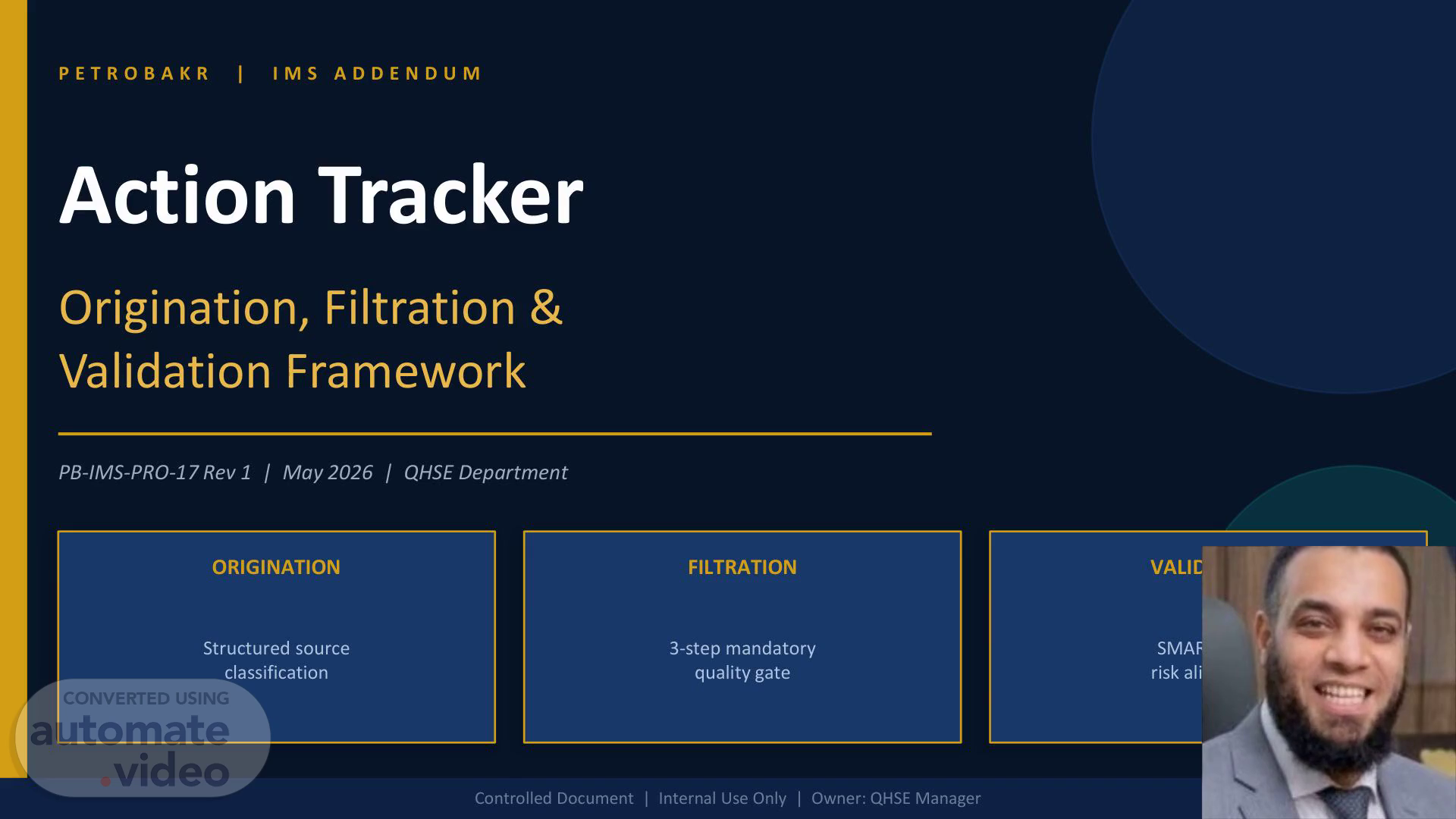
P E T R O B A K R | I M S A D D E N D U M Action Tracker Origination, Filtration & Validation Framework PB-IMS-PRO-17 Rev 1 | May 2026 | QHSE Department ORIGINATION Structured source classification FILTRATION 3-step mandatory quality gate VALIDATION SMART-PS & risk alignment Controlled Document | Internal Use Only | Owner: QHSE Manager.
Scene 2 (2m 2s)
[Audio] The existing PB-IIMS-PRO-17 procedure permits direct ATR registration without formal filtration and validation gate. This creates systemic weaknesses in action quality, traceability, and management focus. The identified deficiencies include ATR overpopulation, duplicate actions, poor traceability, and low-value and locally manageable items that inflate the register, reducing its strategic value. Similar or overlapping actions from different IMS sources entered without duplication. Actions not linked to specific risks, hazards, or system weaknesses—untraceable to root cause. Diluted leadership focus reduced, reduced audit confidence, and management attention drawn away from material risk to administrative noise. Inconsistency in action quality and closure standards undermines regulatory defense. PB-IIMS-PRO-17 Rev. 1 | Sect..
Scene 3 (3m 6s)
[Audio] The structured filtration and validation process ensures that all findings and observations are subjected to a rigorous review by both QHSE and line managers prior to being recorded in the Action Tracking Register. This process aims to track only those items that are risk-based, actionable, and accountable, thereby enhancing the overall quality and manageability of the tracking system. The three-step mandatory process involves the initial review of each finding, followed by a risk alignment check and finally, a verification of duplicates. Each step is guided by the SMART-PS quality standard, which emphasizes the importance of specificity, measurability, and actionability. The process also incorporates assurance and audit entries, ensuring that all aspects of the tracking system are thoroughly evaluated and documented. By implementing this framework, we can ensure that our tracking system is robust, reliable, and effective in managing risks and improving operational efficiency..
Scene 4 (4m 13s)
[Audio] The action source families are categorized into several groups based on their nature and scope. These categories include HAZOP/Hazid studies, safety observations, internal and external audits, operational risk assessments, safety conversations, assurance reviews, incident investigations, management walkthroughs, management reviews, integrity and asset reliability reports, worksite inspections, regulatory obligation actions, and LOPA, SIL, FMEA studies. All these types of activities are considered mandatory and always eligible for entry into the ATR system, provided they meet certain criteria such as passing the filtration gate and being non-deferred without ATR committee approval. The filtration gate is used to filter out non-systemic, non-recurring, or non-organizational risks, ensuring that only high-priority risks are addressed..
Scene 5 (5m 19s)
[Audio] The Filtration Gate serves as the initial point of contact for all formal actions within our organization. This four-step process guarantees that every action is thoroughly reviewed before being recorded in our Action Tracking Register. Each step involves a thorough evaluation of critical information to ensure that the action meets our standards for quality, traceability, and accountability. The first step, Action Origination Review, verifies the accuracy and citation of the source document and confirms that a search for similar sources or findings has been conducted. The second step, Risk Alignment Check, evaluates if the action aligns with our risk profile and makes any necessary adjustments. The third step, Duplicate Check, confirms that the action is not a duplicate of any existing work. Finally, the fourth step, Action Quality Gate, assesses if the action meets our SMART-PS quality standard, including its measurability, specificity, and actionability. Once all steps are completed, the action is deemed ready to be entered into our Action Tracking Register..
Scene 6 (6m 30s)
[Audio] The PETROBAKR company has identified deficiencies in their existing action tracking process. To address this, they have implemented a new framework called the Action Quality Gate (AQG) to improve the quality, traceability, and management focus of actions. This framework consists of seven essential elements that must be present for an action to be considered compliant with their SMART-PS Compliance Standard. These elements will now be discussed in further detail. The first element of the AQG is specificity. This means that the action must have a clearly defined and unambiguous deliverable with a defined scope. This ensures that all individuals involved understand exactly what needs to be done. The second element is measurability. This requires that there must be a way to confirm completion through verifiable closure evidence and a quantifiable outcome. The third element is actionability, which means that the action should result in a tangible output, such as implementing a new process or installing a safety measure. Vague terms should be avoided and more specific language, such as "implement" or "revise", should be used. Next, the action must be linked to risk. This means that there should be a clear and traceable connection between the action and the identified hazard, root cause, or regulatory gap that it is addressing. The action must also be time-bound, with a risk-proportional completion date and no open-ended actions. This ensures that actions are completed in a timely manner. Furthermore, prioritization is key. Actions should be severity-ranked in comparison to other open action tracking items to properly allocate resources and focus on the most critical actions. Lastly, the action should have one designated owner who is accountable for completing it and has the necessary authority and resources to do so. To summarize, the Action Quality Gate is a vital component of PETROBAKR's new framework for action origination, filtration, and validation. It guarantees that all actions meet their SMART-PS Compliance Standard and are effectively managed. This concludes the discussion on slide 6, and we will now move on to the next element of the AQG checklist..
Scene 7 (8m 56s)
[Audio] Our new action tracking data model, PB-IMS-FRM-50, introduces several mandatory fields that are crucial for ensuring regulatory defensibility. These fields include the action ID, a unique identifier generated by the system, as well as mandatory fields for risk, observation, and assurance. We have also implemented a source reference field to trace the origin of each action. The filtration decision, whether related to a HAZOP node, SOCC number, or audit reference, is now mandatory to improve the quality and focus of our actions. Additionally, our data model includes the option to mark actions as accepted or rejected, with a required rationale for any rejections. This will assist in managing and tracking the implementation of actions. Furthermore, the new data model includes fields for initial and interim risk levels, determined using our PB-IMS-PRO-10 risk matrix during the origination stage. In cases where temporary controls have been applied or verified, there is now a conditional field for the residual risk level. Each action will have one named owner responsible for verifying the risk level upon closure to ensure accountability and transparency. We have also added fields for budget classification and verification method, such as site inspection, document review, or testing. Lastly, each action will have a closure evidence type, such as a physical record, photo, or certificate, and the date of the last committee review will be mandatory to track progress. Our enhanced data model, PB-IMS-FRM-50, is the result of our ongoing efforts to improve our action tracking process and ensure regulatory defensibility..
Scene 8 (10m 52s)
[Audio] Slide number 8 outlines the roles and authorities of the Action Tracking Committee (ATC). The ATC is responsible for reviewing, validating, and managing proposed actions to ensure their quality and traceability. Each role within the ATC has a specific purpose and designated level of authority. The Field GMs and QHSE Managers are members of the ATC with the ultimate escalation authority. They review and assess proposed actions at the source level and hold themselves and their departments accountable for assigned actions. The ATC Chair, a senior member of the organization, can formally accept or reject proposed actions and escalate high or critical risk actions to the Managing Director. Departmental GMs or their delegates also serve as members of the ATC, responsible for conducting source-level reviews and being accountable for assigned actions. The QHSE Department Focal Point or Secretary maintains the ATC's agenda, register, and reports to the committee. They also have the authority to approve or reject requests for due-date extensions. The ATC can recommend the closure of stale or invalidated actions after reassessment to maintain efficiency and effectiveness. For more details on the authorities and responsibilities of each role within the ATC, please refer to section 7 and the Roles Sheet in the provided workbook. Let's now move on to our next slide, where we will discuss the requirements for action tracking within our governance framework..
Scene 9 (12m 32s)
[Audio] Slide number 9 discusses the strategic benefits of a new enhancement for PETROBAKR. This framework addresses deficiencies in the previous process and aims to improve the overall quality, traceability, and management focus of actions. One significant benefit is a decrease in low-value entries, saving time and resources. This enhancement also shifts the action tracking register from a compliance log to a strategic risk management tool, allowing for a more proactive approach. Implementation of this framework is expected to result in a higher proportion of actions being closed on time with verified evidence, improving closure effectiveness and audit confidence. A quality gate has been put in place to prevent unnecessary or duplicate actions from being added to the register. For auditors, this enhancement provides a clean, traceable, and defensible register that is fully linked to source documents and risk references. It also helps leadership focus on critical risks and eliminates unnecessary noise from the governance agenda. Integration of SOC data ensures a streamlined and accurate view of risks. Furthermore, this enhancement maintains traceability of mandatory actions, promoting accountability and regulatory defensibility. Let's move on to the next slide..
Scene 10 (14m 2s)
[Audio] In this slide, we will be discussing the 7-phase activation sequence of our new framework for improving the action tracking process at PETROBAKR. The first phase is focused on addressing any current issues with our process by issuing PB-IMS-PRO-17 Rev 1/ Addendum QHSE/MD. Next, we will create an Action Tracking Committee, led by our Field GM and QHSE team, to oversee the implementation. To ensure a smooth transition, targeted training will be provided to our QHSE team, GMs, and ATC members. This will help them understand their roles and responsibilities in the new process. A legacy ATR audit will also be conducted, in collaboration with our QHSE team and the ATR Committee, to remove duplicates, stale, or low-value items and improve the quality of our action tracking. Additionally, we will be updating our PB-IMS-FRM-50 with a new mandatory data model to ensure consistency and accuracy in our tracking. From the declared cutover date, a filtration gate will be enforced to filter out any actions that do not meet the ATC's criteria. After implementation, a 90-day review will be conducted to assess the effectiveness of the new framework. Thank you for your attention and please feel free to ask any questions during the Q&A session..
Scene 11 (15m 33s)
[Audio] The new action tracking framework is designed to elevate the Action Tracking Register (ATR) from a passive compliance tool to a strategic risk management mechanism. The goal is to create a robust, auditable, and strategically focused ATR that supports leadership decision-making and ensures regulatory defensibility. The framework is risk-focused and filtered, meaning only value-adding actions are registered, resulting in a more efficient use of resources and a focus on the most critical areas. The ATR has full integration with the IMS system, including the PRO-10 risk matrix, PRO-25 SOC, and PRO-17 execution, providing a comprehensive and integrated approach to risk management. The framework also features governance-grade traceability, making the ATR audit-ready and regulatory defensible. This enhances transparency and accountability in operations, allowing for better decision-making and regulatory compliance. The new framework improves the action tracking process by shifting the focus from mere compliance to strategic risk management, providing a strong foundation for decision-making and regulatory defensibility. The implementation of this framework is expected to have a positive impact on PETROBAKR..