Scene 1 (0s)
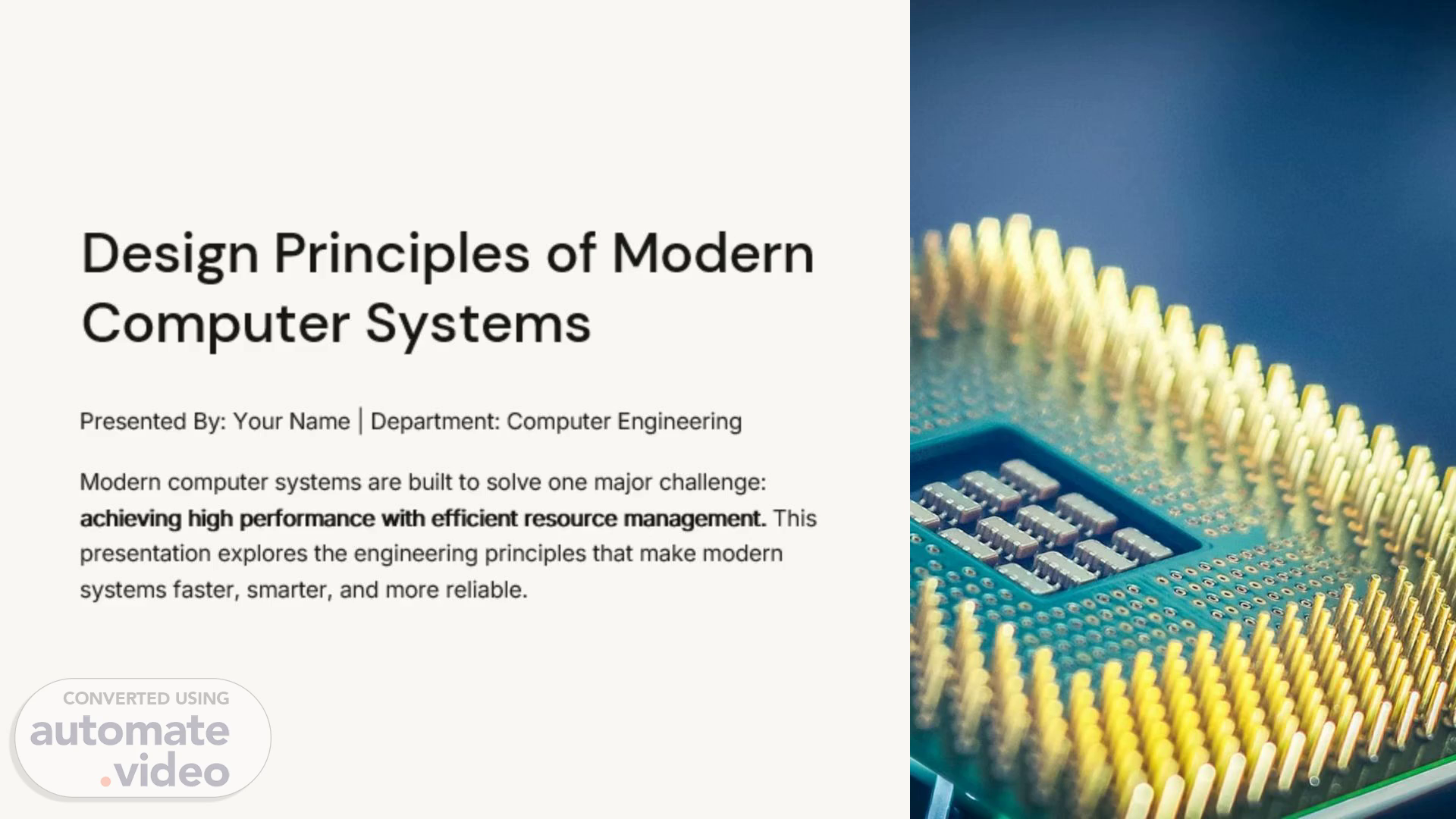
[Audio] Good morning, everyone! I'm from the Computer Engineering Department. Today, I'm thrilled to walk you through the fascinating world of modern computer systems. Have you ever wondered what truly makes your devices so incredibly fast, responsive, and reliable? It's not magic; it's the result of brilliant engineering and carefully designed principles. In a world increasingly reliant on technology, from the smartphones in our pockets to the vast data centers powering the internet, the design of these systems directly impacts our daily lives and the pace of innovation. On this first slide, titled "Design Principles of Modern Computer Systems," we set the stage for what we'll explore today. My goal is to demystify how these complex machines are built to achieve a seemingly contradictory goal: delivering peak performance while managing their resources with utmost efficiency. We'll delve into the core engineering principles that transform raw hardware into intelligent, high-performing systems. Throughout this presentation, we'll uncover the secrets behind why modern systems are not just powerful, but also smarter and more dependable. Get ready to gain a deeper understanding of the architectural marvels that power our digital world. Let's begin our journey into the heart of modern computer engineering!.
Scene 2 (1m 21s)
[Audio] Modern computer systems operate under considerable pressure, driven by evolving user and application demands. Today, systems must seamlessly handle massive data processing, execute high-speed computations, and facilitate real-time communication without lag. Users expect robust multitasking capabilities, running numerous applications simultaneously, all while demanding efficient power consumption from their devices. These intertwined demands necessitate a sophisticated design approach. To meet these complex requirements, system engineers focus on several critical goals. Foremost among these is maximizing speed, ensuring operations complete as quickly as possible. Equally important is reducing delays, known as latency, which directly impacts user experience. Furthermore, effective design emphasizes efficient hardware utilization, ensuring that every component works optimally and no resources are wasted. Ultimately, the objective is to improve system reliability, creating stable and dependable computing environments. This leads us to a fundamental understanding: a truly effective system is not merely powerful; it is intelligently optimized to balance performance, efficiency, and stability..
Scene 3 (2m 47s)
[Audio] Modern computer systems prioritize efficient memory utilization. This approach intelligently stores and accesses data, significantly boosting overall performance. When numerous applications operate concurrently, the system dynamically allocates memory, thus preventing system crashes and undesirable lag. Several design approaches facilitate this efficiency. Dynamic memory allocation allows the system to adjust memory assignments as needed. Techniques like paging and segmentation further organize memory into manageable blocks, enhancing access and protection. Virtual memory systems extend the perceived memory capacity, enabling programs to use more memory than physically available. Moreover, efficient RAM scheduling optimizes the order and timing of memory access requests. These strategies collectively contribute to several critical benefits. They lead to faster execution of applications, reduce memory wastage by allocating precisely what is required, and enable seamless multitasking. Ultimately, these advancements ensure stable and reliable system performance, forming a cornerstone of modern computing..
Scene 4 (4m 4s)
[Audio] Modern computer systems face a fundamental challenge: the CPU operates at lightning speed, but main memory (RAM) is significantly slower. This disparity creates a bottleneck, as the processor often idles, waiting for data. To bridge this performance gap, computer architects developed cache memory, an ingenious solution that strategically places frequently accessed data closer to the CPU, thereby drastically reducing processor idle time and enhancing execution efficiency. Cache memory is not a monolithic entity; it is typically organized into a hierarchical structure, each level serving a distinct purpose. The L1 Cache, the smallest and fastest, resides directly within each CPU core. Its proximity ensures instant data access, critical for high-frequency operations. Moving outwards, the L2 Cache offers a larger storage capacity with moderately fast access times, striking a balance between size and speed. This level serves as an intermediary, capturing data that is frequently used but not necessarily required at the immediate microsecond. Finally, the L3 Cache, the largest and slowest of the three, is often shared across multiple CPU cores. This shared resource facilitates efficient coordination and data exchange between different processing units, ensuring that common data is readily available to all cores. This multi-tiered approach optimizes data flow, ensuring that the CPU is almost always engaged in processing rather than waiting, which is crucial for overall system performance..
Scene 5 (5m 48s)
[Audio] Modern computer systems implement a sophisticated memory hierarchy, a layered approach designed to balance the inherent trade-offs between speed and capacity. Essentially, the faster memory layers possess smaller storage capacities, while slower memory layers offer significantly larger storage. This hierarchical structure strategically places frequently accessed data in the faster, smaller layers, which are physically closer to the processor. Consequently, this design dramatically reduces the average access delay for data, a critical factor in overall system responsiveness. Furthermore, by optimizing where data resides, the system effectively lowers overall hardware costs. It achieves this by utilizing expensive, fast memory only for critical, frequently used data, and relying on more economical, slower memory for bulk storage. Ultimately, this intelligent organization of memory significantly improves system efficiency. Programs launch faster, applications run smoother, and the user experience becomes more seamless because the processor spends less time waiting for data, directly impacting performance and productivity..
Scene 6 (7m 3s)
[Audio] Modern computer systems achieve their impressive speed not only through fast processors and clever memory management but also through sophisticated input/output mechanisms. These advancements significantly reduce the burden on the CPU, allowing it to focus on complex computations rather than managing data transfers. Consider Direct Memory Access, or DMA, a crucial innovation. DMA effectively allows peripherals to exchange data directly with memory without involving the CPU, thus freeing the processor to continue its primary tasks. This offloading of data transfer responsibilities ensures smoother operation and prevents bottlenecks. Furthermore, storage technology has seen dramatic improvements with NVMe SSDs. Unlike older HDDs, NVMe SSDs leverage the PCIe interface, enabling significantly faster data transfer rates. This translates directly into quicker boot times for operating systems and remarkably faster loading times for large applications and games. High-speed connectivity also plays a vital role. Technologies like USB-C and Thunderbolt provide versatile, high-bandwidth interfaces, facilitating rapid communication between the computer and external devices. Finally, advanced networking protocols are essential for modern high-speed computing. These protocols minimize latency and maximize data throughput, which is critical for cloud computing, real-time online applications, and large-scale data exchanges. Collectively, these I/O enhancements are fundamental to the overall responsiveness and efficiency of modern computer systems..
Scene 7 (8m 53s)
[Audio] Instruction pipelining significantly enhances processor efficiency by breaking down the execution of each instruction into distinct stages. This approach allows the CPU to process multiple instructions concurrently, much like an assembly line in manufacturing. Instead of completing one instruction entirely before starting the next, the processor initiates a new instruction at each stage as the previous one advances. Consider the four primary stages illustrated: Fetch, Decode, Execute, and Memory. The "Fetch" stage retrieves the instruction from memory. "Decode" interprets the instruction to understand what operation it needs to perform. "Execute" performs the actual computation or data manipulation. Finally, "Memory" accesses data from or writes data to memory if required by the instruction. By overlapping these stages, for example, while one instruction is executing, the next instruction can be decoding, and a third can be fetched. This parallel execution dramatically increases the number of instructions the processor can complete per unit of time, known as throughput, without needing to increase the processor's clock speed. This clever design ensures that all parts of the processing unit remain active, leading to substantial performance gains and more efficient utilization of the CPU's resources..
Scene 8 (10m 19s)
[Audio] Here, we delve into the realm of parallel processing, a cornerstone of modern system performance. This concept involves breaking down large computational problems into smaller, independent tasks that can be executed simultaneously. This fundamental shift from sequential processing unlocks significantly faster computation and substantially improves resource utilization across the system. Consider its impact across various domains. In Artificial Intelligence, parallel processing powers the rapid training of complex neural networks through concurrent matrix operations. Similarly, in Machine Learning, distributed computation effectively shortens the immense training times required for sophisticated models. Graphics Rendering heavily relies on parallel processing, where Graphics Processing Units (GPUs) simultaneously render millions of pixels to create the immersive visuals we experience. Furthermore, Scientific Computation leverages parallel architectures to accelerate complex simulations and calculations, leading to quicker insights and discoveries. A practical illustration of this principle is evident in video rendering software, which efficiently divides a video into numerous smaller segments and processes them concurrently, dramatically reducing the overall rendering time. This simultaneous execution across multiple processing units represents a profound advancement in how modern systems tackle computationally intensive workloads..
Scene 9 (11m 57s)
[Audio] Our journey through modern computer systems culminates in understanding multi-core computing. This technological leap integrates multiple CPU cores onto a single processor chip. Imagine each core as an independent mini-processor, capable of executing tasks autonomously. This architectural design fundamentally enhances a system's ability to handle numerous operations concurrently, leading to substantial improvements in overall performance. The advantages of multi-core systems are profound and tangible. Firstly, they facilitate efficient multitasking, allowing users to run multiple demanding applications simultaneously without experiencing significant slowdowns. Secondly, this architecture provides immense computational power, essential for complex operations like data analysis or scientific simulations. Furthermore, multi-core processors often offer better energy efficiency compared to single, extremely high-frequency cores, as distributing workload across multiple cores can be more power-optimized. Ultimately, these benefits culminate in a vastly improved system performance, offering a smoother and more responsive user experience. A perfect illustration of this is the modern user who can seamlessly engage in coding, browse the web, and participate in a video conference all at once, without any noticeable degradation in system responsiveness. This capability is a direct result of the parallel processing power offered by multi-core systems..
Scene 10 (13m 33s)
[Audio] We have explored how modern computer systems achieve smart, optimized performance across every architectural layer. The foundational principles we discussed contribute to the efficiency and power we experience daily. Smart memory utilization ensures that data is stored and accessed intelligently, preventing bottlenecks and improving overall system responsiveness. Furthermore, faster data access, facilitated by sophisticated cache architectures, dramatically reduces the time processors spend waiting for information, directly enhancing execution speed. Efficient I/O communication allows peripherals and storage devices to interact seamlessly with the CPU, minimizing disruptions and maximizing data throughput. High-speed execution through instruction pipelining ensures that processors are constantly busy, processing multiple instructions concurrently like a well-oiled assembly line. Simultaneously, parallel processing leverages multiple computational units to tackle complex tasks by breaking them down into smaller, manageable parts, leading to significantly faster computation. Finally, multi-core systems enable superior multitasking, allowing users to run numerous applications without performance degradation. The future of computer systems undeniably hinges on intelligent optimization, where every design choice aims to boost performance while rigorously conserving computational resources. This holistic approach ensures that our systems are not just powerful but also inherently efficient and sustainable..