Scene 1 (0s)
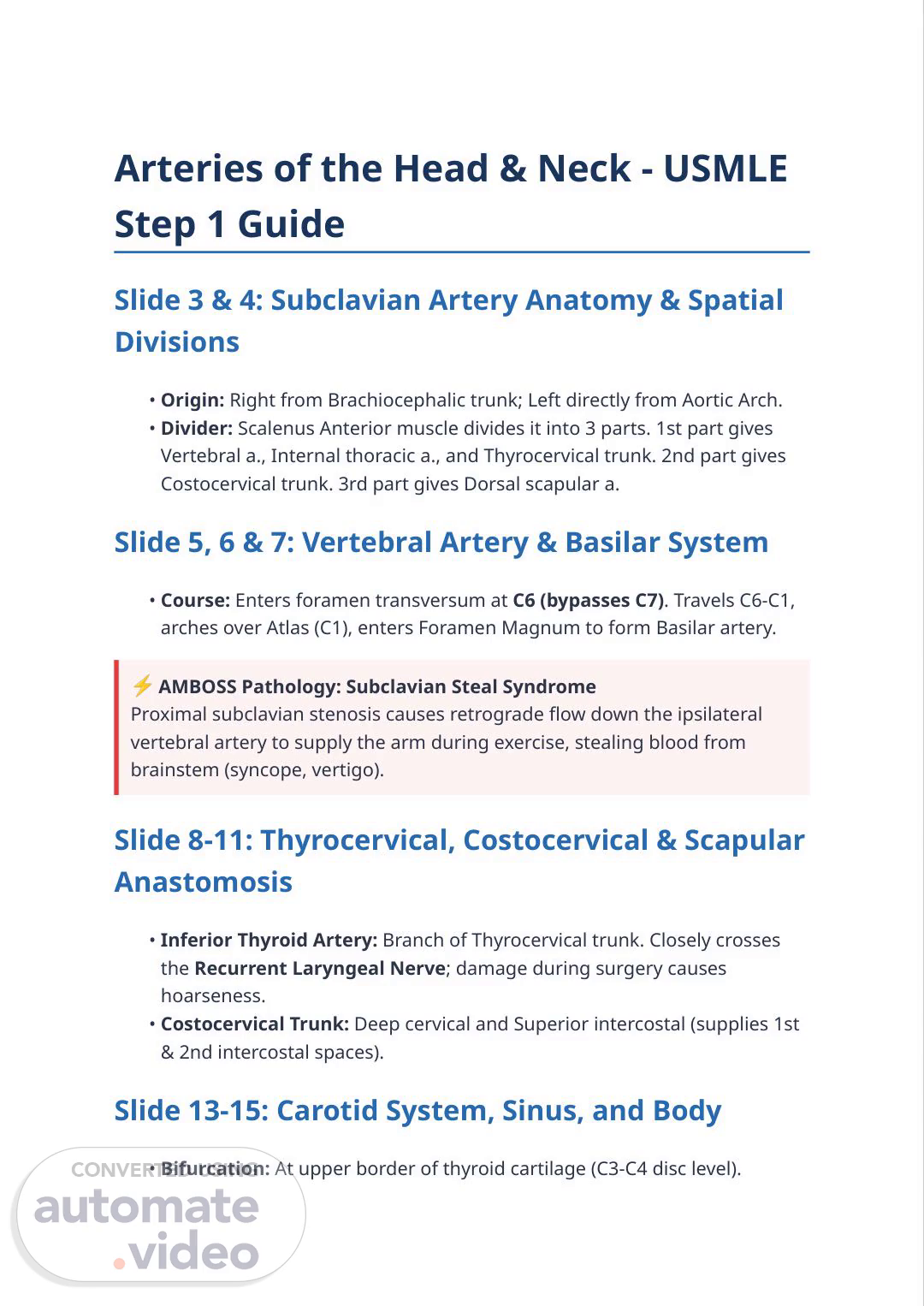
Arteries of the Head & Neck - USMLE Step 1 Guide Slide 3 & 4: Subclavian Artery Anatomy & Spatial Divisions Origin: Right from Brachiocephalic trunk; Left directly from Aortic Arch. Divider: Scalenus Anterior muscle divides it into 3 parts. 1st part gives Vertebral a., Internal thoracic a., and Thyrocervical trunk. 2nd part gives Costocervical trunk. 3rd part gives Dorsal scapular a. Slide 5, 6 & 7: Vertebral Artery & Basilar System Course: Enters foramen transversum at C6 (bypasses C7). Travels C6-C1, arches over Atlas (C1), enters Foramen Magnum to form Basilar artery. ⚡ AMBOSS Pathology: Subclavian Steal Syndrome Proximal subclavian stenosis causes retrograde flow down the ipsilateral vertebral artery to supply the arm during exercise, stealing blood from brainstem (syncope, vertigo). Slide 8-11: Thyrocervical, Costocervical & Scapular Anastomosis Inferior Thyroid Artery: Branch of Thyrocervical trunk. Closely crosses the Recurrent Laryngeal Nerve; damage during surgery causes hoarseness. Costocervical Trunk: Deep cervical and Superior intercostal (supplies 1st & 2nd intercostal spaces). Slide 13-15: Carotid System, Sinus, and Body Bifurcation: At upper border of thyroid cartilage (C3-C4 disc level). • • • • • •.
Scene 2 (43s)
Carotid Sinus: Baroreceptor tracking blood pressure. Afferent path is CN IX. Massaging both causes profound syncopal bradycardia (Vagal reflex). Carotid Body: Chemoreceptor monitoring hypoxia (pO2 < 60 mmHg), pCO2, and pH. Innervated by CN IX and CN X. Slide 16-17: Pulsations & Internal Carotid Artery Carotid Pulse: Palpated against transverse process of C6. Internal Carotid Artery (ICA): Gives zero branches in the neck; enters Carotid Canal. Slide 18-21: External Carotid Artery (ECA) Branches Mnemonic: Some American Ladies Found Our Pyramids So Magnificent (Superior thyroid, Ascending pharyngeal, Lingual, Facial, Occipital, Posterior auricular, Superficial temporal, Maxillary). Slide 22-30: Detailed Branch Criteria & Pulsations Superior Thyroid Artery: Travels with External branch of Superior Laryngeal nerve. Facial Artery: Palpable at anteroinferior masseter/mandible edge. Highly tortuous course. Ends as Angular artery. Superficial Temporal Artery: Palpable in front of ear tragus. Highly targeted in Giant Cell (Temporal) Arteritis (headache, jaw claudication, blindness risk). High-Yield Summary Matrix Structure Landmark USMLE Target Subclavian A. Scalenus Anterior muscle Subclavian Steal Syndrome Vertebral A. Enters C6 foramen Bypasses C7; prone to dissection loops Thyrocervical trunk • • • • • • •.
Scene 3 (1m 28s)
Inferior Thyroid A. Crosses Recurrent Laryngeal Nerve (hoarseness risk) Carotid Sinus C3-C4 bifurcation Baroreceptor; CN IX afferent; vagal reflex shock Facial Artery Anteroinferior masseter Tortuous course across movable face lines Superficial Temporal A. Anterior to ear tragus Diagnostic biopsy target for Giant Cell Arteritis.