Scene 1 (0s)
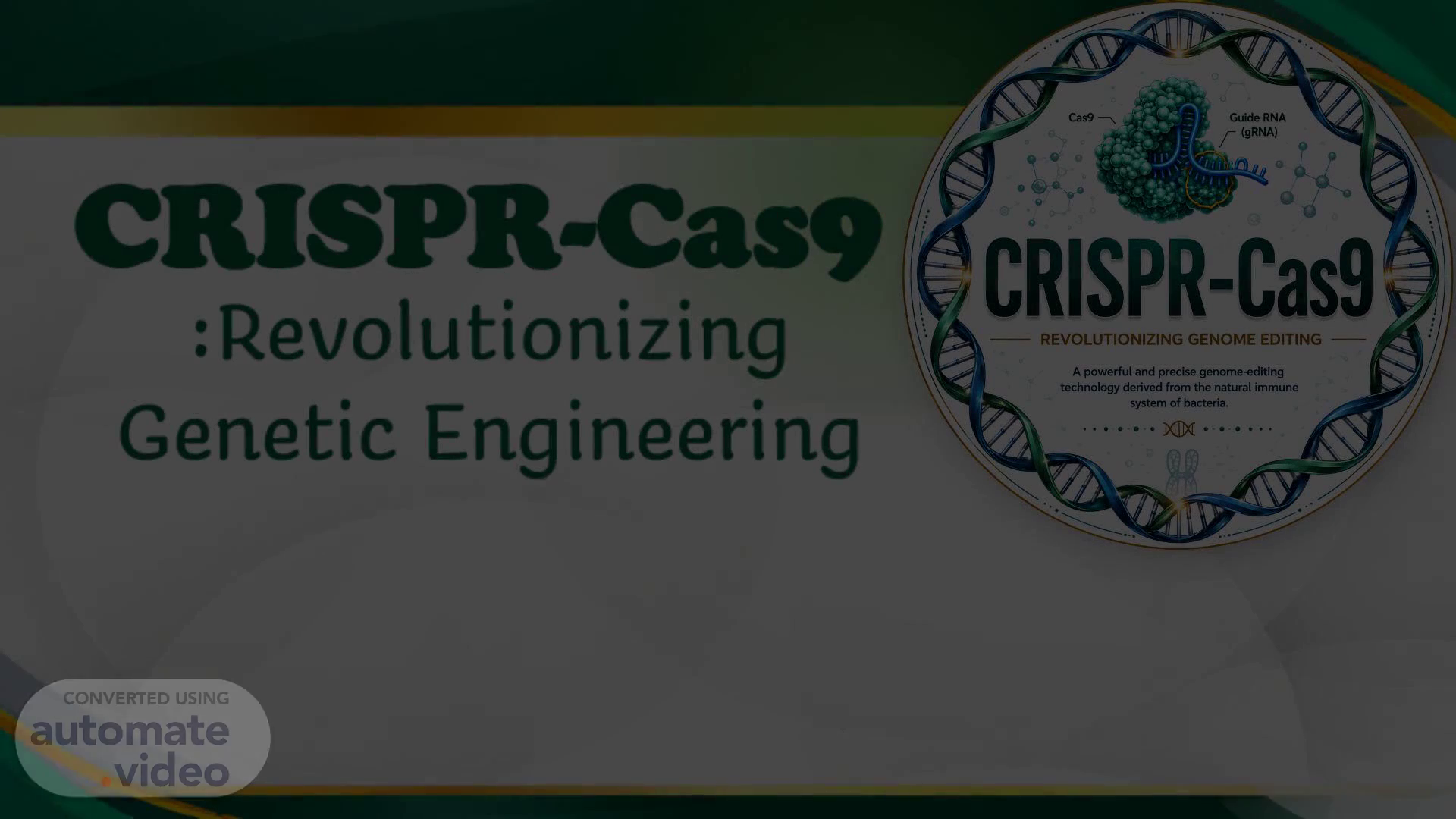
[Audio] "Imagine a future where genetic diseases can be corrected before they cause suffering. Thanks to CRISPR-Cas9, that future is becoming a reality." Good day everyone. I am Grace Ann B. Argana, a Master of Arts in Science Teaching student from St. Paul University Surigao. Today, I will be discussing one of the most revolutionary breakthroughs in modern biology and biotechnology entitled "CRISPR-Cas9: Revolutionizing Genetic Engineering." This presentation will explain what CRISPR-Cas9 is, how it works, its applications, advantages, limitations, and future potential in transforming medicine, agriculture, biotechnology, and scientific research..
Scene 2 (44s)
[Audio] Before we discuss how CRISPR works, let us first understand what it is. CRISPR-Cas9 is a powerful genome-editing technology derived from the adaptive immune system of bacteria. "In simple terms, Cas9 acts like a pair of molecular scissors that can cut DNA at a specific location." Scientists adapted this natural bacterial defense mechanism and transformed it into a tool capable of making precise changes in DNA. Because of its accuracy, efficiency, and affordability, CRISPR-Cas9 has become one of the most widely used technologies in genetic engineering. The term CRISPR stands for Clustered Regularly Interspaced Short Palindromic Repeats. These are repeated DNA sequences found in bacterial genomes. Meanwhile, Cas9 stands for CRISPR-associated protein 9, an enzyme that acts like molecular scissors. Genome editing refers to the intentional modification of an organism's DNA sequence to alter gene function. Together, CRISPR and Cas9 allow scientists to target, cut, and modify specific genes with remarkable precision..
Scene 3 (1m 56s)
[Audio] "Genome editing is the process of modifying an organism's DNA to alter gene function. Using technologies such as CRISPR-Cas9, scientists can precisely add, remove, or change specific DNA sequences. This breakthrough technology has important applications in medicine, agriculture, biotechnology, and scientific research.".
Scene 4 (2m 21s)
[Audio] To provide a better understanding of how CRISPR-Cas9 works, let us first watch a short introductory video. As you watch, pay attention to how scientists use guide RNA and Cas9 to locate and edit specific DNA sequences. (Play video.) After watching the video, we can appreciate how CRISPR has transformed the field of genetic engineering..
Scene 5 (3m 59s)
[Audio] This diagram illustrates the overall workflow of CRISPR-Cas9. The process begins with identifying a target DNA sequence. A guide RNA is then designed to match that target. The guide RNA directs Cas9 to the specific DNA location. Cas9 cuts the DNA, and the cell's natural repair mechanisms modify the genetic sequence. This simple yet powerful process enables scientists to edit genes with high precision..
Scene 6 (4m 38s)
[Audio] The development of CRISPR-Cas9 is the result of decades of scientific discoveries. In 1987, unusual repetitive DNA sequences were first observed in bacteria. In 2002, these sequences were officially named CRISPR. By 2005, scientists discovered that these sequences matched viral DNA, suggesting an immune defense role. A major breakthrough occurred in 2012 when Jennifer Doudna and Emmanuelle Charpentier developed CRISPR-Cas9 as a programmable gene-editing tool. Because of this groundbreaking work, they were awarded the Nobel Prize in Chemistry in 2020. This discovery revolutionized genetic engineering by making genome editing faster, cheaper, and more precise..
Scene 7 (5m 29s)
[Audio] Originally, CRISPR functions as a bacterial immune defense system. It protects bacteria against invading viruses called bacteriophages. The process occurs in three stages. First is Adaptation, where fragments of viral DNA are captured and stored in the bacterial genome. Second is Expression, where stored viral sequences are transcribed into guide RNAs. Third is Interference, where Cas9 uses guide RNA to identify and destroy invading viral DNA. Scientists were inspired by this natural mechanism and adapted it for genome editing..
Scene 8 (6m 10s)
[Audio] The CRISPR-Cas9 system consists of four main components. First is the Guide RNA or gRNA, which directs Cas9 to the target DNA sequence. Second is the Cas9 enzyme, which acts as molecular scissors and cuts the DNA. Third is the Target DNA, which is the specific genetic sequence to be edited. Fourth is the PAM sequence, a short DNA sequence required for Cas9 recognition and binding. Together, these components enable accurate DNA targeting and cutting. "We can think of guide RNA as the GPS, Cas9 as the scissors, and the PAM sequence as the address marker that helps Cas9 find the correct location.".
Scene 9 (6m 55s)
[Audio] Now let us examine how CRISPR-Cas9 edits DNA. The first step is designing a guide RNA complementary to the target DNA sequence. Next, Cas9 binds with the guide RNA, forming a CRISPR-Cas9 complex. This complex scans the DNA and locates the target sequence adjacent to a PAM site. Once the correct sequence is found, Cas9 cuts both strands of the DNA. The cell then activates its repair mechanisms to repair the break. Finally, the repair process results in a desired genetic modification such as gene deletion, insertion, or correction. This mechanism makes CRISPR-Cas9 an extremely powerful genome-editing tool. This process allows scientists to edit genes with unprecedented precision..
Scene 10 (7m 47s)
[Audio] CRISPR-Cas9 has transformed multiple fields of science and technology. One of the reasons CRISPR-Cas9 is revolutionary is because its applications extend far beyond the laboratory. In Medicine, it is being used to develop treatments for genetic disorders, cancer, and infectious diseases. In Agriculture, CRISPR helps produce disease-resistant crops, drought-tolerant plants, and improved livestock. In Biotechnology, scientists use CRISPR to engineer microorganisms for producing medicines, vaccines, enzymes, and biofuels. In Research, it is widely used to study gene functions, create disease models, and advance our understanding of genetics. These applications demonstrate the enormous potential of CRISPR technology..
Scene 11 (8m 40s)
[Audio] Like any technology, CRISPR-Cas9 has both advantages and limitations. Its advantages include high precision, lower cost, faster results, ease of use, and the ability to edit multiple genes simultaneously. However, there are also challenges. Technical challenges include off-target mutations and incomplete editing efficiency. Biological concerns include immune responses and cellular toxicity. Ethical concerns involve germline editing, designer babies, and equitable access to genetic technologies. Therefore, responsible use and regulation are essential. While the benefits are remarkable, responsible use is necessary to ensure safety and ethical integrity..
Scene 12 (9m 29s)
[Audio] The future of CRISPR technology is very promising. Emerging innovations include Base Editing, Prime Editing, CRISPR Diagnostics, and Epigenome Editing. These newer technologies aim to improve accuracy and reduce unintended genetic changes. Future applications may include personalized medicine, advanced gene therapies, sustainable agriculture, and environmental conservation. As research continues, CRISPR is expected to play a major role in addressing some of humanity's greatest health and environmental challenges..
Scene 13 (10m 5s)
[Audio] The information presented in this report was obtained from peer-reviewed scientific publications, textbooks, and reputable institutions including the National Human Genome Research Institute and OpenStax. These references provided the scientific foundation for this presentation..
Scene 14 (10m 40s)
[Audio] In conclusion, CRISPR-Cas9 has transformed genetic engineering by providing a precise, efficient, and versatile method for genome editing. Its applications continue to expand across medicine, agriculture, biotechnology, and scientific research. Thank you for your time and attention. God bless us all..