Scene 1 (0s)
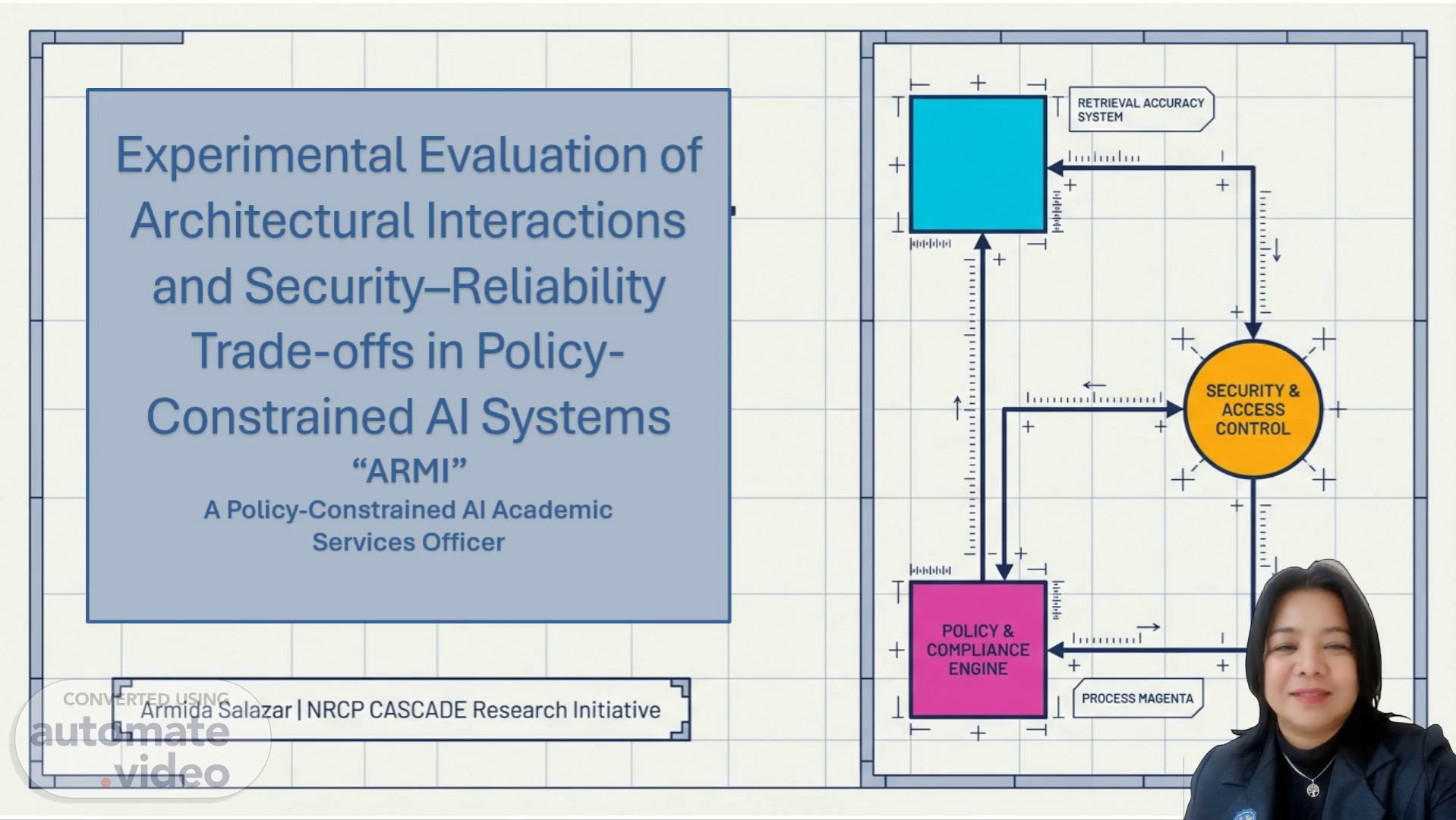
This research examines how different components of an A-I system work together and affect its accuracy, security, reliability, and compliance with policies. Specifically, it investigates how improving one component, such as retrieval accuracy or access control, may affect the performance of other components. The goal is to identify the best balance between providing accurate answers, protecting sensitive information, following institutional policies, and maintaining efficient system performance. In simple terms, we want to understand how to build A-I systems that are not only intelligent but also secure, trustworthy, and compliant with established rules..
Scene 2 (49s)
[Audio] The Institutional A-I Imperative In an ideal situation, A-I systems provide fast and accurate answers to users. However, in universities, A-I cannot simply provide information without restrictions. It must also ensure secure access, compliance with institutional policies, and protection of sensitive data. For example, an A-I assistant may know a student's grades, but it should only share that information with authorized individuals. The challenge is that adding these security and policy controls may affect the A-I system's accuracy, speed, and reliability. Our research aims to understand these effects and determine how to balance A-I performance, security, and policy compliance without unnecessarily sacrificing efficiency..
Scene 3 (1m 44s)
[Audio] The Security–Reliability Trilemma This slide highlights three important requirements of a trustworthy A-I system: Retrieval and Accuracy – Providing correct and reliable answers. Access Control and Security – Ensuring that sensitive information is accessible only to authorized users. Policy Compliance and Efficiency – Following institutional rules while responding quickly. The challenge is that improving one requirement may affect the others. For example, adding more security checks can increase response time, while restricting access to information may affect the A-I 's ability to provide complete answers. Our research aims to investigate these trade offs and determine how the three requirements can work together effectively. The goal is not simply to make A-I smarter, but to make it accurate, secure, policy compliant, and efficient at the same time. Importantly, these trade offs are what the research intends to measure experimentally, rather than assuming they always occur..
Scene 4 (2m 54s)
[Audio] What We Know against The Engineering Blind Spot Existing research has already established methods for making A-I systems accurate through Retrieval Augmented Generation (R-A-G--) and secure through access control mechanisms. However, most of these technologies have been studied separately. The research gap is that we still have limited understanding of how these components affect one another when integrated into a single A-I system. For example, adding access restrictions might prevent an A-I from retrieving certain information, potentially affecting its accuracy. Additional verification may also increase response time. Our research aims to investigate these interactions through controlled experiments, identify potential weaknesses, and determine how to integrate these technologies without unnecessarily compromising accuracy, security, or efficiency. In simple terms, we know how the individual components work, but we need to better understand how well they work together..
Scene 5 (4m 1s)
[Audio] Diagnosing the Cost of Integration This slide compares an A-I system operating on its own with one that incorporates security and institutional policy controls. A standalone A-I system primarily focuses on providing accurate answers. However, when we add access control, policy compliance, and response verification, the system becomes more complex. For example, an A-I assistant answering a student's question may need to verify the student's identity, check what information they are authorized to access, and ensure that its response follows university policies. These additional checks may increase processing time, consume more computing resources, or introduce conflicting decisions. Our research aims to measure these additional costs and determine which architectural designs can minimize them without compromising security and reliability. In simple terms, we want to know how much performance we sacrifice when making A-I more secure—and how to reduce that sacrifice. Research clarification: The slide's reference to "exponential security overhead" should be treated as a hypothesis, not an established fact. Whether the overhead is linear, exponential, or follows another pattern must be determined experimentally..
Scene 6 (5m 26s)
[Audio] The Core Research Question Our research seeks to understand how different combinations of A-I technologies affect the overall performance of an institutional A-I system. Specifically, we examine four components: information retrieval, policy enforcement, access control, and response verification. For example, if we change when or how security checks are performed, will the A-I become more secure? Will it still provide accurate answers? Will it respond more slowly? We aim to compare different A-I architectural designs through controlled experiments to measure their effects on accuracy, security, reliability, and efficiency. In simple terms, we want to determine how to organize and combine these technologies so that A-I systems provide correct answers, protect sensitive information, follow institutional rules, and respond efficiently. This is the central engineering question our research intends to answer..
Scene 7 (6m 29s)
[Audio] The Experimental Pipeline This slide explains how we will conduct the research in four steps. 1. Data Preparation – We will use approved or simulated university data, including academic policies and access restrictions, to create realistic testing conditions. 2. Simulated Workflows – We will test different A-I architectures using common university tasks, such as answering enrollment questions or retrieving student records. 3. Security Testing – We will examine whether the A-I follows institutional policies, prevents unauthorized access, and protects sensitive information. 4. Statistical Analysis – We will compare the results to measure accuracy, security, reliability, and response time across different architectures. The goal is to identify which architectural designs perform best under different conditions and understand the trade offs involved. In simple terms, we will build different A-I configurations, test them using the same scenarios, challenge their security, and compare their performance using measurable evidence. This ensures that our recommendations are based on controlled experiments rather than assumptions..
Scene 8 (7m 50s)
[Audio] Isolating Friction Through Component Ablation This slide explains how we will identify which A-I components affect system performance and by how much. We will use a technique called ablation testing, where we systematically turn individual components on and off to measure their effects. For example, we will compare two A-I configurations: Full System: Retrieval (R-A-G--), response verification, and policy enforcement are all enabled. Modified System: Retrieval and policy enforcement remain enabled, but response verification is disabled. We will then compare their accuracy, security, reliability, and response time. This allows us to determine whether verification improves answer quality, how much additional processing time it requires, and what happens when it is removed. Our goal is to identify which components provide measurable benefits and which combinations introduce unnecessary performance costs. In simple terms, we want to know what each security and verification layer contributes, how much it costs in performance, and whether that cost is justified. Research clarification: The diagram's suggestion of high latency and high security is an expected outcome to be tested, not a confirmed experimental result..
Scene 9 (9m 22s)
[Audio] Feasibility and System Guardrails This slide explains how we will address potential challenges and ensure that the research is conducted safely and responsibly. We have identified three major challenges and their corresponding solutions: 1. Data Privacy – We will use synthetic or properly authorized university data to protect sensitive student and institutional information. 2. Policy Interpretation – We will translate institutional policies into clear, measurable rules that the A-I system can follow and that we can evaluate objectively. 3. Security Risks – We will conduct experiments in a controlled, isolated environment to prevent unauthorized access to actual university systems. These safeguards will help ensure that our experiments are technically feasible, ethically responsible, and secure. In simple terms, we want to test how A-I systems behave under real world university rules without putting actual student records, institutional data, or university operations at risk. The goal is to produce reliable research findings while maintaining data privacy, security, and compliance throughout the study..
Scene 10 (10m 41s)
[Audio] Defending the Rigor: Beyond Software Development This slide explains why our study is scientific research rather than simply a software development project. Technologies such as Retrieval Augmented Generation (R-A-G--) and access control already exist. Simply combining them into an A-I application would not necessarily constitute novel research. Our research goes beyond integration. We aim to experimentally investigate how these technologies interact and affect accuracy, security, reliability, and system performance. For example, we will measure whether adding security mechanisms improves protection, how much processing time they require, and whether alternative architectural designs can achieve better results. The findings will help us develop evidence based engineering principles that may guide the design of secure and reliable A-I systems beyond universities. In simple terms, our contribution is not the A-I application itself, but the scientific knowledge we can produce about how to design better A-I systems. This distinction is important for N-R-C-P because the study seeks to generate measurable, reproducible, and potentially generalizable research findings rather than deliver only a functional software product..
Scene 11 (12m 7s)
[Audio] Strategic Alignment: nibra and N-R-C-P This slide explains how our research supports the Philippines' national research priorities and the objectives of the National Research Council of the Philippines (N-R-C-P-). Our study aligns with three important areas: 1. Engineering and Industrial Research (NRCP Division VII) – We will conduct systematic experiments to understand how different A-I components interact and develop evidence based principles for designing reliable A-I systems. 2. Cybersecurity – We will investigate how A-I systems can protect sensitive information, enforce access restrictions, and prevent unauthorized access. 3. Inclusive Nation Building – Our findings may help Philippine universities and other institutions adopt A-I technologies that are secure, reliable, and responsible. The main contribution is not simply developing an A-I application, but generating scientific evidence that can guide the design of trustworthy A-I systems. In simple terms, our research aims to help Philippine institutions adopt A-I safely and effectively while contributing new engineering knowledge that can benefit other sectors. Research alignment clarification: N-R-C-P officially recognizes Division 7 as Engineering and Industrial Research, while Inclusive Nation Building is a priority under nibra 2022–2028. Cybersecurity is best presented as a research focus supporting these priorities, rather than automatically treating it as a separate nibra category. National Research Council of the Philippines plus 2.
Scene 12 (14m 4s)
[Audio] Expected Scientific Contributions This slide presents the three major scientific contributions we expect from our research. 1. Empirical Evidence – We will generate measurable data showing how security, accuracy, reliability, and efficiency affect one another when different A-I components are combined. 2. Reproducible Framework – We aim to develop a standardized testing framework that other researchers can use to evaluate A-I systems operating under institutional policies and security restrictions. 3. Engineering Principles – Based on our experimental findings, we will formulate practical design guidelines for developing secure, reliable, and efficient A-I systems. The significance of this research goes beyond developing a working A-I application. We aim to produce scientific knowledge that other researchers and system developers can validate, reproduce, and potentially apply in different institutional settings. In simple terms, our contribution is threefold: evidence on what works, a framework for testing it, and engineering guidelines for designing better A-I systems. These are the expected contributions, which will be established and refined based on the actual experimental results..
Scene 13 (15m 28s)
The Blueprint for Trustworthy Al By mastering the architectural friction between retrieval, access, and policy, this research provides the essential blueprint for deploying resilient, secure Al-not just in higher education, but across all policy-governed systems. ENCRYPTION Al Use Disclosure: ChatGPT (GPT-6) assisted in research conceptualization, literature synthesis, and gap analysis. Findings require independent verification; researcher Armida Salazar retains ultimate accountability for accuracy and ex: - Gemini Notebook.