Scene 1 (0s)
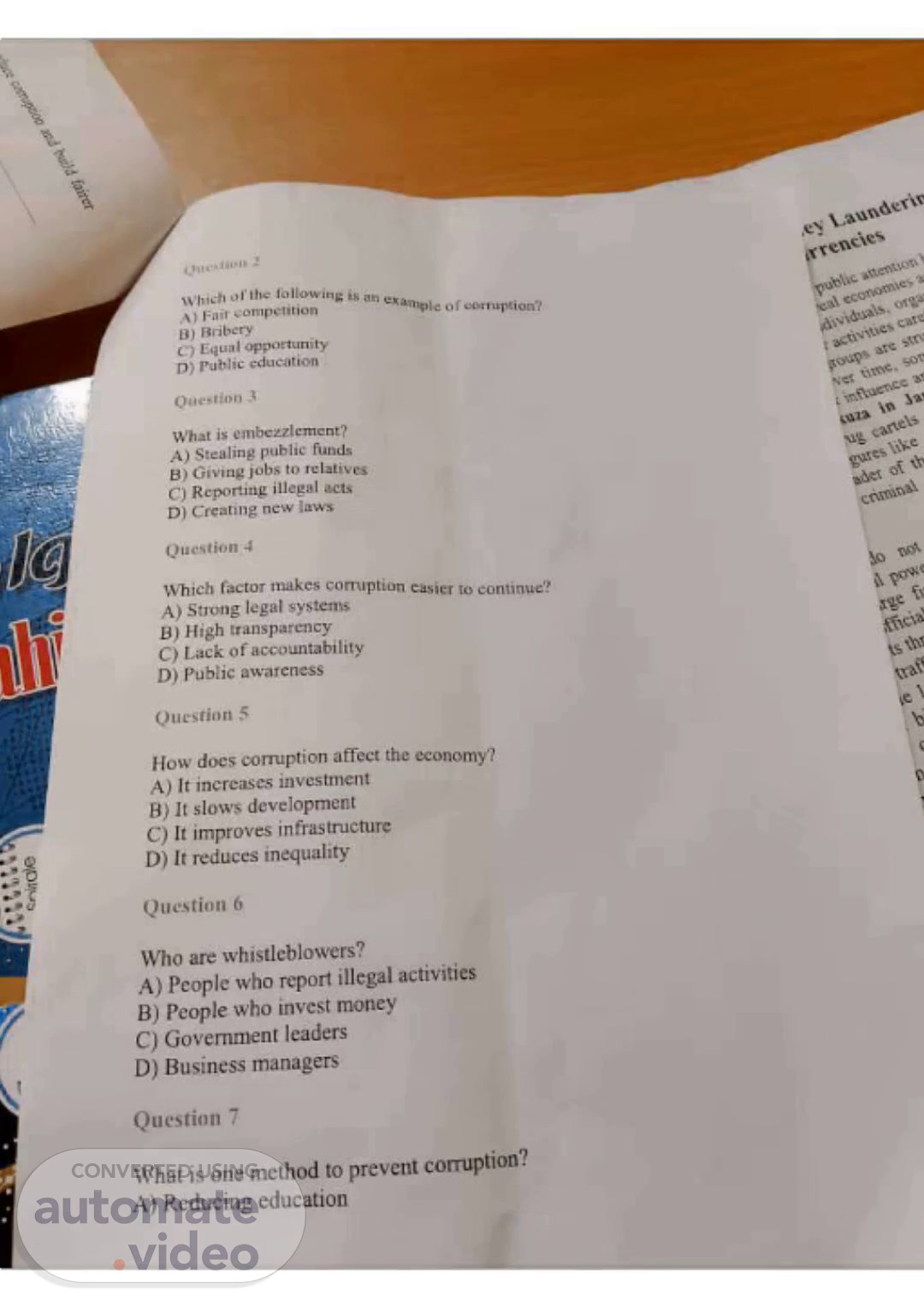
€4. Which of thc iöllowing is an example of corruption? B) Bribery C) Equal opportunity D) Public education Question What is embezzlement? A) Stealing public funds B) Giving jobs to relatives C) Reporting illegal acts D) Creating new laws Question 4 Which factor makes corruption easier to continue? A) Strong legal systems B) High transparency C) Lack Of accountability D) Public awareness Question 5 How does corruption affect the economy? A) It increases investment B) It slows development C) It improves infrastructure D) It reduces inequality Question 6 Who are whistleblowers? A) People who report illegal activities B) People who invest money C) Government leaders D) Business managers Question 7 mut is one method to prevent con-uption? A) Reducing education.
Scene 2 (2m 6s)
[Audio] Today, we will be discussing various aspects and examples of corruption, including embezzlement, bribery, and the effects of corruption on the economy. Our focus will be on ways to prevent corruption and how education can play a role in reducing it. First, let's define corruption as the abuse of power for personal gain, which can take many forms such as embezzlement, where someone in a position of trust takes money or assets for their own use. Another common form is bribery, where public officials are influenced or bought off for personal gain. Nepotism is also a form of corruption, where individuals in power show favoritism towards family members or friends, resulting in unfair advantages and hindering the progress of a fair and just society. Corruption can have a detrimental impact on institutions, eroding the trust of the public and leading to a lack of transparency and accountability. To combat corruption, it is essential to have a strong legal framework in place, including clear laws and regulations to prevent and punish corrupt acts. Enforcement of these laws is crucial, and there should be severe consequences for those who engage in corrupt activities. Whistleblowers play a vital role in exposing corruption and holding those accountable. They are individuals who report corruption or illegal activities within an organization, and it is essential to have protections in place for them to prevent retaliation. Additionally, corruption has a significant impact on the economy as it discourages investment and creates inequality, damages public trust, and leads to a decline in public services and infrastructure. To prevent corruption, there is a need for awareness and education. By educating individuals from a young age about the dangers of corruption and its effects on society, we can promote a culture of integrity and ethical behavior. Furthermore, international cooperation is essential in the fight against corruption. Working together with other countries to share best practices, information, and resources can help prevent corruption on a global scale..
Scene 3 (4m 25s)
[Audio] Today, we will be discussing the prevalent issue of corruption in society. On this slide, we will explore various aspects of corruption, including examples and its impact on the economy. Let's begin by defining corruption as the misuse of public power for personal gain. This can take different forms, such as embezzlement, bribery, and political corruption. Understanding these forms is crucial in identifying and preventing them. One consequence of corruption is the detention of individuals who speak out against it, violating their basic human rights. Another consequence is the restriction of freedom of expression, hindering accountability and the ability to address corruption. Additionally, corruption contributes to political instability and worsens inequality, benefiting corrupt individuals at the expense of the public. Economic development is also hindered by corruption, as resources are misused and misallocated, leading to economic sanctions by international organizations. It is important for individuals and governments to be held accountable for corrupt practices to restore trust and prevent future corruption. Ultimately, corruption goes against the principles of human dignity, exploiting vulnerable individuals and depriving them of their basic rights. Let's now test your understanding with some multiple-choice questions. Human rights violations are failures to respect basic human rights, and discrimination is the unfair treatment based on race, gender, or other factors..
Scene 4 (6m 3s)
[Audio] In this slide, we will be discussing the various forms and effects of corruption. Corruption is a serious issue that not only affects individual lives, but also the economy as a whole. One example of corruption is embezzlement, where individuals in positions of power use their authority to steal public funds for personal gain. This has a direct impact on the economy, as it diverts resources away from public services and development. Bribery is another common form of corruption, where individuals offer or accept money or gifts in exchange for favors or influence. This creates an unfair advantage for those with more resources and undermines equality. The consequences of corruption on the economy include a decrease in foreign investment and slower economic growth. Corruption also leads to a lack of trust in institutions and government, causing social tensions and instability. Poverty, lack of education, and limited opportunities can make individuals more susceptible to corruption, resulting in human rights violations. This can lead to fear and tension within society. International organizations and NGOs play a crucial role in monitoring and reporting human rights violations, working towards a more just and equal society. As citizens, it is our responsibility to speak out against corruption and hold our governments and institutions accountable. Thank you for your attention, and we will continue with our presentation on slide number 5..
Scene 5 (7m 41s)
[Audio] Slide number 5 out of 14 is up next. Our fifth slide will discuss the crucial role of education in preventing violations. Corruption is a complex issue that affects all aspects of society, from governmental institutions to individual citizens. To effectively combat it, we must understand its root causes. As seen in previous slides, corruption takes various forms, such as embezzlement and bribery. This not only undermines democracy and the rule of law, but it also has a significant impact on the economy. So, why is education essential in preventing violations? The answer is simple but powerful. Education empowers individuals and societies to recognize their rights and stand up against corruption. It equips people with the knowledge and tools to hold those in positions of power accountable for their actions. Additionally, education plays a crucial role in promoting transparency and accountability. By educating citizens, we can create a culture that values integrity and ethical behavior, making it harder for corruption to thrive. On a larger scale, education can contribute to the development of strong and effective legal and institutional frameworks. It provides the necessary skills to build and maintain a fair and just society where corruption is not tolerated. In summary, education is one of the most powerful tools in the fight against corruption. By increasing awareness and understanding, we can prevent violations and create a brighter and more just future for all. Let's now move on to our next slide to explore more examples and ways to prevent this destructive issue..
Scene 6 (9m 28s)
[Audio] Today, our presentation will focus on the topic of corruption. We will discuss various aspects and examples, including embezzlement, bribery, and the impact of corruption on the economy. Additionally, we will cover ways to prevent corruption and its effects on financial systems and the rule of law. Slide 6 will examine the involvement of organized crime and criminal networks in corrupt activities. These groups aim to generate profits while concealing their illegal actions through money laundering and financial organizations. For those in the field of law, understanding how organized crime operates is crucial in safeguarding financial systems, upholding the rule of law, and preventing criminal networks from exploiting the global economy. To aid in this understanding, we have compiled a legal vocabulary list in both English and Arabic. This list includes terms such as organized crime, criminal network, drug trafficking, and human trafficking, as well as terms related to modern forms of currency and technology used in criminal activities. It's important to note that these terms may differ in different countries, but our goal is to provide a comprehensive understanding of the language used in this field. By learning these terms, we can better equip ourselves to combat corruption and protect our financial systems. This includes collaborating with financial intelligence units and law enforcement agencies to identify and prosecute those involved in organized crime and money laundering. We hope this vocabulary list will be a valuable resource for your studies and professional careers. Together, let's strive for a transparent and just society, free from the damaging effects of corruption..
Scene 7 (11m 21s)
[Audio] We will now discuss one method to prevent corruption on slide number 7. Corruption can take different forms such as embezzlement, bribery, and nepotism. One reason why it persists in many societies is the lack of accountability. When individuals are not held responsible for their actions, corruption becomes easier to continue. The next question asks which factor makes corruption easier to continue, with the correct answer being C) Lack of accountability. Moving on to question 5, we are asked about the effects of corruption on the economy. It is widely known that corruption has a negative impact on economic development, slowing down progress and leading to inequalities. The correct answer for this question is B) It slows development. Another important factor in preventing corruption is whistleblowers, who are individuals that report illegal activities. They play a crucial role in bringing corruption to light and holding those responsible accountable. Moving on to the last question for this slide, we are asked about one method to prevent corruption, with the answer being education. By providing public education and raising awareness about corruption, we can reduce its prevalence. The correct answer is A) Reducing education. Let's now move on to the next slide for further examples and discussions on corruption..
Scene 8 (12m 47s)
[Audio] Slide number 8 focuses on methods to prevent corruption. One effective method is whistleblowing, where individuals report illegal activities in government or business. Whistleblowers play a crucial role in exposing corruption and holding those responsible accountable. Corruption is defined as the misuse of power for personal gain. Today, we will specifically discuss embezzlement, bribery, and the effects of corruption on the economy. Embezzlement is the theft of public funds and is often carried out by those in positions of power. This can have devastating effects on economies, especially in developing countries where these funds are needed for growth. Bribery involves offering or accepting something of value in exchange for a favor and perpetuates a cycle of corruption and dishonesty. Lack of accountability makes it easier for corruption to continue. Strong legal systems and transparency are important in combating corruption. Corruption slows development and negatively impacts society as a whole by widening the gap between the rich and the poor. Another effective method to prevent corruption is through public education, creating a society that values honesty and integrity. In conclusion, corruption undermines the foundations of a fair and just society..
Scene 9 (14m 10s)
[Audio] Now, let's focus on slide number 9 which discusses the topic of organized crime and its connection to corruption. Corruption can take various forms, such as embezzlement and bribery. One of the most concerning aspects of corruption is its association with organized crime groups. Our first question is what is the primary goal of these groups? The options are A) political retarm, B) profit and power, C) education, or D) scientific research. The correct answer is B) profit and power. Organized crime groups are primarily motivated by financial gain and gaining control and influence over others. Moving on to our second question, which activity is commonly linked to organized crime? The options are A) drug trafficking, B) legal trade, C) public administration, or D) education services. The correct answer is A) drug trafficking. This illegal activity serves as a major source of income for organized crime groups. Our third question asks why criminal organizations engage in money laundering. The options are A) to hide the illegal origin of money, B) to increase taxes, C) to create new currencies, or D) to reduce financial transactions. The correct answer is A) to hide the illegal origin of money. Money laundering enables criminals to disguise their illegal funds as legitimate. Lastly, our final question for this slide is what is the first stage of money laundering? The options are A) integration, B) investment, C) layering, or D) placement. The correct answer is D) placement, which is the initial stage of introducing illegal funds into the financial system. These multiple-choice questions provide examples of the connection between organized crime and corruption. Understanding the tactics and motivations of criminal organizations is crucial in effectively combating corruption. Thank you for your attention and let's move on to the next slide..
Scene 10 (16m 22s)
[Audio] Today's presentation focuses on organized crime and its role in corruption. Organized crime involves groups or networks that engage in illegal activities for financial gain, such as drug trafficking, human trafficking, and arms smuggling. These criminal networks often use money laundering and other financial techniques to hide their illegal profits and integrate them into the financial system. It is crucial for law students to understand how organized crime operates in order to protect our financial systems and strengthen the rule of law. To aid in this understanding, a legal vocabulary list in both English and Arabic has been provided, including terms related to organized crime, financial systems, and corruption. Some important terms to know are placement, integration, tax evasion, and cryptocurrency. Combatting organized crime and its involvement in corruption requires the implementation of anti-money laundering measures, such as financial intelligence units and law enforcement agencies. As future legal professionals, it is essential to be aware of these measures and their role in maintaining the integrity of our financial systems. In conclusion, organized crime poses a threat to the global economy and understanding the legal vocabulary related to it is key for preventing and combatting this issue. Thank you for your attention. Please refer to the legal vocabulary list for further study..
Scene 11 (17m 52s)
[Audio] In discussing corruption, it is important to examine specific examples and the effects of this widespread issue. Embezzlement, bribery, and other forms of corruption can have detrimental impacts on both the economy and society as a whole. To address this problem, it is crucial to first understand its underlying causes and then take appropriate measures to prevent it. One common type of corruption is embezzlement, where someone misuses entrusted funds for personal gain. This can occur in both the private and public sectors, resulting in a depletion of resources and damaging the trust between institutions and the public. Another prevalent example is bribery, where gifts or money are given or received in exchange for desired outcomes. Not only does this undermine fair competition, but it also impedes the development and progress of a society. Corruption also directly affects the economy, as the misuse of resources or allocation based on bribery rather than merit can hinder economic growth and contribute to income inequality. Furthermore, the lack of transparency and accountability in corrupt systems can discourage foreign investments and further hinder economic development. One solution to combat this problem is to replace corrupt individuals in positions of power with those who possess integrity and a commitment to upholding ethical standards. Additionally, increasing transparency and accountability through measures such as public audits can help prevent corruption. It is also crucial to educate the public about the negative effects of corruption and involve citizens in fighting against it. By raising awareness and promoting a culture of honesty and integrity, we can take a step towards a more just and equitable society. As we have seen, corruption takes different forms and has far-reaching consequences. It is everyone's responsibility to stand against it and work towards a society free from corruption. Let us continue to strive for transparency, accountability, and ethical leadership in order to build a better future for all..
Scene 12 (20m 6s)
[Audio] We have now reached slide number 12 out of 14 in our presentation on corruption. This slide discusses various examples and effects of corruption that are prevalent in today's society. We will take a closer look at each one. Embezzlement, the misuse or theft of funds by those in positions of power, can have serious consequences for businesses and governments. It can lead to financial losses and damage trust from the public. Bribery, the exchange of something of value for an unfair advantage, exists in various forms and can involve high-ranking officials. It not only undermines fair competition, but also undermines the integrity of our institutions. Corruption can have a negative impact on the economy by misusing or redirecting resources for personal gain, resulting in economic instability and hindering a country's development. That is why it is crucial to address and prevent corruption in all its forms. Corruption often persists due to control and enablement by governments. This must be addressed at the highest levels in order to effectively combat corruption. One approach to preventing corruption is by promoting transparency and accountability in financial transactions. This can include monitoring and enforcing laws and regulations, as well as promoting ethical practices in both public and private sectors. It is important to note that the purpose of this slide is not to encourage illegal trade, replace banks, or increase corruption, but to remind us to monitor and prevent financial crimes, such as corruption, in order to create a fair and just society. To conclude, corruption takes many forms and can have devastating effects on individuals, businesses, and entire economies. It is the responsibility of all to work towards preventing and eliminating corruption in all its forms. Thank you for your attention..
Scene 13 (22m 9s)
[Audio] Slide number 13 will cover the various types of corruption and their impact on the economy. Corruption is a significant problem that not only affects the government but also businesses and individuals. Embezzlement, the misuse of funds for personal gain, is one of the most common forms of corruption. It often occurs in public offices where those in charge have access to large sums of money. Another form is bribery, where money or favors are exchanged for a desired outcome. This can happen in different contexts, such as business deals or the hiring process. Bribery creates an unfair advantage and undermines fairness and integrity. The consequences of corruption on the economy are severe. It hinders growth and development by diverting funds away from essential projects and services such as healthcare, education, and infrastructure. Corruption also creates an unfavorable business environment, discouraging investors and hampering progress. To prevent corruption, we must increase transparency and accountability. Governments and organizations should have strict protocols in place for handling funds and punishing corrupt behavior. Additionally, we must all take responsibility and refuse to participate in corrupt practices. It is crucial to replace corruption with honesty and integrity, requiring a collective effort from both the government and citizens. By promoting a culture of transparency and accountability, we can combat corruption and create a fair society. We must not turn a blind eye to corruption and be vigilant in reporting any suspicious activities or individuals to the proper authorities. Together, we can create a more ethical society free from the detrimental effects of corruption..
Scene 14 (24m 6s)
[Audio] As we reach the final slide of our presentation, we will now delve into the topic of corruption. Throughout this presentation, we have covered various aspects and examples of this societal issue, including embezzlement, bribery, and the impact of corruption on the economy. On this last slide, we will briefly touch upon potential solutions and ways to prevent corruption. However, before we do so, let us take a moment to look at the text displayed on the screen. It mentions individuals such as "Chapo," "Lucky," and "Why can," who are all examples of corrupt individuals who have gained power and wealth through illegal means. Unfortunately, these individuals are prevalent and often under the control of governments. The text also mentions the potential benefits of these corrupt actions, such as promoting illegal trade or replacing banks. However, we must remember that these actions only contribute to the increase of corruption and ultimately harm the economy in the long run. So, what is the purpose of monitoring and preventing financial corruption? It is not to replace banks or encourage illegal trade, as the text suggests. The true purpose is to eliminate corruption and safeguard the economy and society from its detrimental effects. As educators and students in higher education, it is our responsibility to raise awareness about corruption and find ways to prevent it. By promoting ethical and transparent practices, we can contribute to a fairer and more just society. With that being said, we have reached the end of our presentation. I want to express my gratitude to all of you for your attention and participation. Let us continue to learn and work towards a world free from corruption. Thank you..