Scene 1 (0s)
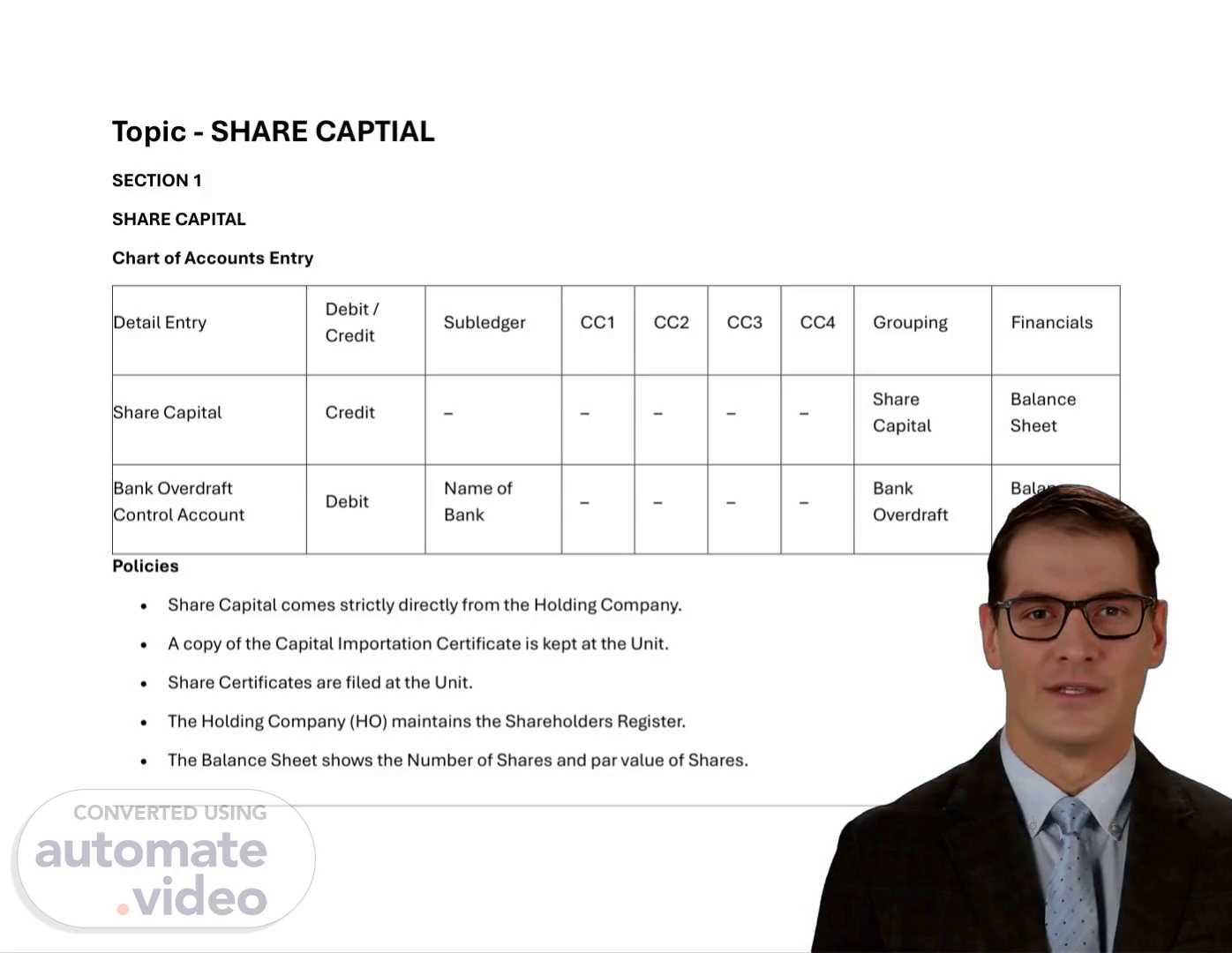
[Virtual Presenter] The share capital of a company is recorded on a specific chart of accounts entry. The source of the share capital is documented, including its origin from the parent company. Specific policies govern the management of share capital, which include storing relevant documents such as the capital importation certificate and filing share certificates. The balance sheet provides a detailed breakdown of the current share capital, including the total number of shares and their respective values. Accurate financial records are essential for maintaining the integrity of the company's financial statements..
Scene 2 (36s)
[Audio] The company issues shares at a premium, which means that the market value of the shares exceeds their face value. For example, if a company issues 1000 shares with a par value of $10 each, but sells them for $15 each, the market value of the shares is $15. The premium is the difference between the market value and the par value. In this case, the premium is $5 per share. The company records the premium in the Balance Sheet under the Share Premium account. This occurs when shares are issued at a price higher than their par value. The premium amount is then allocated to this specific account rather than being added to the Share Capital. As a result, Share Premium appears as a separate component within the Equity section of the Balance Sheet. Furthermore, the Balance Sheet also displays the total number of shares issued on premium and the corresponding premium per share. This information provides insight into the financial implications of issuing shares at a premium. The accounting treatment for issuing shares at a premium involves several steps. First, the company must determine the number of shares to be issued and the par value of each share. Next, the company calculates the market value of the shares by multiplying the par value by the number of shares to be issued. Finally, the company records the premium in the Balance Sheet under the Share Premium account. The premium amount is then allocated to this specific account rather than being added to the Share Capital. The accounting treatment for issuing shares at a premium can vary depending on the jurisdiction and the type of shares being issued. However, the general principle remains the same: the premium is recorded in the Balance Sheet under the Share Premium account. The premium amount is then allocated to this specific account rather than being added to the Share Capital. In some cases, the company may choose to record the premium as an expense in the Income Statement instead of recording it in the Balance Sheet. This approach is often used when the company has already paid for the shares and wants to recognize the cost of the shares immediately. However, this approach is not always necessary and may require additional disclosure in the Financial Statements. The accounting treatment for issuing shares at a premium should be carefully considered to ensure compliance with relevant accounting standards and regulations. Companies should consult with their auditors or accountants to determine the most appropriate accounting method..
Scene 3 (3m 7s)
[Audio] The unit will make a separate transfer to pay dividend. No set off with other accounts will be allowed. The unit will make a separate transfer to pay dividend. No set off with other accounts will be allowed. The unit will make a separate transfer to pay dividend. No set off with other accounts will be allowed. The unit will make a separate transfer to pay dividend. No set off with other accounts will be allowed. The unit will make a separate transfer to pay dividend. No set off with other accounts will be allowed. The unit will make a separate transfer to pay dividend. No set off with other accounts will be allowed. The unit will make a separate transfer to pay dividend. No set off with other accounts will be allowed. The unit will make a separate transfer to pay dividend. No set off with other accounts will be allowed. The unit will make a separate transfer to pay dividend. No set off with other accounts will be allowed. The unit will make a separate transfer to pay dividend. No set off with other accounts will be allowed. The unit will make a separate transfer to pay dividend. No set off with other accounts will be allowed. The unit will make a separate transfer to pay dividend. No set off with other accounts will be allowed. The unit will make a separate transfer to pay dividend. No set off with other accounts will be allowed. The unit will make a separate transfer to pay dividend. No set off with other accounts will be allowed. The unit will make a separate transfer to pay dividend. No set off with other accounts will be allowed. The unit will make a separate transfer to pay dividend. No set off with other accounts will be allowed. The unit will make a separate transfer to pay dividend. No set off with other accounts will be allowed. The unit will make a separate transfer to pay dividend. No set off with other accounts will be allowed. The unit will make a separate transfer to pay dividend. No set off with other accounts will be allowed. The unit will make a separate transfer to pay dividend. No set off with other accounts will be allowed. The unit will make a separate transfer to pay dividend. No set off with other accounts will be allowed. The unit will make a separate transfer to pay dividend. No set off with other accounts will be allowed. The unit will make a separate transfer to pay dividend. No set off with other accounts will be allowed. The unit will make a separate transfer to pay dividend. No set off with other accounts will be allowed. The unit will make a separate transfer to pay dividend. No set off with other accounts will be allowed. The unit will make a separate transfer to pay dividend. No set off with other accounts will be allowed. The unit will make a separate transfer to pay dividend. No set off with other accounts will be allowed. The unit will make a separate transfer to pay dividend. No set off with other accounts will be allowed. The unit will make a separate transfer to pay dividend. No set off with other accounts will be allowed. The unit will make a separate transfer to pay dividend. No set off with other accounts will be allowed. The unit will make a separate transfer to pay dividend. No set off with other accounts will be allowed. The unit will make a separate transfer to pay dividend. No set off with other accounts will be allowed. The unit will make a separate transfer to pay dividend. No set off with other accounts will be allowed. The unit will make a separate transfer to pay dividend. No set off with other accounts will be allowed. The unit will make a separate transfer to pay dividend. No set off with other accounts will be allowed. The unit will make a.
Scene 4 (6m 43s)
[Audio] The text rewritten in full sentences only, removing greetings and introduction sentences, and thanking sentences is as follows: Under Debit, we have the Name of Unit followed by Intercompany, Other Debtors, Balance Sheet, Dividend Receivable Control Account, and Overseas Interface Control Account. On the other hand, under Credit, we have Intercompany, Trade Creditors, Balance Sheet, Group HO Interface Account, and Overseas Interface Control Account. Moving on to the next section, we have Debit which includes Intercompany, Trade Creditors, Balance Sheet, Group HO Interface Account, and Overseas Interface Control Account. Lastly, under Credit, we have Purchase H Account which will be passed by HO immediately with dividend declaration entry. It is also important to note that HO accounts will inform BPO immediately after dividend declaration by the Unit. This entry will be recorded in the Dubai Books (Group HO) Chart of Accounts..
Scene 5 (7m 48s)
[Audio] The detail entry section allows users to record debit and credit transactions for various subledgers such as CC1, CC2, CC3, and CC4. These subledgers group financial data according to different categories, including financials, overseas interface, control accounts, and grouping. Debit entries are recorded under the Afro-Asian interface account, while credit entries are recorded under the same account. Intercompany trade transactions are also tracked through this section. The balance sheet reflects debtors and creditors balances, with dividend received and loan from shareholders accounted for separately. This entry is automatically generated by BPO upon receipt of information from Nigeria HO..
Scene 6 (8m 39s)
[Audio] The company has been declared bankrupt by the court. The company has been dissolved and all assets are now owned by the shareholders. The shareholders are required to pay back the loans made to the company by the creditors. The shareholders must also pay the dividends to the employees who received them as part of their employment contract. The shareholders must also pay the interest on the loans made to the other creditors. The shareholders must also pay the taxes owed by the company. The shareholders must also pay the costs associated with the bankruptcy proceedings. The shareholders must also pay the legal fees incurred during the bankruptcy proceedings. The shareholders must also pay the costs associated with the winding up of the company..
Scene 7 (9m 23s)
[Audio] The details of this entry include Debit and Credit transactions related to various financial activities such as Purchase H Account, Intercompany Trade, Short Term Loans, Holding Company, and other debtors and creditors. These entries are grouped under the Financials grouping and are subject to Overseas Interface control. The Name of Unit and Name of Holdco fields are used to identify specific units or companies involved in these transactions. The Intercompany Funding Account and Intercompany Trade Debtors Balance Sheet are also affected by these entries. The Dubai Books on receipt of payment are recorded using Chart of Accounts Entry. This entry is part of the overall accounting process and is necessary for accurate financial reporting..
Scene 8 (10m 11s)
[Audio] The process for clearing expenses involves several steps including the import of trading items such as raw materials and spare parts from various sources including African commodities and carbon commodities. This is done through the use of specific chart of accounts entries which allow for the tracking and management of these expenses. One key entry is the detail entry under the subledger CC1, where the nature of purchases is specified. This information is critical in determining the correct accounting treatment for the expense. Another important entry is the grouping of financials under CC4, which enables the calculation of the advance price for the purchased items. The advance price is then used to calculate the debit amount for the expense. Additionally, the shipping file number and vessel name are also recorded to ensure accurate tracking and payment of the expenses. These entries work together to provide a clear and transparent record of all expenses incurred during the import process..
Scene 9 (11m 8s)
[Audio] ## Step 1: Identify the main purpose of each field The fields on this slide provide detailed information about certain transactions. ## Step 2: Describe the content of each field CC1 represents the import form reference number, which can be found on the original document or invoice related to the transaction. CC2 includes the vessel name or shipping file number along with its corresponding monetary value. CC3 denotes the type of goods imported, ranging from raw materials to trading items, consumables, or spare parts. CC4 indicates the value of the purchased goods based on the invoice provided. ## Step 3: Explain the policies section The policies section outlines the method for determining the cost of these transactions. In this case, the rate used is specified by finance for accounting purposes. The final answer is:.
Scene 10 (12m 8s)
[Audio] The process for importing trading items, raw materials, spare parts, or consumables from third-party suppliers involves several steps. First, the supplier's information is recorded, including their name and Form M number. Next, the nature of the purchases is identified, such as whether it is a trading item, raw material, spare part, or consumable. This information is then used to determine the correct accounting entry. The accounting entry includes debits and credits to various subledgers, which record the transactions in different areas of the financial system. The specific details of the transaction are captured using the Chart of Accounts, where each line represents a unique account code. The accounts used depend on the type of transaction, such as imports, advances, and prepayments. The accounting entry also requires the identification of the supplier, the vessel or shipping file number, and the purchase price. Finally, the accounting entry is grouped into financial statements, such as the Balance Sheet, to provide a comprehensive view of the company's financial position..
Scene 11 (13m 18s)
[Audio] The Import Form Reference Number (CC1) is used to identify the specific import form used for each transaction. The Shipping File Number/Vessel Name (CC2) identifies the vessel or shipping file associated with the import. The Nature of Purchases (CC3) categorizes the type of goods imported into different categories. The Purchase Price (CC4) indicates the value of the purchased goods based on the invoice. The policy statement regarding the use of rates from Finance for costing purposes is included in CC4. The rate to be used should be the one provided by Finance for costing purposes..
Scene 12 (14m 2s)
[Audio] The process of importing capital items from African and Carbon companies requires careful consideration of various factors including the type of goods being imported, the value of the goods, and the applicable tax laws. The transaction must be recorded in the company's accounting system, which involves debiting the appropriate accounts and crediting other relevant accounts. The main objective is to accurately record the purchase price and the subsequent movement of these assets into the company's balance sheet. The chart of accounts provides a framework for this process, outlining specific fields such as the form number, vessel name, and nature of purchases. Accurate documentation of these transactions is crucial for maintaining accurate financial records and ensuring compliance with regulatory requirements. Properly documenting these transactions enables the company to maintain transparency and accountability in its financial dealings..
Scene 13 (14m 59s)
[Audio] The fields on this slide provide detailed information about the import of assets into the company. The first field, CC1, represents the Import Form Reference Number, which can be found on the relevant documentation. The second field, CC2, includes both the Shipping File Number and the Vessel Name, providing essential details about the shipment. The third field, CC4, indicates the Purchase Price of the asset, based on the invoice received. The fourth field, CC3, describes the type of asset being imported, such as Plant & Machinery, Vehicles, or Equipment. Additionally, the policies section outlines the method for determining the cost of these assets, using the rates provided by Finance. This information is crucial for accurate accounting and financial reporting..
Scene 14 (15m 51s)
[Audio] The process for importing capital items from third parties involves several steps. First, a supplier's Form M number is recorded in the system, which serves as a unique identifier for the transaction. This information is then linked to the corresponding shipping file number and vessel name. Next, the nature of the purchased asset is identified, such as plant and machinery, vehicle, or equipment. The purchase price is also captured, based on the invoice provided by the supplier. Finally, the asset is accounted for under the balance sheet, where it is classified as either work-in-progress or capital. The system ensures accurate tracking and management of these transactions, allowing for efficient financial reporting..
Scene 15 (16m 37s)
[Audio] The fields listed below describe the information required for importing assets into the system. The first field, Shipping File Number/Vessel Name, represents the unique identifier for the asset being imported. This can include either the vessel name or shipping file number, along with its corresponding monetary value. For example, MV Unity or AFL-123 - $10000. The second field, Nature of Assets, describes the type of capital item being imported. This can range from Plant & Machinery to Equipment and so on. The third field, Purchase Price, indicates the value of the capital item based on the invoice received. It's essential to note that the policies outlined specify the rates to be used for costing purposes. Specifically, finance charges are booked at 1.5% of the purchase order value of the unit. Additionally, if there are mixed shipments, each unit will pass through entry at 1.5% of the purchase order value of each unit. This ensures accurate tracking and valuation of assets within the system..
Scene 16 (17m 48s)
[Audio] The detail entry section is a critical component of the accounting system that enables users to record and track all types of financial transactions. This section allows for the recording of debit and credit entries, as well as the management of subledgers and various groupings within financial statements. The detail entry section is used to record and manage various types of financial transactions, including other finance charges, advance payments, and prepayments. It also records purchases, such as raw materials, trading items, consumables, and spare parts. Furthermore, it tracks credit transactions and control accounts. The detail entry section is an essential tool for accountants and bookkeepers who need to accurately record and report financial data..