Scene 1 (0s)
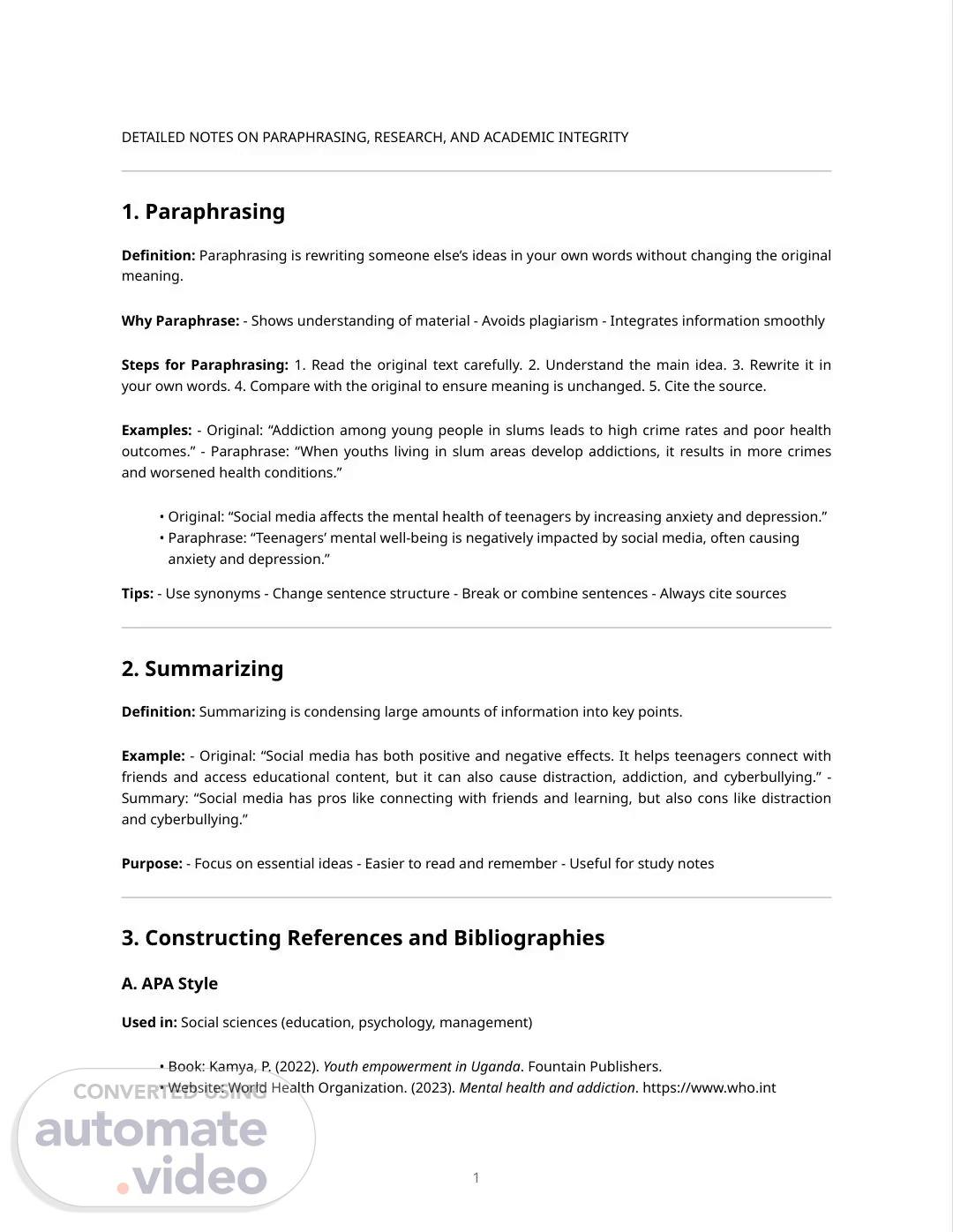
[Virtual Presenter] DETAILED NOTES ON PARAPHRASING, RESEARCH, AND ACADEMIC INTEGRITY 1. Paraphrasing Definition: Paraphrasing is rewriting someone else’s ideas in your own words without changing the original meaning. Why Paraphrase: - Shows understanding of material - Avoids plagiarism - Integrates information smoothly Steps for Paraphrasing: 1. Read the original text carefully. 2. Understand the main idea. 3. Rewrite it in your own words. 4. Compare with the original to ensure meaning is unchanged. 5. Cite the source. Examples: - Original: “Addiction among young people in slums leads to high crime rates and poor health outcomes.” - Paraphrase: “When youths living in slum areas develop addictions, it results in more crimes and worsened health conditions.” Original: “Social media affects the mental health of teenagers by increasing anxiety and depression.” Paraphrase: “Teenagers’ mental well-being is negatively impacted by social media, often causing anxiety and depression.” Tips: - Use synonyms - Change sentence structure - Break or combine sentences - Always cite sources 2. Summarizing Definition: Summarizing is condensing large amounts of information into key points. Example: - Original: “Social media has both positive and negative effects. It helps teenagers connect with friends and access educational content, but it can also cause distraction, addiction, and cyberbullying.” Summary: “Social media has pros like connecting with friends and learning, but also cons like distraction and cyberbullying.” Purpose: - Focus on essential ideas - Easier to read and remember - Useful for study notes 3. Constructing References and Bibliographies A. APA Style Used in: Social sciences (education, psychology, management) Book: Kamya, P. (2022). Youth empowerment in Uganda. Fountain Publishers. Website: World Health Organization. (2023). Mental health and addiction. https://www.who.int 1.
Scene 2 (2m 39s)
[Audio] B. MLA Style Used in: Literature, arts, humanities Book: Kamya, Peter. Youth Empowerment in Uganda. Fountain Publishers, 2022. Website: World Health Organization. Mental Health and Addiction. WHO, 12 May 2023, https:// www.who.int Notes: - APA uses author-date in-text citations: (Kamya, 2022) - MLA uses author-page in-text citations: (Kamya 45) 4. Academic Integrity and Avoiding Plagiarism Definition: Plagiarism is using someone else's work or ideas without giving credit. How to Avoid: - Paraphrase or summarize - Use quotation marks for direct quotes - Cite sources correctly Keep track of references - Plan work early Consequences: - Loss of grades - Damaged reputation - Disciplinary action Example: - Plagiarism: Copying text without citation. - Correct: "Teenagers' mental health is influenced by social media, often increasing anxiety (Kamya, 2022)." 5. Research Skills and Academic Honesty Practices Steps for Effective Research: 1. Define a research question 2. Use credible sources 3. Take organized notes 4. Paraphrase or summarize 5. Cite properly 6. Prepare a complete bibliography Example Topic: The Impact of Social Media on Teenagers - Search credible sources (WHO, peer-reviewed articles) - Understand the material - Write in own words: "Teenagers spending long hours on social media face higher risks of anxiety and low self-esteem (WHO, 2023)." - Include APA citation and reference list 6. Key Words and Meanings Term Meaning Example Credible Sources Trustworthy information WHO, UNICEF, peer-reviewed journals Paraphrasing Rewriting in own words "Social media increases stress" → "Stress levels may rise due to social media use" Summarizing Condensing ideas "Social media has pros and cons" 2.
Scene 3 (5m 14s)
[Audio] Term Meaning Example Citations Giving credit to sources (Kamya, 2022) APA/MLA Styles for referencing APA: social sciences; MLA: arts/humanities Bibliography List of sources used Books, articles, websites Plagiarism Using others' work without credit Copying text without citation 7. Resources for Learning Library or computer lab access Citation guides from teachers Sample annotated bibliographies Online tools: Google Scholar, ResearchGate, WHO, UNICEF Tip: Keep a research notebook for sources, paraphrases, and summaries. 8. Final Tips for Research Success Plan research early Focus on understanding, not copying Ask teachers for help if unsure Practice paraphrasing and summarizing Keep work organized and neat Respect academic rules to maintain integrity and reputation 3.