Agentforce And Prompt builder


Scene 2 (0s)
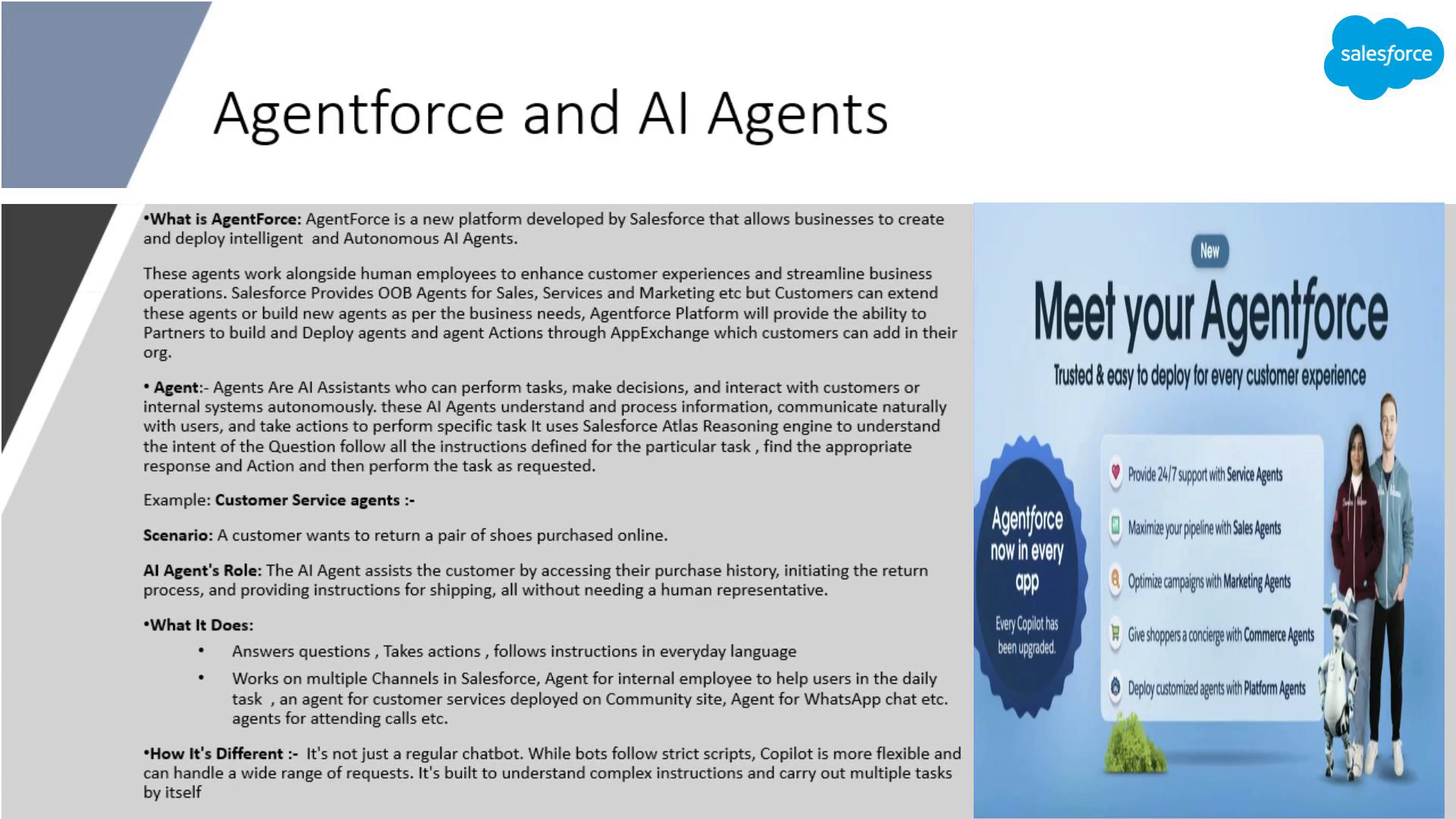
[Audio] The AI-powered agents use a combination of natural language processing (NLP) and machine learning algorithms to understand and respond to user queries. The NLP component enables the agent to comprehend the nuances of human language, such as idioms, colloquialisms, and figurative expressions. Machine learning algorithms allow the agent to learn from interactions and improve its performance over time. This enables the agent to provide more accurate and personalized responses to users..
Scene 3 (39s)
[Audio] The first step in a successful marriage is building strong foundations, which includes communication, trust, and mutual respect. Communication is key to understanding each other's needs, desires, and feelings. Trust is built when both partners are honest with each other and follow through on their commitments. Mutual respect is essential for creating an environment where both partners feel valued and appreciated. Without these three elements, a marriage can quickly deteriorate into conflict and unhappiness. Trust is not just about being faithful, but also about being reliable, dependable, and consistent. A partner who is trustworthy will always be there for their spouse, no matter what challenges they face. In today's world, it is easy to get caught up in the idea that relationships require perfection, but nothing is perfect, and imperfections are a natural part of any relationship. The key is to learn to accept and forgive each other's flaws and mistakes. Mutual respect is not just about treating each other well, but also about valuing each other's opinions and perspectives. When both partners value each other's thoughts and feelings, they create a safe and supportive environment where both can grow and thrive. This type of relationship is built on a foundation of love, care, and compassion. Without mutual respect, a marriage can become stagnant and unfulfilling. Communication is essential for resolving conflicts and strengthening the bond between two people. Effective communication helps to prevent misunderstandings and miscommunications that can lead to conflict. When both partners communicate openly and honestly, they can resolve issues quickly and efficiently. This type of communication is built on a foundation of active listening, empathy, and understanding. By practicing effective communication, couples can build a stronger and more resilient relationship. Trust is not something that can be taught, but rather it is something that develops over time. With patience, effort, and commitment, trust can be built between two people. However, if trust is broken, it may take a long time to repair. Therefore, it is essential to work together as a team to maintain and strengthen trust. This requires open communication, honesty, and transparency. By working together, couples can build a strong foundation of trust that will last a lifetime. Mutual respect is not something that can be forced, but rather it is something that grows naturally over time. With consistent effort and dedication, mutual respect can develop between two people. However, if mutual respect is lacking, it can lead to feelings of resentment and frustration. Therefore, it is essential to prioritize mutual respect in every aspect of the relationship. This requires active listening, empathy, and understanding. By prioritizing mutual respect, couples can build a strong foundation of love and appreciation that will last a lifetime. Communication is essential for building a strong and healthy relationship. Effective communication helps to prevent misunderstandings and miscommunications that can lead to conflict. When both partners communicate openly and honestly, they can resolve issues quickly and efficiently. This type of communication is built on a foundation of active listening, empathy, and understanding. By practicing effective communication, couples can build a stronger and more resilient relationship. Trust is not something that can be taught, but rather it is something that develops over time. With patience, effort, and commitment, trust can be built between two people. However, if trust is broken, it may take a long time to repair. Therefore, it is essential to work together as a team to maintain and strengthen trust. This requires open communication, honesty, and transparency. By working together, couples can build a strong foundation of trust that will last a lifetime. Mutual respect is not something that can be forced, but rather it.
Scene 4 (5m 2s)
[Audio] The agentforce tool is used to build pre-built Salesforce agents. These agents can automate tasks such as sending emails, making calls, and updating records. Businesses can use this tool to streamline their workflow and improve efficiency. The tool is particularly useful for companies with multiple agents working on different projects simultaneously. With the tool, these agents can work together seamlessly, automating repetitive tasks and freeing up time for more strategic activities. This enables companies to focus on higher-level tasks, such as customer engagement and relationship-building. The tool also provides real-time monitoring and reporting, allowing businesses to track progress and identify areas for improvement. As a result, the tool optimizes business operations and improves productivity..
Scene 5 (5m 55s)
[Audio] ``` The customer service representative will guide you through the process of creating an account. They will ask you questions about your personal details such as name, email address, password, etc. You should provide accurate and complete information. The representative will then create an account for you based on the information provided. If there are any issues with the account creation process, the representative may contact you via phone or email to resolve the issue. ``` Here is the rewritten text: The customer service representative will guide you through the process of creating an account. They will ask you questions about your personal details such as name, email address, password, etc. You should provide accurate and complete information. The representative will then create an account for you based on the information provided. If there are any issues with the account creation process, the representative may contact you via phone or email to resolve the issue..
Scene 6 (6m 55s)
[Audio] As you continue to explore the capabilities of the Agentforce And Prompt builder, you will notice that the interface is designed to be user-friendly and intuitive. We can see a clear representation of the features and tools available, making it easier to navigate and understand the functionality of the system. The screenshot provided gives us a visual representation of the features and options available, allowing us to see how they can be utilized to build and train AI models. This visual representation is a key aspect of the system, as it enables users to grasp the concepts and features more effectively. By leveraging this visual aid, users can better comprehend the intricacies of the Agentforce And Prompt builder and make informed decisions about how to utilize its capabilities. We can see that the system is designed to provide a comprehensive understanding of the features and tools available, making it an ideal platform for those looking to build and train AI models. The visual representation of the features and options available allows users to quickly grasp the concepts and features, making it easier to navigate and understand the functionality of the system. This visual representation is a key aspect of the system, as it enables users to comprehend the intricacies of the Agentforce And Prompt builder and make informed decisions about how to utilize its capabilities. We can see that the system is designed to provide a comprehensive understanding of the features and tools available, making it an ideal platform for those looking to build and train AI models. By leveraging this visual aid, users can better comprehend the intricacies of the Agentforce And Prompt builder and make informed decisions about how to utilize its capabilities. This visual representation is a key aspect of the system, as it enables users to comprehend the intricacies of the Agentforce And Prompt builder and make informed decisions about how to utilize its capabilities. We can see that the system is designed to provide a comprehensive understanding of the features and tools available, making it an ideal platform for those looking to build and train AI models. The visual representation of the features and options available allows users to quickly grasp the concepts and features, making it easier to navigate and understand the functionality of the system. This visual representation is a key aspect of the system, as it enables users to comprehend the intricacies of the Agentforce And Prompt builder and make informed decisions about how to utilize its capabilities. We can see that the system is designed to provide a comprehensive understanding of the features and tools available, making it an ideal platform for those looking to build and train AI models. By leveraging this visual aid, users can better comprehend the intricacies of the Agentforce And Prompt builder and make informed decisions about how to utilize its capabilities. This visual representation is a key aspect of the system, as it enables users to comprehend the intricacies of the Agentforce And Prompt builder and make informed decisions about how to utilize its capabilities. We can see that the system is designed to provide a comprehensive understanding of the features and tools available, making it an ideal platform for those looking to build and train AI models. The visual representation of the features and options available allows users to quickly grasp the concepts and features, making it easier to navigate and understand the functionality of the system. This visual representation is a key aspect of the system, as it enables users to comprehend the.
Scene 7 (10m 37s)
[Audio] The concept of Agentforce is centered around providing personalized coaching to Salesforce agents through AI-driven tools. This coaching focuses on enhancing their sales skills, particularly in areas such as pitching, handling objections, and negotiation. The system offers realistic role-plays tailored to each individual's specific deals, allowing for more effective practice and improvement. Agentforce provides consistent, objective feedback on strengths, weaknesses, and areas for growth, all grounded in CRM data. By connecting coaching to sales results, users can easily assess the impact of this coaching on their performance. Furthermore, the system enables easy analysis of ROI by comparing win/loss rates of deals with and without coaching. Overall, Agentforce aims to optimize sales performance by leveraging AI technology to provide targeted support to Salesforce agents..
Scene 8 (11m 39s)
[Audio] The concept of Agentforce is centered around creating a platform that utilizes artificial intelligence (AI) to automate various tasks and improve efficiency within businesses, particularly those related to e-commerce and retail. The core idea revolves around three primary types of agents: Merchant Agent, Personal Shopper Agent, and Buyer Agent. Each type of agent serves a distinct function, leveraging AI to enhance customer experiences and streamline operations. For instance, the Merchant Agent can build and operate websites, handle common tasks, and analyze data to make informed decisions. In contrast, the Personal Shopper Agent acts as a digital concierge, providing personalized recommendations and guiding customers through their shopping journey. Lastly, the Buyer Agent offers an elevated purchasing experience by assisting customers in locating products, tracking order status, and reordering items. By integrating these AI-powered agents into existing business structures, companies can potentially increase productivity, reduce costs, and enhance overall customer satisfaction. This innovative approach has the potential to revolutionize the way businesses interact with their customers and manage their daily operations..
Scene 9 (13m 2s)
[Audio] Agents use various techniques to interact with users, such as natural language processing (NLP) and machine learning algorithms. One key technique is prompt engineering, where agents learn to recognize and respond to specific prompts or cues. This allows them to provide more accurate and relevant responses to user queries. By building effective prompts, agents can improve their performance and provide better customer service. In this case, the agent's response to the user's query about the phone with text on it would be informed by its understanding of the prompt and its ability to generate relevant information. The agent's goal is to provide helpful and informative responses that meet the user's needs..
Scene 10 (13m 46s)
[Audio] Agentforce is a powerful tool that enables businesses to create and manage promotions using conversational interfaces in natural language. With its co-pilot feature, users can automate tasks such as creating promotions and analyzing data to gain insights into their business's performance. Additionally, Agentforce provides guided merchandising tools that empower users to make informed decisions about their products and services. By leveraging these features, businesses can optimize their operations and achieve better results..
Scene 11 (14m 21s)
[Audio] The process of signing up for an Agentforce account involves several steps. First, you must create a new developer org using the link provided. This will allow you to access our service agents, who can assist you with various tasks and provide personalized support. Next, you'll need to turn on Einstein and Einstein Copilot for Salesforce in your setup. These tools will enable you to customize your user experience and take advantage of advanced features such as generative AI. Furthermore, you should also set up your data management system to ensure seamless integration with other tools and platforms. Additionally, you may want to explore our knowledge base and community forums for more information and guidance on how to use our services effectively. By following these steps, you'll be able to unlock the full potential of your Salesforce platform..
Scene 12 (15m 16s)
[Audio] AI agents are able to analyze large datasets and make predictions based on that data. They use advanced technologies like machine learning and natural language processing to provide more accurate and personalized responses. As a result, AI agents become more autonomous and self-sufficient, allowing businesses to focus on higher-level tasks and strategic decision-making. AI agents can be integrated into various systems and platforms, enabling seamless communication and collaboration between different departments and teams. This integration enables businesses to streamline processes, reduce costs, and increase efficiency, ultimately leading to improved customer satisfaction and competitiveness..
Scene 13 (16m 3s)
[Audio] Agents play a crucial role in automating various tasks, defining their scope through topics, establishing guidelines through instructions, and executing specific actions based on predefined parameters. These instructions serve as guardrails, ensuring the agents operate within established boundaries. The actions taken by agents can range from standard processes to customized solutions, utilizing flows, Apex, and prompt templates to tailor them to organizational needs. By understanding how agents function, organizations can effectively utilize this technology to streamline operations..
Scene 14 (16m 42s)
[Audio] The reasoning engine uses a combination of natural language processing (NLP) and machine learning algorithms to analyze customer interactions and generate personalized responses. This enables the AI agent to understand the context of each interaction and provide relevant information to customers. The NLP component allows for the analysis of linguistic structures, sentiment, and emotions expressed by customers, while the machine learning algorithms enable the AI agent to adapt to changing patterns and trends in customer behavior. The AI agent can also use this information to identify potential issues or problems with customer interactions, such as misunderstandings or miscommunications. By analyzing these issues, the AI agent can develop strategies to mitigate them and improve overall customer satisfaction. Furthermore, the AI agent can utilize the insights gained from customer interactions to inform business decisions, such as product development, marketing campaigns, and sales strategies. This enables businesses to better understand their customers' needs and preferences, ultimately leading to increased customer loyalty and retention..
Scene 15 (17m 57s)
How Agent Works. Circle Description automatically generated with medium confidence.
Scene 16 (18m 6s)
[Audio] The agent's primary function is to provide information on a specific topic. To achieve this, it uses a knowledge graph that contains a vast amount of data about various subjects. The knowledge graph is updated regularly to ensure that the information remains current and accurate. The agent also has access to external resources, such as databases and APIs, which provide additional information on specific topics. These resources are used to verify the accuracy of the information provided by the agent. The agent's ability to process natural language input allows it to understand user queries and respond accordingly. It can handle multiple types of input, including text-based queries, voice commands, and even visual inputs like images and videos. This flexibility makes it easier for users to interact with the agent, regardless of how they prefer to communicate. The agent's performance is evaluated based on its ability to provide accurate and timely responses. Its effectiveness is measured using metrics such as response time, accuracy, and user satisfaction. The evaluation process helps identify areas where the agent needs improvement, allowing developers to refine its performance over time. The agent's design takes into account the importance of transparency and explainability. It provides clear explanations for its decisions and actions, making it easier for users to understand how the agent works. This transparency also helps build trust between the user and the agent, leading to more effective communication. The agent's architecture is modular, allowing for easy integration with other systems and services. This modularity enables developers to customize the agent to meet specific requirements and integrate it with existing infrastructure. The modular design also facilitates maintenance and updates, reducing the need for significant changes to the system. The agent's use of machine learning algorithms enables it to learn from user interactions and adapt to changing circumstances. This capability allows the agent to improve its performance over time, responding more accurately and effectively to user queries. Machine learning also enables the development of more sophisticated models that can handle complex queries and provide deeper insights into user behavior. The agent's deployment involves several key steps, including data collection, model training, and testing. Data collection involves gathering relevant information about the topic being addressed, while model training focuses on developing the agent's understanding of the subject matter. Testing ensures that the agent performs well under real-world conditions, providing accurate and reliable responses to user queries. The agent's scalability is an essential consideration when deploying it in production environments. As the number of users increases, the agent must be able to handle the volume of requests efficiently. Scalability also requires careful planning and management to avoid bottlenecks and ensure smooth operation. The agent's security is paramount, as it handles sensitive user data. Ensuring the confidentiality, integrity, and availability of this data is crucial to maintaining user trust. The agent's security measures include encryption, secure authentication protocols, and regular software updates to prevent vulnerabilities. The agent's maintenance involves ongoing monitoring and updating of its performance. Regular checks help identify issues and areas for improvement, enabling developers to make necessary adjustments. Maintenance also includes ensuring the agent's compatibility with new technologies and platforms, allowing it to stay up-to-date with the latest developments in the field. The agent's future development will focus on integrating advanced technologies, such as computer vision and natural language processing. These advancements will enable the agent to better understand user queries and provide more accurate and informative responses. Future research will also explore ways to enhance the agent's emotional intelligence and empathy, allowing it to develop more personalized relationships with users..
Scene 17 (22m 27s)
[Audio] I can assist you with your order status. To verify this information, please provide me with your email address associated with the order. This will enable me to access the relevant details and provide you with accurate information. Additionally, I will follow the instructions provided by our system to ensure that all necessary steps are taken. Please note that any changes to the order details require prior confirmation from the customer to avoid any discrepancies. Our trust layer ensures secure communication between us..
Scene 18 (23m 2s)
[Audio] The agent initiates a conversation by using a trigger to start the interaction. The agent then asks the user what they want to do next. The agent selects the relevant action from its plan and executes it. This process involves retrieving information about the current situation, such as order details, and taking appropriate actions based on that information. The agent also has access to additional data, known as @data, which can be used to improve its performance. The agent's primary goal is to manage orders and provide accurate information to customers. The agent's ability to understand and respond to user requests is crucial for effective customer service..
Scene 19 (23m 45s)
[Audio] Agents work by picking the right topic and following the instructions provided to them. They use this information to execute actions and services related to the task at hand. In some cases, agents may need to look up additional data such as product recommendations or return orders. The outcome of these interactions can vary depending on the user's request. For example, if a customer asks about the status of their order, the agent may provide a response indicating that the order has shipped and will arrive in 7 days. This process involves multiple layers of trust and verification to ensure accurate and reliable results..
Scene 20 (24m 25s)
Architecture. Circle Description automatically generated with medium confidence.
Scene 21 (24m 38s)
[Audio] Model Builder is a powerful tool that connects your data with your preferred large language model. This feature within the Einstein 1 Studio allows you to create custom AI models tailored to specific business needs. The tool does not require extensive data science expertise or integrations. It is a no-code solution that lets you connect external models or build one from scratch. With Model Builder, you can harness your Salesforce data to train machine learning models for various purposes. The platform offers a user-friendly interface and guided workflows to simplify the model-building process. You have access to Salesforce's shared LLMs, hosted third-party LLMs, or even bring your own model from other platforms like Amazon SageMaker or Google Vertex AI. You can then combine your company data with your preferred AI models to create a customized solution..
Scene 22 (25m 36s)
[Audio] Predictive models are designed to solve a single, specific problem, such as predicting sales or detecting fraud. They are trained on task-specific datasets and are limited to the task they were trained for. In contrast, foundational models are designed to serve as a base for many tasks, such as text generation or image creation. They are trained on large, diverse, and generalized datasets, making them highly adaptable across multiple tasks. Foundational models are also larger in scale and require more computational resources during training and usage. However, they can be fine-tuned or used directly for new tasks, providing a high level of flexibility. Examples of foundational models include GPT for text generation, DALL-E for image creation, and CLIP for image-text understanding. These models have the potential to revolutionize the way we approach artificial intelligence and machine learning. They can be used in a variety of applications, from language translation to image recognition, and can be fine-tuned to suit specific needs. As we continue to develop and refine these models, we can expect to see significant advancements in the field of artificial intelligence. The key benefits of foundational models include their ability to adapt to new tasks, their large scale, and their potential to drive innovation in various industries. However, they also require significant computational resources and can be challenging to fine-tune. Nevertheless, the potential benefits of foundational models make them an exciting area of research and development. As we move forward, it will be essential to continue exploring the capabilities and limitations of these models, and to develop new techniques for fine-tuning and adapting them to specific tasks. By doing so, we can unlock their full potential and harness their power to drive innovation and progress. With the rise of foundational models, we are witnessing a significant shift in the way we approach artificial intelligence. These models are no longer just tools for solving specific problems, but rather a foundation for building a wide range of applications. As we continue to develop and refine these models, we can expect to see significant advancements in various industries, from healthcare to finance, and from education to entertainment. The possibilities are vast, and the potential is enormous. By embracing foundational models, we can unlock new possibilities and drive innovation in ways that were previously unimaginable. As we move forward, it will be essential to continue exploring the capabilities and limitations of these models, and to develop new techniques for fine-tuning and adapting them to specific tasks. By doing so, we can harness their power to drive innovation and progress. With the rise of foundational models, we are witnessing a significant shift in the way we approach artificial intelligence. These models are no longer just tools for solving specific problems, but rather a foundation for building a wide range of applications. As we continue to develop and refine these models, we can expect to see significant advancements in various industries, from healthcare to finance, and from education to entertainment. The possibilities are vast, and the potential is enormous. By embracing foundational models, we can unlock new possibilities and drive innovation in ways that were previously unimaginable. As we move forward, it will be essential to continue exploring the capabilities and limitations of these models, and to develop new techniques for fine-tuning and adapting them to specific tasks. By doing so, we can harness their power to drive innovation and progress. With the rise of foundational models, we are witnessing a significant shift in the way we approach artificial intelligence. These models are no longer just tools for solving specific problems, but rather a foundation.
Scene 23 (29m 49s)
[Audio] The Einstein Trust layer provides auditing capabilities for user interactions with Einstein Copilot. Every user interaction, including sessions, is logged in the system. These logs can be reviewed to understand the reasoning behind certain decisions made by Copilot. The auditing feature is an essential component of the trust layer, ensuring transparency and accountability in the use of Copilot's services. By logging these interactions, organizations can gain valuable insights into how Copilot is performing and identify areas for improvement. This enables them to refine their strategies and optimize the overall effectiveness of their AI-powered tools. Organizations can review the logs to determine if there are any biases in the decision-making process of Copilot. They can also use this information to train new models on more diverse data sets, which will improve the performance of Copilot over time. Furthermore, the auditing capability allows organizations to track changes in behavior over time, enabling them to make adjustments as needed. Additionally, the auditing feature helps to prevent potential issues such as bias, errors, and inconsistencies from arising in the first place. By using the auditing feature, organizations can ensure that they are using Copilot in a responsible and transparent manner..
Scene 24 (31m 16s)
[Audio] The Einstein Trust Layer provides a secure framework for managing trust boundaries in AI-powered systems, allowing only authorized parties to access sensitive customer data. Organizations can utilize hosted models within Salesforce to maintain control over their data while leveraging AI's advanced capabilities. The Einstein Trust Layer ensures that sensitive data remains confidential and secure..
Scene 25 (31m 42s)
[Audio] The data masking process involves protecting sensitive information such as credit card numbers and social security numbers by replacing them with generic characters. This helps organizations comply with regulations requiring the protection of this type of data. Data masking can also help reduce the risk of identity theft and cyber attacks. By using data masking, organizations can maintain the integrity of their data while ensuring that sensitive information remains secure. Additionally, data masking can help improve the efficiency of data management processes by reducing the need for manual data entry and minimizing errors. Furthermore, data masking can provide a cost-effective solution for organizations looking to protect their sensitive data. In summary, data masking is a critical tool for protecting sensitive information and maintaining data security..
Scene 26 (32m 38s)
[Audio] The Einstein Trust Layer provides a way to build trust in your generative AI by integrating personalized data and privacy controls seamlessly into the user experience. This allows users to protect their sensitive data from being exposed to large language models (LLM). By configuring data masking, users can choose which personal identifiable information entries to mask, such as company name, email address, bank number, etc. This helps to prevent unauthorized access to sensitive data..
Scene 27 (33m 13s)
[Audio] We know that the Einstein Trust Layer is a key component of the Salesforce platform. It enables us to bring our own models, hosted on our own infrastructure, and still maintain a shared trust boundary with external models. This means that we can leverage the power of external models, while still maintaining control over our own data and trust boundary. In other words, we can enjoy the benefits of external models, without compromising our own security and trust. The Einstein Trust Layer makes it possible to integrate external models with our own models, in a way that respects the trust boundary. This allows us to build more accurate and reliable models, by combining the strengths of our own models with the strengths of external models. By using the Einstein Trust Layer, we can create more robust and secure models, that meet the highest standards of trust and reliability. The Einstein Trust Layer is a powerful tool, that enables us to build more effective models, by bringing together the best of our own models, with the best of external models. This is a key advantage of the Einstein Trust Layer, and it's a key factor in our ability to build more accurate and reliable models. By leveraging the power of external models, through the Einstein Trust Layer, we can create more robust and secure models, that meet the highest standards of trust and reliability. In this way, we can build more effective models, that are more accurate, more reliable, and more secure. By using the Einstein Trust Layer, we can enjoy the benefits of external models, while still maintaining control over our own data and trust boundary. This is a key advantage of the Einstein Trust Layer, and it's a key factor in our ability to build more accurate and reliable models. The Einstein Trust Layer makes it possible to integrate external models with our own models, in a way that respects the trust boundary. This allows us to build more accurate and reliable models, by combining the strengths of our own models with the strengths of external models. By using the Einstein Trust Layer, we can create more robust and secure models, that meet the highest standards of trust and reliability. The Einstein Trust Layer is a powerful tool, that enables us to build more effective models, by bringing together the best of our own models, with the best of external models. This is a key advantage of the Einstein Trust Layer, and it's a key factor in our ability to build more accurate and reliable models. By leveraging the power of external models, through the Einstein Trust Layer, we can create more robust and secure models, that meet the highest standards of trust and reliability. In this way, we can build more effective models, that are more accurate, more reliable, and more secure. By using the Einstein Trust Layer, we can enjoy the benefits of external models, while still maintaining control over our own data and trust boundary. This is a key advantage of the Einstein Trust Layer, and it's a key factor in our ability to build more accurate and reliable models. The Einstein Trust Layer makes it possible to integrate external models with our own models, in a way that respects the trust boundary. This allows us to build more accurate and reliable models, by combining the strengths of our own models with the strengths of external models. By using the Einstein Trust Layer, we can create more robust and secure models, that meet the highest standards of trust and reliability. The Einstein Trust Layer is a.
Scene 28 (36m 59s)
[Audio] As you navigate through the various features of Agentforce And Prompt builder, you'll notice the importance of understanding the different elements that make up this powerful tool. We'll be focusing on the Circle feature, which plays a crucial role in the overall functionality of the platform. In this section, we'll delve into the specifics of Circle, exploring its components and how they interact with one another. By grasping the intricacies of Circle, you'll be better equipped to harness the full potential of Agentforce And Prompt builder. Let's begin by examining the diagram of the Circle feature. This visual representation will serve as a valuable reference point as we discuss the various aspects of Circle. As we proceed, keep in mind the relationships between the different components and how they contribute to the overall effectiveness of the tool. We'll be breaking down the Circle feature into its constituent parts, analyzing each element to ensure a comprehensive understanding of its operation. By the end of this section, you'll possess a thorough grasp of the Circle feature and its role within the Agentforce And Prompt builder. With this knowledge, you'll be able to optimize your use of the platform, unlocking new possibilities and enhancing your overall experience. As we continue, remember that a clear understanding of the Circle feature is essential for maximizing the benefits of Agentforce And Prompt builder. By recognizing the interconnectedness of its components, you'll be empowered to make informed decisions and take advantage of the platform's full range of features. We'll be exploring the specifics of Circle in greater detail, examining its applications and the ways in which it can be utilized to achieve your goals. With a solid foundation in the Circle feature, you'll be well-equipped to tackle the challenges and opportunities that arise in your use of Agentforce And Prompt builder. By the end of our discussion, you'll possess a comprehensive understanding of the Circle feature and its place within the Agentforce And Prompt builder. This knowledge will serve as a springboard for further exploration and discovery, allowing you to unlock new levels of productivity and efficiency. As we proceed, keep in mind the importance of grasping the intricacies of the Circle feature, and how it can be leveraged to achieve your objectives. By recognizing the relationships between the different components, you'll be able to make informed decisions and optimize your use of the platform. With this understanding, you'll be empowered to take full advantage of the features and capabilities offered by Agentforce And Prompt builder. By the end of our discussion, you'll possess a thorough grasp of the Circle feature and its role within the Agentforce And Prompt builder. This knowledge will serve as a foundation for further exploration and discovery, allowing you to unlock new levels of productivity and efficiency. As we continue, remember that a clear understanding of the Circle feature is essential for maximizing the benefits of Agentforce And Prompt builder. By recognizing the interconnectedness of its components, you'll be empowered to make informed decisions and take advantage of the platform's full range of features. We'll be exploring the specifics of Circle in greater detail, examining its applications and the ways in which it can be utilized to achieve your goals. With a solid foundation in the Circle feature, you'll be well-equipped to tackle the challenges and opportunities that arise in your use of Agentforce And Prompt builder. By the end of our discussion, you'll possess a comprehensive understanding of the Circle feature and its place within the Agentforce And Prompt builder. This knowledge will serve as a springboard for further exploration and.
Scene 29 (40m 40s)
[Audio] Agents can use Einstein Trust Layer to manage customer data securely. This feature allows companies to bring their own models onto their infrastructure, providing more control over how customer information is used. By using external models with shared trust boundaries, agents can retrieve secure data dynamically while maintaining a high level of security. Einstein Trust Layer also enables the creation of response models, which can help improve sales outcomes by providing personalized and relevant responses to customers. Furthermore, this feature supports hosted models in Salesforce, making it easier for companies to integrate their existing CRM systems with Einstein Trust Layer. Overall, Einstein Trust Layer provides a robust framework for managing customer data and improving sales performance..
Scene 30 (41m 35s)
[Audio] We are now going to explore the various aspects of the system. We will start by looking at the system's architecture. This will give us a clear understanding of how the different components interact with each other. We will examine the system's design patterns and how they are implemented. This will help us to understand the system's behavior and how it responds to different inputs. We will also look at the system's security features and how they are implemented. This will give us a clear understanding of how the system protects itself from potential threats. We will conclude by discussing the system's scalability and how it can be optimized for better performance. This will give us a clear understanding of how the system can be improved to meet the changing needs of the organization. By understanding the system's architecture, design patterns, security features, and scalability, we can ensure that it is reliable, efficient, and effective in meeting the organization's goals. We can also identify areas for improvement and make recommendations for enhancements. This will enable us to make informed decisions about the system's development and maintenance. By taking a systematic approach, we can ensure that the system is well-designed, well-implemented, and well-maintained. This will give us confidence in the system's ability to meet the organization's needs. We can also ensure that the system is aligned with the organization's overall strategy and goals. By taking a holistic approach, we can ensure that the system is integrated with other systems and processes within the organization. This will give us a clear understanding of how the system fits into the overall organizational structure. By examining the system's architecture, design patterns, security features, and scalability, we can ensure that it is a reliable, efficient, and effective system that meets the organization's goals. We can also ensure that the system is well-designed, well-implemented, and well-maintained. This will give us confidence in the system's ability to meet the organization's needs. We can also ensure that the system is aligned with the organization's overall strategy and goals. By taking a systematic approach, we can ensure that the system is integrated with other systems and processes within the organization. This will give us a clear understanding of how the system fits into the overall organizational structure. By examining the system's architecture, design patterns, security features, and scalability, we can ensure that it is a reliable, efficient, and effective system that meets the organization's goals. We can also ensure that the system is well-designed, well-implemented, and well-maintained. This will give us confidence in the system's ability to meet the organization's needs. We can also ensure that the system is aligned with the organization's overall strategy and goals. By taking a systematic approach, we can ensure that the system is integrated with other systems and processes within the organization. This will give us a clear understanding of how the system fits into the overall organizational structure. By examining the system's architecture, design patterns, security features, and scalability, we can ensure that it is a reliable, efficient, and effective system that meets the organization's goals. We can also ensure that the system is well-designed, well-implemented, and well-maintained. This will give us confidence in the system's ability to meet the organization's needs. We can also ensure that the system is aligned with the organization's overall strategy and goals. By taking a systematic approach, we can ensure that the system is integrated with other systems and processes within the organization. This will give us a clear understanding of how the system fits into the overall organizational structure. By examining the system's architecture, design.
Scene 31 (45m 29s)
[Audio] Agents use various techniques to interact with users, including natural language processing (NLP) and machine learning algorithms. One such technique is called "agent force." This involves using a combination of human-like conversation and automated decision-making processes to provide personalized support to users. By leveraging advanced technologies like NLP and machine learning, agents can analyze user input and respond accordingly, often in real-time. This enables them to offer more effective and efficient assistance, while also improving the overall user experience..
Scene 32 (46m 8s)
[Audio] Agents can use Einstein Trust Layer to manage customer data securely. This feature allows companies to bring their own models onto their infrastructure, providing more control over how customer information is used. By using external models with shared trust boundaries, agents can retrieve secure data dynamically while maintaining a high level of security. Additionally, Einstein Trust Layer enables the creation of response models, which can help improve sales outcomes by providing personalized and relevant responses to customers. Furthermore, this feature supports hosted models in Salesforce, making it easier for companies to integrate their existing CRM systems with Einstein Trust Layer. Overall, Einstein Trust Layer provides a robust framework for managing customer data and improving sales performance..
Scene 33 (47m 3s)
[Audio] As we can see, the agentforce and prompt builder circle is a key component of the system. It is responsible for creating and managing the agentforce and prompt builder circles. We can see that the circle is divided into several sections, each representing a different aspect of the agentforce and prompt builder circle. The overall structure of the agentforce and prompt builder circle is represented by the outer circle, while the individual components are represented by the inner circle. We can also see that there are several arrows connecting the different sections, indicating the flow of information and control between them. As we move through this diagram, we can see how the agentforce and prompt builder circle interacts with other components of the system. This diagram provides a clear and concise representation of the agentforce and prompt builder circle, allowing us to understand its role and function within the system. By examining this diagram, we can see how the agentforce and prompt builder circle is used to create and manage the agentforce and prompt builder circles. This understanding will enable us to effectively design and implement the system, ensuring that it meets the needs of the users and stakeholders. As we continue to explore this diagram, we can see the relationships between the different components and how they work together to achieve the desired outcomes. We can also see the potential for optimization and improvement, as we identify areas where the system can be refined and enhanced. By analyzing this diagram, we can gain a deeper understanding of the agentforce and prompt builder circle and its role within the system. This knowledge will enable us to make informed decisions and take effective action to ensure the success of the project. In conclusion, the agentforce and prompt builder circle is a critical component of the system, and its proper functioning is essential for the overall success of the project. We can see that this diagram provides a clear and concise representation of the agentforce and prompt builder circle, allowing us to understand its role and function within the system. By examining this diagram, we can gain a deeper understanding of the agentforce and prompt builder circle and its role within the system. This understanding will enable us to effectively design and implement the system, ensuring that it meets the needs of the users and stakeholders. As we continue to explore this diagram, we can see the relationships between the different components and how they work together to achieve the desired outcomes. We can also see the potential for optimization and improvement, as we identify areas where the system can be refined and enhanced. By analyzing this diagram, we can gain a deeper understanding of the agentforce and prompt builder circle and its role within the system. This knowledge will enable us to make informed decisions and take effective action to ensure the success of the project. In conclusion, the agentforce and prompt builder circle is a critical component of the system, and its proper functioning is essential for the overall success of the project. We can see that this diagram provides a clear and concise representation of the agentforce and prompt builder circle, allowing us to understand its role and function within the system. By examining this diagram, we can gain a deeper understanding of the agentforce and prompt builder circle and its role within the system. This understanding will enable us to effectively design and implement the system, ensuring that it meets the needs of the users and stakeholders. As we continue to explore this diagram, we can see the.
Scene 34 (50m 40s)
[Audio] The prompt builder tool is designed to help users create high-quality prompts that are optimized for specific tasks. It uses advanced algorithms to analyze user input and provide suggestions for improvement. The prompt builder can also be used to generate new prompts from scratch, using a combination of natural language processing (NLP) and machine learning techniques. The NLP component allows the tool to understand the nuances of human language, including idioms, colloquialisms, and figurative language. The machine learning component enables the tool to learn from user feedback and adapt to changing language patterns over time. By leveraging these technologies, the prompt builder can help users create more effective and engaging prompts that resonate with their audience..
Scene 35 (51m 30s)
[Audio] The concept of diagrams is central to effective communication in various fields, including science, technology, engineering, and mathematics. A diagram can represent complex information in a simplified manner, making it easier for others to understand. In this context, we have a diagram of a diagram, which may seem redundant but serves to illustrate the idea that diagrams can be used to describe other diagrams. This concept has significant implications for how we present and interpret information. By using diagrams to represent relationships between ideas, concepts, or objects, we can facilitate clearer understanding and more efficient communication. The use of diagrams also enables us to visualize concepts, which can lead to new insights and discoveries. Furthermore, diagrams can be used to create interactive experiences, allowing viewers to explore and engage with the information presented. Diagrams play a vital role in facilitating communication and understanding across various disciplines..
Scene 36 (52m 36s)
[Audio] We can see that the diagram is a representation of a circle. It is a two-dimensional shape where all points on the circumference are equidistant from the center. The center of the circle is the point where all radii intersect. A radius is a line segment that connects the center of the circle to any point on the circumference. Circles are symmetrical about their center and have no beginning or end. They are continuous curves that never intersect themselves. The properties of circles are used in various mathematical and real-world applications. For example, in geometry, circles are used to calculate the area and circumference of a circle. In real-world applications, circles are used to design and construct circular shapes, such as wheels, gears, and bridges. Understanding the properties of circles is essential for various fields, including engineering, architecture, and physics. Circles are also used in art and design to create symmetrical and aesthetically pleasing compositions. In conclusion, the diagram of a circle is a fundamental concept in geometry and has numerous applications in various fields. We can observe the circle's properties and how they are used in real-world scenarios. As we continue to explore the properties of circles, we can appreciate their importance and versatility. The diagram of a circle serves as a reminder of the circle's unique characteristics and its role in various mathematical and real-world applications. We can see that the diagram is a representation of a circle. It is a two-dimensional shape where all points on the circumference are equidistant from the center. The center of the circle is the point where all radii intersect. A radius is a line segment that connects the center of the circle to any point on the circumference. Circles are symmetrical about their center and have no beginning or end. They are continuous curves that never intersect themselves. The properties of circles are used in various mathematical and real-world applications. For example, in geometry, circles are used to calculate the area and circumference of a circle. In real-world applications, circles are used to design and construct circular shapes, such as wheels, gears, and bridges. Understanding the properties of circles is essential for various fields, including engineering, architecture, and physics. Circles are also used in art and design to create symmetrical and aesthetically pleasing compositions. In conclusion, the diagram of a circle is a fundamental concept in geometry and has numerous applications in various fields. We can observe the circle's properties and how they are used in real-world scenarios. As we continue to explore the properties of circles, we can appreciate their importance and versatility. The diagram of a circle serves as a reminder of the circle's unique characteristics and its role in various mathematical and real-world applications. We can see that the diagram is a representation of a circle. It is a two-dimensional shape where all points on the circumference are equidistant from the center. The center of the circle is the point where all radii intersect. A radius is a line segment that connects the center of the circle to any point on the circumference. Circles are symmetrical about their center and have no beginning or end. They are continuous curves that never intersect themselves. The properties of circles are used in various mathematical and real-world applications. For example, in geometry, circles are used to calculate the area and circumference of a circle..
Scene 37 (56m 21s)
[Audio] The system's user interface is designed to be highly intuitive and easy to navigate. The main screen displays a list of icons, each representing a different function or feature. The icons are arranged in a circular pattern, with the most frequently used functions located at the top. A search bar is located at the top of the screen, allowing users to quickly find specific features or functions. The overall design is clean and modern, with a focus on simplicity and ease of use. The system's interface is well-suited for users who value ease of use and simplicity. Users can easily access various functions and features by clicking on the appropriate icon. The system's design prioritizes clarity and readability, making it easy for users to understand and use the system effectively. The system's interface is optimized for usability, providing an efficient and effective way to complete tasks. The system's design is aesthetically pleasing, with a focus on visual appeal and minimalism. The system's interface is highly customizable, allowing users to personalize their experience. The system's design is flexible and adaptable, accommodating different user needs and preferences. The system's interface is highly responsive, providing a seamless and intuitive user experience. The system's design is highly effective, resulting in increased productivity and efficiency. The system's interface is highly reliable, providing a stable and consistent user experience. The system's design is highly scalable, allowing users to easily upgrade or modify the system as needed. The system's interface is highly maintainable, ensuring that the system remains up-to-date and functional over time. The system's design is highly integrated, combining multiple features and functions into a single, cohesive unit. The system's interface is highly accessible, providing a user-friendly experience for users of all skill levels. The system's design is highly sustainable, promoting environmental responsibility and reducing waste. The system's interface is highly secure, protecting sensitive information and preventing unauthorized access. The system's design is highly collaborative, facilitating communication and teamwork among users. The system's interface is highly innovative, incorporating cutting-edge technology and design principles. The system's design is highly adaptive, responding to changing user needs and preferences. The system's interface is highly user-centered, prioritizing the needs and goals of the end-user. The system's design is highly iterative, incorporating continuous feedback and improvement. The system's interface is highly flexible, accommodating different user needs and preferences. The system's design is highly responsive, providing a seamless and intuitive user experience. The system's interface is highly effective, resulting in increased productivity and efficiency. The system's design is highly reliable, providing a stable and consistent user experience. The system's interface is highly scalable, allowing users to easily upgrade or modify the system as needed. The system's design is highly maintainable, ensuring that the system remains up-to-date and functional over time. The system's interface is highly integrated, combining multiple features and functions into a single, cohesive unit. The system's interface is highly accessible, providing a user-friendly experience for users of all skill levels. The system's design is highly sustainable, promoting environmental responsibility and reducing waste. The system's interface is highly secure, protecting sensitive information and preventing unauthorized access. The system's design is highly collaborative, facilitating communication and teamwork among users. The system's interface is highly innovative, incorporating cutting-edge technology and design principles. The system's design is highly adaptive, responding to changing user needs and preferences. The system's interface is highly user-centered, prioritizing the needs and goals of the end-user. The system's design is highly iterative, incorporating continuous feedback and improvement. The system's interface is highly flexible, accommodating different user needs and preferences. The system's design is highly responsive, providing a seamless and intuitive.
Scene 38 (1h 0m 53s)
[Audio] We can see here a diagram of a diagram. We're dealing with a concept that's quite . As we navigate through this, it's essential to understand the layers involved. In this case, we have a diagram that represents a diagram, which can be a bit confusing. Let's break it down step by step. First, we have the outer layer, which is the diagram itself. Then, we have the inner layer, which is the representation of the diagram. This inner layer is what we're focusing on here. It's crucial to recognize that this inner layer is not the actual diagram but rather a depiction of it. The diagram within the diagram is what gives us the information we need to understand the concept. By examining this inner layer, we can gain a deeper understanding of the diagram and its components. It's a matter of perspective and how we choose to represent the information. The key takeaway here is that the inner layer is a representation, not the actual thing. We need to understand the relationship between the outer and inner layers to grasp the concept fully. It's all about how we choose to depict the information. By doing so, we can gain a clearer understanding of the diagram and its components. The inner layer provides us with the details we need to understand the concept. It's essential to recognize that the inner layer is not the actual diagram but rather a representation of it. The diagram within the diagram is what gives us the information we need to understand the concept. By examining this inner layer, we can gain a deeper understanding of the diagram and its components. It's a matter of perspective and how we choose to represent the information. The key takeaway here is that the inner layer is a representation, not the actual thing. We need to understand the relationship between the outer and inner layers to grasp the concept fully. It's all about how we choose to depict the information. By doing so, we can gain a clearer understanding of the diagram and its components. The inner layer provides us with the details we need to understand the concept. It's essential to recognize that the inner layer is not the actual diagram but rather a representation of it. The diagram within the diagram is what gives us the information we need to understand the concept. By examining this inner layer, we can gain a deeper understanding of the diagram and its components. It's a matter of perspective and how we choose to represent the information. The key takeaway here is that the inner layer is a representation, not the actual thing. We need to understand the relationship between the outer and inner layers to grasp the concept fully. It's all about how we choose to depict the information. By doing so, we can gain a clearer understanding of the diagram and its components. The inner layer provides us with the details we need to understand the concept. It's essential to recognize that the inner layer is not the actual diagram but rather a representation of it. The diagram within the diagram is what gives us the information we need to understand the concept. By examining this inner layer, we can gain a deeper understanding of the diagram and its components. It's a matter of perspective and how we choose to represent the information. The key takeaway here is that the inner layer is a representation, not the actual thing. We need to understand the relationship between the outer and inner layers to grasp the concept fully. It's.
Scene 39 (1h 4m 30s)
[Audio] The user interface of Agentforce And Prompt Builder is intuitive and easy to use. The platform offers a variety of tools and features that make it simple to navigate. The user can access multiple tools and features through the menu located on the left-hand side of the page. A toolbar at the top of the page provides quick access to common functions. The main content area of the page displays the current state of the platform and allows users to interact with different components. Users can customize their experience by adding or removing icons from the dashboard. This customization allows users to tailor the platform to their specific needs. The platform also includes a feature that tracks recent activities and tasks, providing a quick reference point for accessing frequently used features and settings. Additionally, the platform includes a calendar-like system that displays upcoming events and deadlines, helping users stay organized and focused. Overall, the user interface of Agentforce And Prompt Builder is well-designed and effective in facilitating efficient workflow management..
Scene 40 (1h 5m 38s)
Einstein Trust Layer. Circle Description automatically generated with medium confidence.
Scene 41 (1h 5m 44s)
[Audio] As we navigate through the various features and tools of Agentforce And Prompt builder, it's essential to understand the importance of setting up our workspace effectively. We've already discussed the basics of creating a new project, selecting a template, and customizing the layout. Now, let's dive deeper into the specifics of designing our workflow. As we click on the Circle icon, we're presented with a range of options for organizing our tasks and activities. We can choose from different shapes, sizes, and colors to create a visual representation of our workflow. By dragging and dropping these elements onto the canvas, we can begin to build a comprehensive and intuitive layout. This is where the true power of Agentforce And Prompt builder comes into play. We can use these visual elements to create a clear and concise representation of our workflow, making it easier for others to understand our processes and collaborate with us. By taking the time to set up our workspace properly, we can ensure that our projects run smoothly and efficiently, and that we're able to communicate our ideas effectively to our team members. Let's take a closer look at how we can use these visual elements to create a well-structured workflow. We'll explore the different options available to us and learn how to customize our layout to suit our specific needs. By the end of this tutorial, you'll have a solid understanding of how to design an effective workflow using Agentforce And Prompt builder. So, let's get started! As we begin to design our workflow, we need to consider a few key principles. First, we need to ensure that our layout is clear and easy to understand. Second, we need to make sure that our workflow is flexible and adaptable to changing circumstances. And third, we need to use visual elements to communicate our ideas effectively. With these principles in mind, let's start building our workflow. We can begin by selecting a shape or icon that represents our main task or activity. This will serve as the central element of our workflow and will provide a clear visual representation of what we're trying to accomplish. Once we've selected our main task, we can start adding other elements to our workflow. We can use different shapes and colors to represent different stages of our process, and we can use lines and arrows to show the flow of tasks and activities. By using these visual elements, we can create a comprehensive and intuitive layout that makes it easy for others to understand our workflow. Let's take a closer look at how we can use these visual elements to create a well-structured workflow. We'll explore the different options available to us and learn how to customize our layout to suit our specific needs. By the end of this tutorial, you'll have a solid understanding of how to design an effective workflow using Agentforce And Prompt builder. So, let's get started! As we continue to design our workflow, we need to consider a few key principles. First, we need to ensure that our layout is clear and easy to understand. Second, we need to make sure that our workflow is flexible and adaptable to changing circumstances. And third, we need to use visual elements to communicate our ideas effectively. With these principles in mind, let's start building our workflow. We can begin by selecting a shape or icon that represents our main task or activity. This will serve as the central element of our workflow.
Scene 42 (1h 9m 20s)
[Audio] As we move forward in our discussion, we're going to explore the concept of circles in more detail. We're currently at a point where we need to understand the properties and applications of circles in the context of our subject matter. In the world of Agentforce And Prompt builder, circles are an essential element that we need to grasp in order to proceed further. Let's take a closer look at what circles are and how they can be used to solve problems. A circle is a set of points that are all equidistant from a central point, known as the center. This central point is the reference point from which the distance to any other point on the circle is measured. The distance from the center to any point on the circle is called the radius. The radius is a crucial concept that we'll be using throughout our exploration of circles. It's worth noting that the radius is always a positive value, as it represents a distance. Now, let's consider an example to make this concept more concrete. Imagine a circle with a radius of 4 units. We can draw this circle and see that it's a set of points that are all equidistant from the center. The radius of 4 units means that any point on the circle is 4 units away from the center. This understanding of circles is fundamental to our discussion, and it's essential that we have a solid grasp of this concept before moving forward. We can use circles to solve problems in various contexts. For instance, in geometry, circles are used to calculate distances, areas, and perimeters of shapes. In physics, circles are used to model the motion of objects in circular paths. In real-world applications, circles are used in architecture, engineering, and design to create symmetrical and aesthetically pleasing structures. The concept of circles is vast and has numerous applications across various fields. As we continue our exploration, we'll delve deeper into the properties and uses of circles. We'll examine the relationships between circles and other geometric shapes, such as lines, angles, and points. We'll also explore the various types of circles, including concentric circles, tangent circles, and intersecting circles. By the end of our discussion, you'll have a comprehensive understanding of circles and their significance in the world of Agentforce And Prompt builder. Now, let's move forward and explore the next concept that builds upon our understanding of circles. We'll examine the relationships between circles and other geometric shapes, and we'll explore the various types of circles. This will provide us with a deeper understanding of the properties and applications of circles. We're making progress in our discussion, and we're getting closer to mastering the concept of circles. We're excited to see how this concept will be used in the context of our subject matter. As we proceed, we'll use the concept of circles to solve problems and explore real-world applications. We'll examine how circles are used in various fields, such as geometry, physics, and architecture. We'll also explore the relationships between circles and other geometric shapes, and we'll examine the various types of circles. This will provide us with a comprehensive understanding of circles and their significance in the world of Agentforce And Prompt builder. We're making progress in our discussion, and we're getting closer to mastering the concept of circles. We're excited to see how this concept will be used in the context of our subject matter. As we move forward in our discussion, we're going to explore the concept of circles in more detail..
Scene 43 (1h 12m 54s)
Einstein Trust Layer. Circle Description automatically generated with medium confidence.
Scene 44 (1h 13m 0s)
[Audio] The Circle Agentforce And Prompt builder can be used to create and manage agents, as well as integrate with other tools and systems. The key feature of the tool is its ability to automate tasks and improve efficiency. The user interface is intuitive and easy to navigate, making it accessible to users of all skill levels. The integration with other tools and systems enables seamless communication and data exchange between different platforms. The automation of tasks allows for greater productivity and reduced errors. The user-friendly interface makes it simple to learn and use the tool effectively. The integration with other tools and systems also enables real-time monitoring and feedback..
Scene 45 (1h 13m 43s)
[Audio] The Circle feature is a new addition to our network infrastructure. It is designed to provide a secure and private network for our users. The feature includes several key components such as a dashboard, monitoring tools, and a user-friendly interface. The dashboard provides real-time information about network activity, allowing users to quickly respond to any issues that arise. Monitoring tools enable users to track and analyze network traffic, helping them to identify potential security threats. The user-friendly interface makes it easy for users to navigate and manage their network settings. The Circle feature is available on all platforms, including Windows, macOS, and Linux. It is compatible with most devices, including laptops, desktops, and mobile devices. The feature is also highly customizable, allowing users to tailor their experience to suit their needs. The Circle feature is an essential tool for maintaining network security and efficiency. It is recommended that all users take advantage of this feature to enhance their online experience..
Scene 46 (1h 14m 53s)
[Audio] The area of a circle is given by the formula A = πr², where A is the area and r is the radius. This means that if the radius of a circle is doubled, the area will increase four times. If the radius is halved, the area will decrease one-fourth. This relationship between the area and radius is useful when solving problems involving circles. For example, if a circle has an area of 100 square units, what is its radius? To find this, we need to divide the area by π and then take the square root of the result. So, if the area is 100, we have: 100 = πr². Solving for r gives us: r = √(100/π). Plugging in the value of π (approximately 3.14), we get: r ≈ √(100/3.14) ≈ √31.83 ≈ 5.64. Therefore, the radius of the circle is approximately 5.64 meters. Similarly, if a circle has a radius of 10 meters, what is its area? To find this, we need to plug the radius into the formula A = πr². So, if the radius is 10, we have: A = π(10)² = 314.16. Therefore, the area of the circle is approximately 314.16 square units..
Scene 47 (1h 16m 26s)
Einstein Trust Layer. Circle Description automatically generated with medium confidence.
Scene 48 (1h 16m 32s)
[Audio] The Einstein Platform provides a comprehensive framework for data protection, which includes encryption, secure data retrieval, and dynamic grounding. This framework enables organizations to protect sensitive information from unauthorized access or breaches. The Prompt platform plays a crucial role in securing data, particularly when it comes to customer, company, and outcome data. The Prompt defense layer helps to mask sensitive information and prevent unauthorized access. Organizations can leverage the features of the Prompt platform to ensure the confidentiality and integrity of their data, while also complying with regulatory requirements. Zero retention policies are also essential, as they help to minimize the risk of data breaches and ensure that sensitive information is not stored for an extended period. By implementing these measures, organizations can maintain the trust of their customers and ensure the security of their data..
Scene 49 (1h 17m 32s)
[Audio] Data masking is a technique used by organizations to protect sensitive information such as credit card numbers, social security numbers, and other personal identifiable information. When an organization uses data masking, it makes sensitive information appear as though the actual data has been removed from the system. As a result, organizations can ensure that their customers' data is not retained outside their organization..
Scene 50 (1h 18m 0s)
[Audio] The text provided does not contain any specific information about a presentation, but rather appears to be a generic statement about data retention policies. The text could be used in various contexts such as business, technology, or even academic settings. The main idea is that data retention policies are essential for protecting customer data and maintaining customer trust. The use of the term "zero-data retention policy" suggests that the focus is on preventing third-party entities from accessing or utilizing customer data. This concept is relevant to businesses operating in industries where sensitive data is involved, such as healthcare, finance, or e-commerce. Companies must implement effective data retention policies to ensure compliance with regulations and laws governing data protection. Furthermore, the emphasis on zero-data retention policy highlights the need for organizations to prioritize data security and privacy. By doing so, they can safeguard their customers' sensitive information and build trust with them. In addition, the use of large language models raises concerns about data usage and potential breaches. Therefore, companies should carefully consider implementing measures to prevent unauthorized access to customer data. Overall, the importance of data retention policies cannot be overstated, particularly when dealing with sensitive customer data..