Scene 1 (0s)
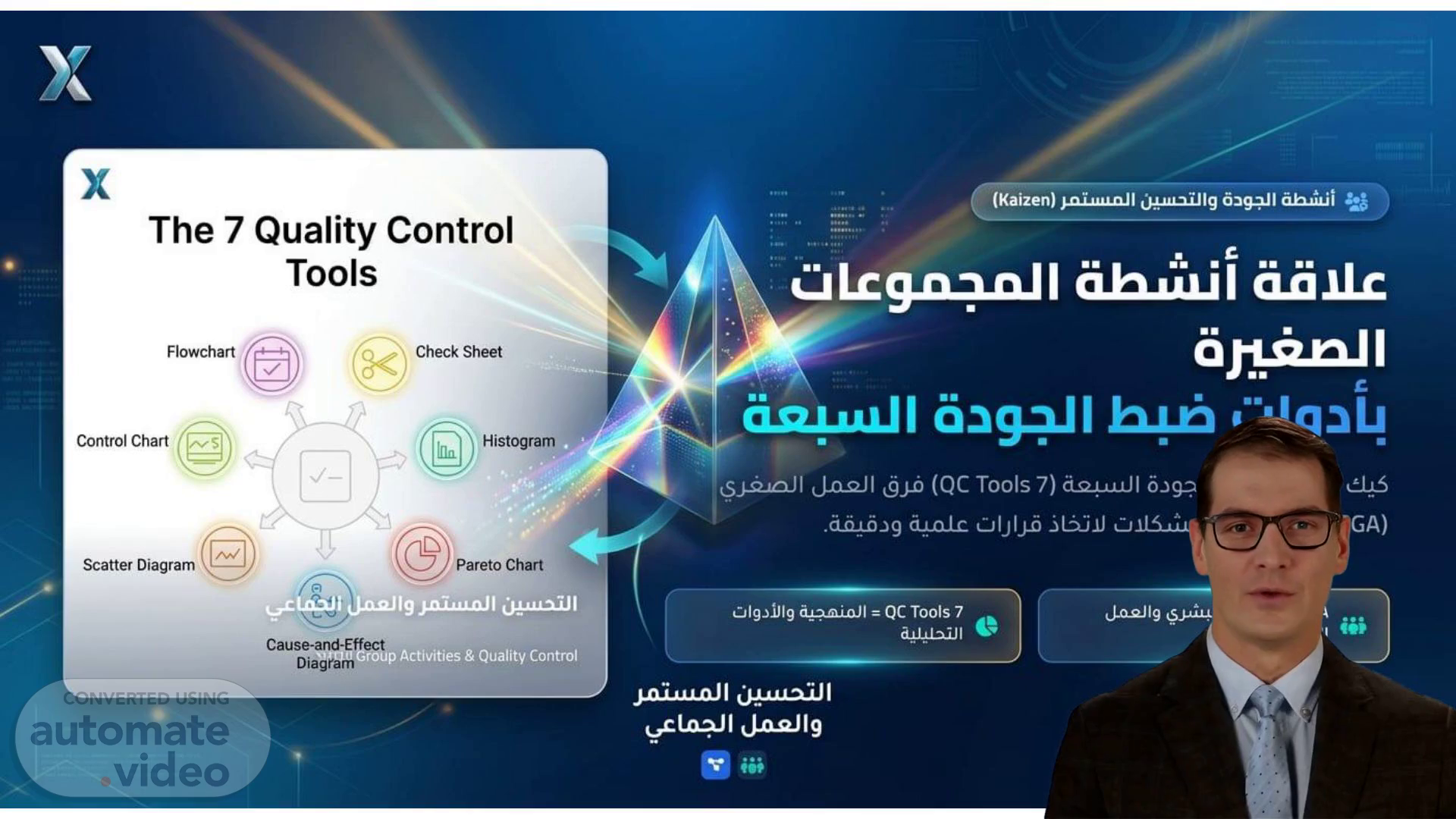
[Virtual Presenter] The quality control process is designed to ensure consistency and accuracy in our work. This process involves several key steps that are outlined in the provided flowchart. The flowchart illustrates the steps taken to identify and address issues, as well as the procedures for implementing changes to enhance our performance. By following this process, we can identify areas for improvement and implement changes to improve our overall quality. The tools listed below provide additional support for quality control activities. These include check sheets, histograms, Pareto charts, scatter diagrams, and control charts. Each tool has its own unique application and benefits, and they all contribute to a comprehensive approach to quality control. Using these tools effectively will enable us to improve our processes and achieve higher levels of quality. Working together and utilizing these resources will allow us to strive for excellence in our work..
Scene 2 (1m 3s)
[Audio] The Ishikai Diagram or Jig is a visual representation of the various factors that may contribute to a problem or issue. It helps identify root causes by showing how different elements interact with one another. For example, if a product has a defect, the Ishikai Diagram would show how the manufacturing process, material quality, and storage conditions all play a role in its occurrence. By analyzing these interactions, the diagram can reveal underlying problems that might not be immediately apparent. The Ishikai Diagram is particularly useful when dealing with complex issues where multiple factors are involved..
Scene 3 (1m 43s)
[Audio] The company has identified several key problem types that are critical to customer success. These problem types include Quality Control (Q.C.), Just-In-Time (JI), Service Improvement (scivjng), Just-In-Case (J..*JI), Operational Efficiency (00 J.ÄJj éJa.iJi), Customer Satisfaction (äSXJl Jc), and Support and Guidance (SGAS). To address these problem types, the company uses a variety of tools and techniques. One such tool is the seven quality control tools, which include flowcharts, check sheets, histograms, Pareto charts, cause and effect diagrams, scatter diagrams, and control charts. These tools help the company to identify and address different problem types. By understanding and utilizing these problem types and tools, the company can effectively address its customers' needs and provide them with the best possible experience..
Scene 4 (2m 50s)
[Audio] The types of problem solvers can be categorized into several key groups. These include the Analysts, the Specialists, and the Generalists. Analysts focus on analyzing data and identifying patterns. Specialists have in-depth knowledge of specific areas and apply this expertise to solve problems. Generalists possess a broad range of skills and can adapt to various situations. Understanding these different types of problem solvers can help organizations better address their challenges and develop effective solutions..
Scene 5 (3m 26s)
[Audio] I dag fokuserar vi på hur du kan ge dina kunder den bästa möjliga upplevelsen och hur du kan förstå deras behov. Vi kommer att gå igenom strategier för att anpassa din kommunikation och service till dina kunder. Genom att ha en stark relation med dina kunder kan du inte bara skapa nöjda kunder, utan också lojala kunder som återkommer och rekommenderar ditt företag. Låt oss nu lära oss mer om hur vi kan bygga starka kundrelationer i vår nästa lektion..
Scene 6 (3m 54s)
[Audio] The process begins with a thorough review of the product's specifications and features. This includes examining the user manual, online documentation, and any other relevant resources. Understanding the product's capabilities and limitations is essential for effective use. Next, we will discuss the setup and configuration process, which involves installing the necessary software and hardware components. We will also cover the initial configuration of the system, including setting up user accounts and passwords. Additionally, we will provide guidance on troubleshooting common issues and offer tips for optimizing performance. Our goal is to ensure a smooth transition into using the product, and we will take the time to address any questions or concerns you may have..
Scene 7 (4m 42s)
[Audio] The customer's needs and expectations are paramount. We strive to deliver solutions that meet their requirements and exceed their expectations. Our goal is to provide seamless integration with existing systems and processes. We aim to minimize disruptions and ensure a smooth transition. By working closely together, we can achieve this goal and ensure the success of our customers..
Scene 8 (5m 7s)
[Audio] The process we use to manage our quality is based on a set of principles that guide our actions. These principles are designed to ensure that our products meet the required standards. Our quality management system is built around the PDCA cycle, which stands for Plan, Do, Check, and Act. This cycle helps us identify areas for improvement and implement changes to achieve our goals. We regularly review and assess our processes to ensure they align with industry standards and customer expectations. By following this structured approach, we can guarantee that our products meet the highest standards of quality..
Scene 9 (5m 47s)
JSLSAAJI J— Qc.
Scene 10 (5m 52s)
[Audio] We are pleased to present to you a comprehensive guide to the art of painting. This guide will cover all aspects of painting, from the basics of color theory to advanced techniques such as glazing and scumbling. The guide will also include information on materials and tools used in painting, including brushes, paints, and canvases. We will provide detailed instructions on how to prepare surfaces, mix colors, and apply paint to achieve desired effects..