Scene 1 (0s)
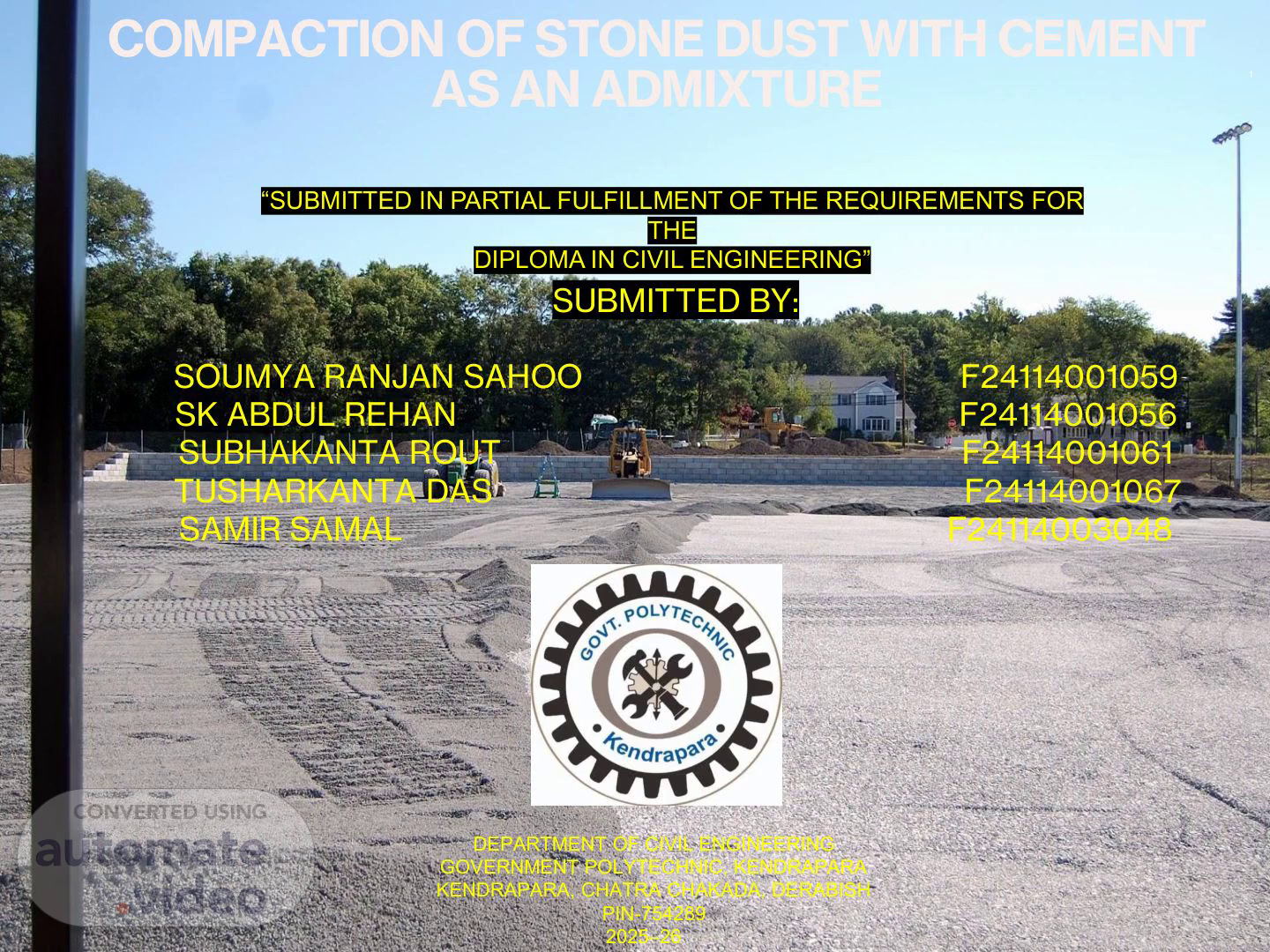
[Audio] COMPACTION OF STONE DUST WITH CEMENT 1 AS AN ADMIXTURE "SUBMITTED IN PARTIAL FULFILLMENT OF THE REQUIREMENTS FOR THE DIPLOMA IN CIVIL ENGINEERING" SUBMITTED BY: SOUMYA RANJAN SAHOO F24114001059 SK ABDUL REHAN F24114001056 SUBHAKANTA ROUT F24114001061 TUSHARKANTA DAS F24114001067 SAMIR SAMAL F24114003048 DEPARTMENT OF CIVIL ENGINEERING GOVERNMENT POLYTECHNIC, KENDRAPARA KENDRAPARA, CHATRA CHAKADA, DERABISH PIN-754289 2025–26.
Scene 2 (1m 6s)
[Audio] 2 CERTIFICATE "This is to certify that the work in this project report entitled COMPACTION OF STONE DUST WITH CEMENT AS AN ADMIXTURE' by SOUMYA RANJAN SAHOO, SAMIR SAMAL, TUSHARKANTA DAS, S.K ABDUL REHAN, SUBHAKANTA ROUT, has been carried out under my supervision in partial fulfillment of the requirements for the Diploma in Civil Engineering (5th semester) during the session 2025–2026 in Civil Engineering Department of Government Polytechnic Kendrapara and this work is the original work of the above students …………………………………… ……………………………………… Project Supervisor Head of the Deartment …………………………………… External Examiner.
Scene 3 (1m 53s)
[Audio] ACKNOWLEDGEMENT 3 At first, we thankful to the supreme power as well as our parents to give us power and opportunity to finish the final year project report very successfully. We would like to express our sincere thanks to project guide Mrs Pramila Gouda, senior lecturer of stage 2 Civil Engineering Department for providing us much wisdom and guidance to the project and seminar faithfully. We would like to specially thank to our Head of Department (HOD) Mrs. Jyotirmayee Samal for helping in preparation of thesis and laboratory tests. We are grateful to the Dept. of Civil Engineering, Government Polytechnic, Kendrapara for giving opportunity to execute this project, which is an important part of the curriculum in Diploma program. Finally, we would like to acknowledge and thanks to all the staff members of Civil Engineering Department and Government Polytechnic, Kendrapara for their help and encouragement. Thanks to our entire group members for their required valuable help, information, and feedbacks as they have offered a tremendous source of support and commitment during this project..
Scene 4 (3m 10s)
[Audio] 4 CONTENTS SL NO CONTENT PAGE NO. CONTENT PAGE SL. NO .NO 1 INTRODUCTION 5 21 COMPARISON OF MDD 19 2 AIM OF THE PROJECT 6 3 OBJECTIVES 6 22 COMPARISON OF OMC 19 4 SCOEP THE PROJECTS 7 5 MATERIAL USED 7 23 SAFETY PREQUATION 20 6 STONE DUST 8 24 QUALITY CONTROL 20 7 CEMENT AS AN ADDMIXTURE 9 8 PROPOSED MIX PROPORTION 10 21 9 LABROTORY EQUIPMENT 11 25 DISCUSSION OF ILLUSTRATIVE RESULTS 10 STANDARD PROCTER TEST 11 11 STANDARD TEST PARAMETERS 13 26 CONCLUSION 21 12 EXPERIMENTAL METHODOLOGY 14 13 SAMPLE PREPARATION 14 27 REFERENCES 22 14 COMPACTION PROCEDURE 15 15 OBSERVATION PARAMETERS 15 16 FORMULA USED 16 17 MOISTEURE CONTENT 17 CALCULATION 18 WET DENSITY CALCULATION 17 19 DRY DENSITY CALCULATION 18 20 MDD AND OMC RESULT 18.
Scene 5 (5m 22s)
[Audio] 5 INTRODUCTION Stone dust is a fine material obtained during the crushing of stones in quarries. It is commonly used in road construction, filling and construction works. Cement can be added to stone dust to improve bonding between particles. Compaction reduces air voids and increases dry density. This project studies the effect of cement percentage on the compaction characteristics of stone dust..
Scene 6 (5m 55s)
[Audio] AIM OF THE PROJECT 6 To investigate the compaction characteristics of stone dust mixed with different percentages of cement using the Standard Proctor Test. OBJECTIVES 1. To study the physical characteristics of stone dust. 2. To prepare stone dust-cement mixtures. 3. To conduct the Standard Proctor Compaction Test. 4. To determine Maximum Dry Density (MDD). 5. To determine Optimum Moisture Content (OMC). 6. To compare the results for different cement percentages. 7. To identify a promising mixture for further investigation..
Scene 7 (6m 49s)
[Audio] 7 SCOPE OF THE PROJECT The project covers: Stone dust as the primary material. Cement as the stabilizing admixture. Cement contents of 0%, 2%, 4%, 6% and 8%. Standard Proctor compaction. Moisture-density relationships. Comparison of MDD and OMC. MATERIALS USED Stone dust Obtained from a stone crusher. Clean and free from organic impurities. Representative sample collected. 2. Cement Ordinary Portland Cement (OPC), preferably 43 or 53 grade. Fresh cement stored in dry conditions. 3. Water Clean water suitable for laboratory testing..
Scene 8 (7m 52s)
[Audio] STONE DUST 8 Properties to be investigated: Particle-size distribution. Specific gravity. Bulk characteristics. Moisture content. Presence of clay, silt and impurities. A representative sample should be collected from different portions of the stockpile..
Scene 9 (8m 19s)
[Audio] 9 CEMENT AS AN ADMIXTURE Cement acts as a binding material. When mixed with water: Cement hydration begins. Cementitious products develop. Particles may become bonded. The mixture's compaction and strength characteristics may change. The effect depends on cement content, moisture, mixing and curing conditions.
Scene 10 (8m 49s)
[Audio] 10 PROPOSED MIX PROPORTIONS Mix ID Stone dust Cement M0 100% 0% M2 98% 2% M4 96% 4% M6 94% 6% M8 92% 8% Example for 1 kg dry stone dust: M0 = 1000 g stone dust + 0 g cement. M2 = 1000 g stone dust + 20 g cement. M4 = 1000 g stone dust + 40 g cement. M6 = 1000 g stone dust + 60 g cement. M8 = 1000 g stone dust + 80 g.
Scene 11 (9m 47s)
[Audio] 11 LABORATORY EQUIPMENT Standard Proctor mould and base plate. Extension collar. 2.6 kg compaction rammer. Balance. Drying oven. Moisture-content containers. Mixing tray. Measuring cylinder. Steel straightedge. Sieves. Sample extruder. STANDARD PROCTOR TEST The Standard Proctor Test determines the relationship between moisture content and dry density. The test gives two important values: Maximum Dry Density (MDD): Highest dry density obtained under the specified compaction effort. Optimum Moisture Content (OMC): Moisture content corresponding to MDD. Indian equivalent: IS 2720 (Part 7): 1980, Light Compaction Test..
Scene 13 (11m 3s)
[Audio] 13 STANDARD TEST PARAMETERS For the usual 1000 cm³ small mould configuration Parameter Value Rammer mass 2.6 kg Height of fall 310 mm Number of layers 3 Blows per layer 25 Total blows 75 Mould volume 1000 cm³ Confirm mould size and the applicable procedure against the standard and particle-size requirements before testing..
Scene 14 (11m 39s)
[Audio] EXPERIMENTAL METHODOLOGY 1. Collect and prepare stone dust. 2. Determine the required cement percentage. 3. Prepare each dry mixture. 4. Add a measured quantity of water. 5. Mix thoroughly. 6. Compact in the standard mould. 7. Determine the wet mass. 8. Determine water content. 9. Calculate dry density. 10. Repeat at increasing moisture contents. 11. Plot the compaction curve. 12. Determine MDD and OMC. SAMPLE PREPARATION Air-dry the stone dust. Break down loose lumps without crushing individual particles. Prepare representative samples. Measure cement according to the selected mix proportion. Mix stone dust and cement until uniform. Add water gradually. Maintain a consistent mixing-to-compaction time for all batches. Important: Cement hydration starts after water addition. Test specimens should be compacted promptly and consistently. Record elapsed time. 14.
Scene 15 (13m 16s)
[Audio] COMPACTION PROCEDURE 15 lean and weigh the mould with base plate. Fix the extension collar. Place the first approximately equal layer of mixture. Compact using 25 evenly distributed blows. Scratch the surface before placing the next layer. Repeat for the second and third layers. Remove the collar. Trim excess material level with the mould. Weigh the mould with compacted material. Obtain a representative sample for moisture-content determination. OBSERVATION PARAMETERS For each test specimen record: Cement percentage. Initial water addition. Empty mould mass. Mould plus compacted wet mixture mass. Wet material mass. Mould volume. Empty moisture tin mass. Tin plus wet sample mass..
Scene 16 (14m 25s)
[Audio] 16 Tin plus dry sample mass. Water content. Wet density. Dry density. FORMULAS USED . Cement content Cement percentage = (Mass of cement / Dry mass of stone dust) × 100 2. Water content w = [(Mass of water) / (Mass of dry sample)] × 100 3. Wet density ρ = Mass of wet compacted mixture / Mould volume 4. Dry density ρd = ρ / (1 + w) Here, w is expressed as a decimal in the dry-density equation..
Scene 17 (15m 14s)
[Audio] 17 MOISTURE CONTENT CALCULATION Example observations: Empty moisture tin = 50 g Tin + wet sample = 116 g Tin + dry sample = 110 g Mass of water: 116 − 110 = 6 g Mass of dry sample: 110 − 50 = 60 g Water content: w = (6 / 60) × 100 Water content = 10% WET DENSITY CALCULATION Illustrative observations for M4: Empty mould mass = 4.500 kg Mould + wet compacted material = 6.542 kg Mould volume = 1000 cm³ = 0.001 m³ Wet material mass: 6.542 − 4.500 = 2.042 kg Wet density: ρ = 2.042 / 0.001 Wet density = 2042 kg/m³.
Scene 18 (16m 35s)
[Audio] 18 DRY DENSITY CALCULATION For the same M4 sample: Wet density = 2042 kg/m³ Moisture content = 10% = 0.10 Dry density: ρd = 2042 / (1 + 0.10) ρd = 2042 / 1.10 Dry density = 1856.36 kg/m³ Or: Dry density = 1.856 g/cm³ This is an illustrative calculation, not a measured result. MDD AND OMC RESULTS Illustrative results: These are assumed representative peak values for demonstration only. Actual MDD and OMC must be determined from measured compaction curves. Mix Cement MDD (g/cm³) OMC M0 0% 1.78 10.0% M2 2% 1.82 9.5% M4 4% 1.86 9.0% M6 6% 1.84 9.5% M8 8% 1.80 10.0%.
Scene 19 (18m 16s)
[Audio] COMPARISON OF MDD 19 Illustrative comparison: M0: 1.78 g/cm³ M2: 1.82 g/cm³ M4: 1.86 g/cm³ M6: 1.84 g/cm³ M8: 1.80 g/cm³ The illustrative data show an increase in MDD up to 4% cement, followed by a decrease. COMPARISON OF OMC ustrative comparison: M0: 10.0% M2: 9.5% M4: 9.0% M6: 9.5% M8: 10.0% The lowest illustrative OMC occurs at 4% cement. The actual trend may differ depending on material characteristics and cement hydration..
Scene 20 (19m 32s)
[Audio] 20 SAFETY PRECAUTIONS Wear gloves, safety shoes and a dust mask. Avoid inhalation of cement and stone dust. Handle the rammer carefully. Keep the mould on a firm, level surface. Use appropriate lifting and handling techniques. Avoid skin and eye contact with wet cement. Follow laboratory safety procedures. QUALITY CONTROL Use representative material samples. Calibrate the mould volume. Verify balance accuracy. Keep mixing proportions consistent. Maintain uniform blows and layer thickness. Record all actual observations. Repeat tests where necessary. Use consistent elapsed time after adding water..
Scene 21 (20m 33s)
[Audio] DISCUSSION OF ILLUSTRATIVE 21 RESULTS The illustrative dataset suggests: MDD increases from 1.78 g/cm³ for pure stone dust to 1.86 g/cm³ at 4% cement. MDD decreases to 1.80 g/cm³ at 8% cement. OMC decreases from 10% to 9% and then increases. The 4% cement mixture gives the highest illustrative MDD. This trend must not be treated as a verified experimental finding. CONCLUSION Based on the illustrative dataset: 1. Cement addition changes the compaction characteristics of stone dust. 2. The highest illustrative MDD is 1.86 g/cm³. 3. The corresponding illustrative OMC is 9%. 4. The 4% cement mixture gives the highest illustrative MDD among the selected proportions. 5. Actual laboratory testing is required before recommending an optimum cement content..
Scene 22 (21m 56s)
[Audio] 22 REFERENCES 1. IS 2720 (Part 7): 1980 – Methods of Test for Soils: Determination of Water Content-Dry Density Relation Using Light Compaction. 2. IS 2720 (Part 2) – Determination of Water Content. 3. IS 383 – Coarse and Fine Aggregate for Concrete: Specification, where applicable for aggregate characterization. 4. Relevant geotechnical engineering laboratory manuals. 5. Standard textbooks on soil mechanics and foundation engineering..
Scene 24 (22m 51s)
[Audio] 24 PICTERS OF STONE DUST. 24 PICTERS OF STONE DUST.
Scene 25 (22m 57s)
[Audio] 25 THANK YOU Project: Compaction of Stone Dust with Cement as an Admixture Department: Civil Engineering Presented by: SOUMYA RANJAN SAHOO S.K ABDUL REHAN SUBHAKANTA ROUT SAMIR SAMAL TUSHARKANTA DAS.