Scene 1 (0s)
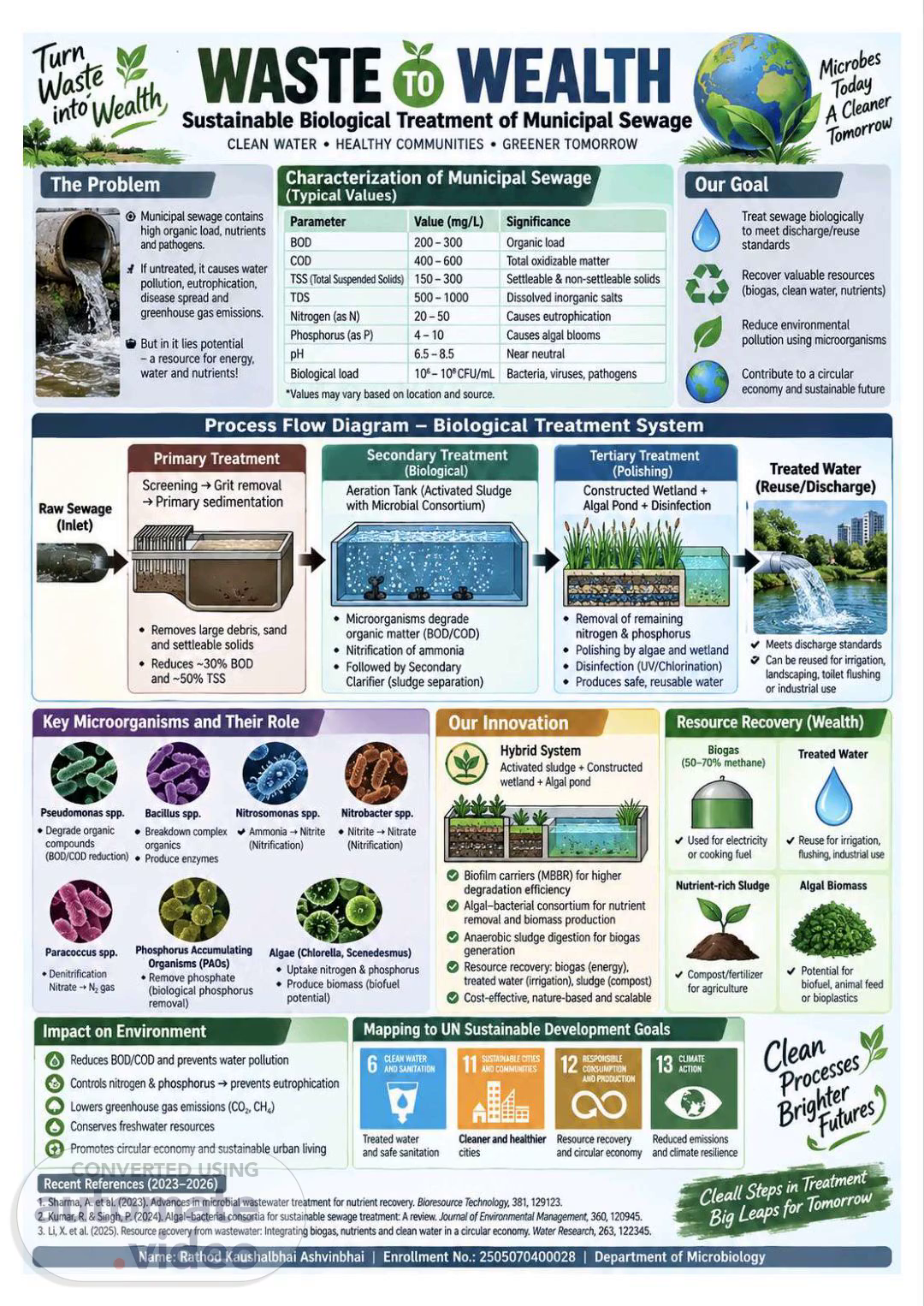
furn The Problem @ Municipal sewage contains high organic load, nutrients and pathogens. If untreated, it causes water pollution, eutrophication. disease spread and greenhouse gas ernissions. But in it lies potential — a resource for energy, water and nutrients! Microbes Today A Cleaner Characterization of Municipal Sewage (Typical Values) Parameter Nitr*l (as N) Phosphorus (as P) pH Biological load Value (mg/L) Significance 200 - 300 400-600 150-300 500-1000 20-50 1 4-10 6.5-8.5 Organic load Total oxidizable matter Settleable & non-settleable solids Dissolved inorganic salts Causes eutrophication Causes algal blwms Near neutral Our Goal Treat sewage biologically to meet discharge/reuse standards Recover valuable resources 106— IOSCFU/mL Bacteria, viruses, pathogens •Values may vary based location and source. Process Flow Diagram — Biological Treatment System Raw Sewage (Inlet) Primary Treatment Screening Grit removal -i Primary sedimentation lilliililiiil ilÄ • Removes large debris, sand and settleable solids • Reduces -30% BOD and -50% TSS Secondary Treatment (Biological) Aeration Tank (Activated Sludge with Microbial Consortium) • Microorganisms degrade organic matter (BOD/COD) • Nitrification Of ammonia • Followed by Secondary Clarifier (sludge separation) Tertiary Treatment (Polishing) Constructed Wetland + Algal Pond + Disinfection • Removal Of remaining nitrogen & phosphorus • Polishing by algae and wetland • Disinfection (UV/Chlorination) • Produces safe, reusable water (biogas, clean water, nutrients) Reduce environmental pollution using microorganisms Contribute to a circular eccmmy ard sustainable future Treated Water (Reuse/Discharge) Meets discharge standards Can be reused for irrigation. landscaping, toilet flushing or industrial Key Microorganisms and Their Role Our Innovation Hybrid System Activated sludge • Constructed wetland + Algal paed e Biofilm carriers (MBBR) for higher degradation efficiency e Algal-bacterial consortium for nutrient removal and biomass production e Anaerobic sludge digestion for biogas generation e Resource recovery. biogas (energy). Resource Recovery (Wealth) spp. Bacillus spp. • Degrade organic • Breakdown conwex compounds organics (BODICOD reduction) • produce enzymes Nitrosomonas Ammonia Nitrite (Nitrification) Nitrobacter • Nitrite Nitrate (Nitrificati(n) Biogas (50-70% methane) used for electricity or cooking fuel Nutrient-rich Sludge • Denitrification Nitrate Nz gas Phosphorus Accumulating Organisms (PAOs) • Remove phosphate (biological phosphorus removal) Algae (Chlorella. Scenedesmus) • Uptake nitrogen & • produce biomass (biofuel potential) treated water (irrigation). (compost) for agriculture e Cost-effective nature-based and scalable Treated Water Reuse for irrigation, flustirg. hdustrial Algal Biomass Potential for biofuel. animal feed or bioplastics Impact on Environment O Reduces BOD/COD and prevents water pollution O Contrt*s nitrogen & phosphorus —Y prevents eutrophication O Lowers greenhouse gas emissions (CQ, CH.) O Conserves freshwater resources Mapping to UN Sustainable Development Goals V 60 0 Resourcerecovery Reduced emissions cities eonomy and Cleanesses hter brigfutures Treated water Promotes circular economy and sustainable urban living ard safe sanitation Recent References (2023-2026) 1. Sharma, A. et al. (2023). Advances in microbial wastewater treatment fw nutrieq Biresoutæ 381, 129123. 2. Kunw, R. & Singh. P (2024Y Algal—bacterial cons«tia for sustainable sew* treatment A review Jburrd Of Environ,Tental Mar*nmt, 360120945. u, k et al. (2025). Restwrce from wastewater: lnWating biogas marients and ckan water a circular eor". Wate 253.122345 Cleall Steps in Treatment Big Leaps for Tomorrow Name: Rathod Kaushalbhai Ashvinbhai I Enrollment No.: 2505070400028 | Department Of Microbiology.