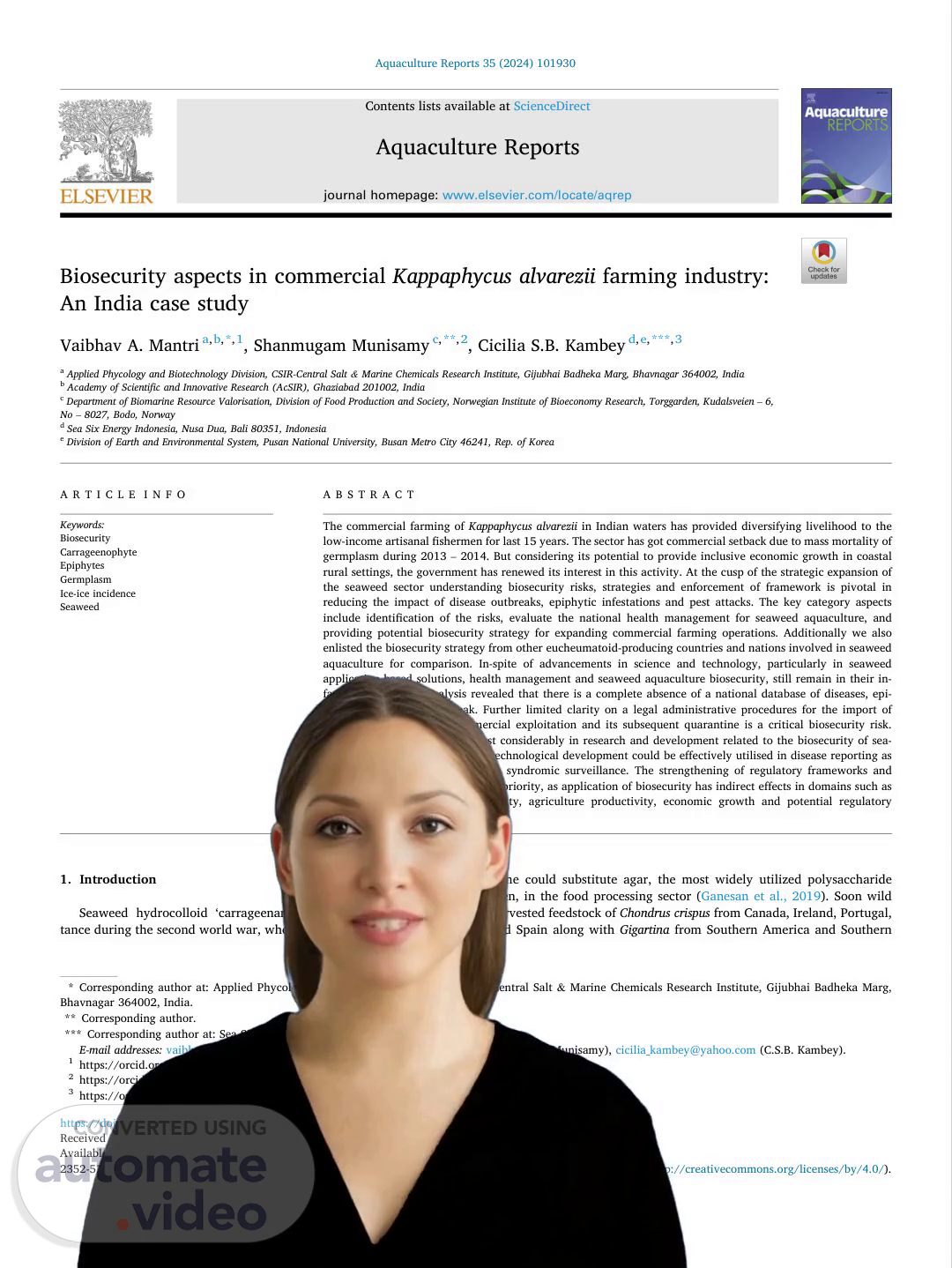
Biosecurity aspects in commercial Kappaphycus alvarezii farming industry: An India case study
Scene 1 (0s)
[Virtual Presenter] The commercial farming of Kappaphycus alvarezii in Indian waters has provided diversifying livelihood to the low-income artisanal fishermen for last 15 years. The sector has got commercial setback due to mass mortality of germplasm during 2013 – 2014. But considering its potential to provide inclusive economic growth in coastal rural settings, the government has renewed its interest in this activity. At the cusp of the strategic expansion of the seaweed sector understanding biosecurity risks, strategies and enforcement of framework is pivotal in reducing the impact of disease outbreaks, epiphytic infestations and pest attacks. The key category aspects include identification of the risks, evaluate the national health management for seaweed aquaculture, and providing potential biosecurity strategy for expanding commercial farming operations. Additionally we also enlisted the biosecurity strategy from other eucheumatoid-producing countries and nations involved in seaweed aquaculture for comparison. In-spite of advancements in science and technology, particularly in seaweed application-based solutions, health management and seaweed aquaculture biosecurity, still remain in their infancy in India. The analysis revealed that there is a complete absence of a national database of diseases, epiphytes, and grazers outbreak. Further limited clarity on a legal administrative procedures for the import of seaweed germplasm for commercial exploitation and its subsequent quarantine is a critical biosecurity risk. There is an urgent need to invest considerably in research and development related to the biosecurity of seaweeds. The rapid internet based technological development could be effectively utilised in disease reporting as well as developing farmer centric syndromic surveillance. The strengthening of regulatory frameworks and policy should be given the highest priority, as application of biosecurity has indirect effects in domains such as products development, food security, agriculture productivity, economic growth and potential regulatory ecosystem services. We need to understand the biosecurity risks, strategies and enforcement of framework is pivotal in reducing the impact of disease outbreaks, epiphytic infestations and pest attacks. We need to evaluate the national health management for seaweed aquaculture and provide potential biosecurity strategy for expanding commercial farming operations. We also need to enlist the biosecurity strategy from other eucheumatoid-producing countries and nations involved in seaweed aquaculture for comparison. We need to invest considerably in research and development related to the biosecurity of seaweeds. We can effectively utilise the rapid internet based technological development in disease reporting as well as developing farmer centric syndromic surveillance. We need to strengthen the regulatory frameworks and policy to give the highest priority, as application of biosecurity has indirect effects in domains such as products development, food security, agriculture productivity, economic growth and potential regulatory ecosystem services. We have to understand the importance of biosecurity in seaweed aquaculture and take necessary steps to ensure the safety of the industry. We need to work together to develop a comprehensive biosecurity framework that will help us to prevent and manage disease outbreaks, epiphytic infestations and pest attacks. We need to invest in research and development to improve our understanding of biosecurity risks, strategies and enforcement of framework. We need to develop a national database of diseases, epiphytes, and grazers outbreak. We need to clarify the legal administrative procedures for the import of seaweed germplasm for commercial exploitation and its subsequent quarantine. We need to strengthen our regulatory frameworks and policy to ensure the safety of the industry. We need to work together to develop a comprehensive biosecurity framework that will help us to prevent and manage disease outbreaks, epiphytic infestations and pest attacks. We need to invest in research and development to improve our understanding of biosecurity risks, strategies and enforcement of framework. We need to develop a national database of diseases, epiphytes, and grazers outbreak. We need to clarify the legal administrative procedures for the import of seaweed germplasm for commercial exploitation and its subsequent quarantine. We need to strengthen our regulatory frameworks and policy to ensure the safety of the industry. We need to work together to develop a comprehensive biosecurity framework that will help us to prevent and manage disease outbreaks, epiphytic infestations and pest attacks. We need to invest in research and development to improve our understanding of biosecurity risks, strategies and enforcement of framework. We need to develop a national database of diseases, epiphytes, and grazers outbreak. We need to clarify the legal administrative procedures for the import of seaweed germplasm for commercial exploitation and its subsequent quarantine. We need to strengthen our regulatory frameworks and policy to ensure the safety of the industry. We need to work together to develop a comprehensive biosecurity framework that will help us to prevent and manage disease outbreaks, epiphytic infestations and pest attacks. We need to invest in research and development to improve our understanding of biosecurity risks, strategies and enforcement of framework. We need to develop a national database of diseases, epiphytes, and grazers outbreak. We need to clarify the legal administrative procedures for the import of seaweed germplasm for commercial exploitation and its subsequent quarantine.
Scene 2 (4m 59s)
[Audio] In this region, the Kappaphycus alvarezii farming industry has been a significant source of livelihood for low-income artisanal fishermen for over 15 years. However, the sector has faced a commercial setback due to mass mortality of germplasm during 2013-2014. Despite its potential to provide inclusive economic growth in coastal rural settings, the government has renewed its interest in this activity. Understanding biosecurity risks, strategies, and enforcement of the framework is crucial in reducing the impact of disease outbreaks, epiphytic infestations, and pest attacks. The key aspects include identifying risks, evaluating national health management for seaweed aquaculture, and providing a potential biosecurity strategy for expanding commercial farming operations. Furthermore, we have enlisted the biosecurity strategy from other eucheumatoid-producing countries and nations involved in seaweed aquaculture for comparison. Although there have been advancements in science and technology, particularly in seaweed application-based solutions, health management and seaweed aquaculture biosecurity still remain in their infancy in India. The analysis reveals that there is a complete absence of a national database of diseases, epiphytes, and grazers outbreak. Additionally, there is limited clarity on legal administrative procedures for the import of seaweed germplasm for commercial exploitation and its subsequent quarantine, which is a critical biosecurity risk. There is an urgent need to invest in research and development related to the biosecurity of seaweeds. The rapid internet-based technological development can be effectively utilized in disease reporting and developing farmer-centric syndromic surveillance. The strengthening of regulatory frameworks and policy should be given the highest priority, as the application of biosecurity has indirect effects in domains such as product development, food security, agricultural productivity, economic growth, and potential regulatory ecosystem services. We are now going to discuss the risk identification aspect of the methodology. The debate on the non-native origin of farmed Kappaphycus alvarezii in India is an important consideration. Europe supported the sprawling carrageenan processing industry, but unsustainable harvesting practices in these countries led to a hindrance in the supply chain. The efforts to diversify the seaweed supply led to the establishment of commercial farms of native Eucheuma in the Tawi-Tawi provinces of the Philippines. The commercial carrageenan seaweed cultivation has rapidly expanded in recent times, especially since 2000, in response to the demand of processed food in growing, rich, urbanized middle-class consumers in developing countries. Besides food processing, this hydrocolloid has found acceptance in a wide range of applications in pharmaceutical, cosmetic, and personal care industries as a binder, emulsifier, and stabilizing agent. Nevertheless, utility to enhance meat and dairy products remained the topmost application domain even today. The primary seaweeds under commercial farming are Eucheuma denticulatum and Kappaphycus alvarezii. Slowly, K. alvarezii established as the dominant species and contributed to about 70% feedstock in the global carrageenan market. These species are native in coral triangle and have been introduced to over 30 countries to evaluate their potential for biomass production either at experimental or commercial scale. The studies indicated that socio-economic impacts of farming of K. alvarezii have been overwhelmingly positive in several places, including in India. K. alvarezii remained the only species till date for which commercial farming has been continued for the past two decades in India. Recently, the cultivation activity of K. alvarezii is well established in the southern state of Tamil Nadu, followed by Gujarat, Andhra Pradesh, and Maharashtra. The reasons for successful thriving farming practices among artisanal fishermen are ease of farming, quick cultivations turn-out, limited capital need, and simple farming procedures. The cumulative commercial production of biomass between 2005-2020 reached 8088 tonnes (dry) with farm gate value of USD 2390,184, mostly as the feedstock for semi-refined.
Scene 3 (9m 59s)
[Audio] We are aware that the commercial farming of Kappaphycus alvarezii in Indian waters has provided a diversifying livelihood to low-income artisanal fishermen for the past 15 years. However, the sector has experienced a commercial setback due to mass mortality of germplasm during 2013-2014. Nevertheless, considering its potential to provide inclusive economic growth in coastal rural settings, the government has renewed its interest in this activity. At the cusp of the strategic expansion of the seaweed sector, understanding biosecurity risks, strategies, and enforcement of framework is pivotal in reducing the impact of disease outbreaks, epiphytic infestations, and pest attacks. The key category aspects include identification of the risks, evaluation of the national health management for seaweed aquaculture, and providing potential biosecurity strategy for expanding commercial farming operations. Furthermore, we have enlisted the biosecurity strategy from other eucheumatoid-producing countries and nations involved in seaweed aquaculture for comparison. In spite of advancements in science and technology, particularly in seaweed application-based solutions, health management and seaweed aquaculture biosecurity still remain in their infancy in India. The analysis revealed that there is a complete absence of a national database of diseases, epiphytes, and grazers outbreak. Moreover, limited clarity on legal administrative procedures for the import of seaweed germplasm for commercial exploitation and its subsequent quarantine is a critical biosecurity risk. Consequently, there is an urgent need to invest considerably in research and development related to the biosecurity of seaweeds. The rapid internet-based technological development could be effectively utilized in disease reporting as well as developing farmer-centric syndromic surveillance. Additionally, the strengthening of regulatory frameworks and policy should be given the highest priority, as the application of biosecurity has indirect effects in domains such as product development, food security, agricultural productivity, economic growth, and potential regulatory ecosystem services. Therefore, a comprehensive study related to this issue is urgently needed to bring out evidence-based conclusions. The documentation on the national contingency plan, and national standards for the environmental risk assessment for developing a framework for seaweed aquaculture is absent in the seaweed policy documents in India. The extensive collaboration among the government, research institutions, and other seaweed stakeholders is imperative. The apex body like the Ministry of Fisheries, Animal Husbandry and Dairying may coordinate with national organizations like the Coastal Aquaculture Authority; and Biodiversity Authority of India; national laboratories like CSMCRI; CMFRI along with industry representatives like the Seaweed Association of India need collaboration to bring a comprehensive document having clear guidelines. We also need to focus on establishing a national monitoring standard system of critical environmental parameters for expanding the Kappaphycus aquaculture industry in India. We should also address the need for periodic monitoring of salinity in the farm area for maintaining consistent growth. Furthermore, we need to establish a comprehensive understanding of the relationship between environmental parameters, disease incidences, and epiphyte infestation. The lack of understanding regarding these relationships, coupled with weak technology support related to monitoring oceanic changes, leads to poor biosecurity outcomes. This essentially invites attention for the need of establishing a national monitoring standard system of critical environmental parameters. Such development is necessary for expanding the Kappaphycus aquaculture industry in India. The ice-ice disease symptom and epiphytism was found in almost all seaweed producing areas of Kappaphycus in Tamil Nadu. The incidences of ice-ice infection were reported to be from about 40% of farm areas in the Gulf of Mannar. Similarly, the epiphytic infestation together with the attachment of benthic fouling animals can reduce the production by about 20-30%, thereby making commercial farming a less economically viable venture. The herbivorous fishes such as Siganus javus, Acanthurus sp., Cetoscarus sp., and Tripneustes sp..
Scene 4 (14m 59s)
[Audio] We can see that the Indian national aquaculture regulation to address the biosecurity concept resources for commercial exploitation is a key aspect. The Directorate of Plant Protection, Quarantine and Storage, under the administrative control of the Department of Agriculture and Farmers Welfare, Ministry of Agriculture and Farmers Welfare, is the nodal agency to permit the import of live material (plant or animal). However, they have clear guidelines for the import of agricultural commodities, but are at a crossroads regarding the regulatory frameworks for seaweed import. The absence of a legal administrative protocol for the import of germplasm for commercial exploitation is a critical biosecurity risk. Science and expert/stakeholder opinions are crucial components of policy formulation and decision-making. We need to incorporate the biosecurity concept for developing the seaweed aquaculture industry. This can be achieved either by policy framework or by enacting appropriate regulation. As of yet, India does not have any policies or regulations related to the seaweed industry. We need to consider the national health management in aquaculture and incorporate the biosecurity concept for developing the seaweed aquaculture industry. This can be achieved either by policy framework or by enacting appropriate regulation. As of yet, India does not have any policies or regulations related to the seaweed industry. The Indian national aquaculture regulation to address the biosecurity concept resources for commercial exploitation is a key aspect. The Directorate of Plant Protection, Quarantine and Storage, under the administrative control of the Department of Agriculture and Farmers Welfare, Ministry of Agriculture and Farmers Welfare, is the nodal agency to permit the import of live material (plant or animal). However, they have clear guidelines for the import of agricultural commodities, but are at a crossroads regarding the regulatory frameworks for seaweed import. The absence of a legal administrative protocol for the import of germplasm for commercial exploitation is a critical biosecurity risk. Science and expert/stakeholder opinions are crucial components of policy formulation and decision-making. We need to incorporate the biosecurity concept for developing the seaweed aquaculture industry. This can be achieved either by policy framework or by enacting appropriate regulation. As of yet, India does not have any policies or regulations related to the seaweed industry. The Indian national aquaculture regulation to address the biosecurity concept resources for commercial exploitation is a key aspect. The Directorate of Plant Protection, Quarantine and Storage, under the administrative control of the Department of Agriculture and Farmers Welfare, Ministry of Agriculture and Farmers Welfare, is the nodal agency to permit the import of live material (plant or animal). However, they have clear guidelines for the import of agricultural commodities, but are at a crossroads regarding the regulatory frameworks for seaweed import. The absence of a legal administrative protocol for the import of germplasm for commercial exploitation is a critical biosecurity risk. Science and expert/stakeholder opinions are crucial components of policy formulation and decision-making. We need to incorporate the biosecurity concept for developing.
Scene 5 (18m 36s)
[Audio] We believe that the biosecurity of the seaweed industry is crucial for its growth and sustainability. The lack of a national database of diseases, epiphytes, and grazers outbreak in India is a significant biosecurity risk. The absence of clear legal administrative procedures for the import of seaweed germplasm for commercial exploitation and its subsequent quarantine is also a critical biosecurity risk. We must invest in research and development related to the biosecurity of seaweeds, and utilize the rapid internet-based technological development in disease reporting and farmer-centric syndromic surveillance. The strengthening of regulatory frameworks and policy should be given the highest priority, as the application of biosecurity has indirect effects in domains such as product development, food security, agriculture productivity, economic growth, and potential regulatory ecosystem services. We should learn from the biosecurity strategies of other seaweed-producing countries, such as Indonesia, the Philippines, and Malaysia, which have emphasized rapid seaweed production while neglecting health management. We can adopt their strategies, such as the use of tissue culture for producing healthy seedlings, and the implementation of national certification programs, such as the 'MyGAP Farm Certification' in Malaysia. We must also acknowledge the importance of measuring risk assessment, and the need for clear guidelines and regulations for small and large-scale operations. We believe that the adoption of these strategies will help us to develop a robust biosecurity framework for the Indian seaweed industry. We note that the manual on best practices of K. alvarezii prepared by the Central Salt and Marine Chemicals Research Institute is the most robust document covering relevant biosecurity information, based on scientific evidence. We should also recognize the importance of voluntary guidelines, such as the Indonesian SNI No. 7672/2011 and the Philippines Code of Good Aquaculture Practices PNS/BAFS 135:2014, which provide information on farm risk challenges. However, we must also acknowledge that these guidelines are not associated with measuring risk assessment, and that the majority of national farm guidelines are linked to fish aquaculture management and strategies. We believe that the adoption of a robust biosecurity framework will have indirect effects in domains such as product development, food security, agriculture productivity, economic growth, and potential regulatory ecosystem services. We should prioritize the strengthening of regulatory frameworks and policy, and invest in research and development related to the biosecurity of seaweeds. We should also learn from the experiences of other seaweed-producing countries, and adopt their strategies for improving biosecurity. We are committed to developing a robust biosecurity framework for the Indian seaweed industry, and we believe that this will have significant benefits for the industry's growth and sustainability. We will work towards the development of a national database of diseases, epiphytes, and grazers outbreak, and the establishment of clear legal administrative procedures for the import of seaweed germplasm for commercial exploitation and its subsequent quarantine. We will also invest in research and development related to the biosecurity of seaweeds, and utilize the rapid internet-based technological development in disease reporting and farmer-centric syndromic surveillance. We will prioritize the strengthening of regulatory frameworks and policy, and adopt the biosecurity strategies of other seaweed-producing countries. We are confident that the adoption of these strategies will help us to develop a robust biosecurity framework for the Indian seaweed industry. We are proud to be part of the Indian seaweed industry, and we are committed to its growth and sustainability. We believe that the adoption of a robust biosecurity framework will have significant benefits for the industry's growth and sustainability. We will work towards the development of a robust biosecurity framework, and we are confident that this will have significant benefits.
Scene 6 (23m 18s)
[Audio] The government of India has been actively engaged with the international community to promote sustainable aquaculture practices through the National Aquatic Animal Health Management Board (NAHMB). NAHMB has been working closely with various stakeholders including farmers, researchers, and policymakers to develop and implement effective policies and guidelines for the promotion of sustainable aquaculture practices. The board has established partnerships with several organizations, including the Food and Agriculture Organization (FAO) of the United Nations, to support the development of sustainable aquaculture practices. The FAO has provided technical assistance to India in the area of aquaculture, including training programs for farmers and policymakers. The board has also established a network of experts who can provide advice and guidance on issues related to aquaculture. These experts come from various fields, including fisheries, marine biology, and veterinary medicine. The board's efforts have led to the development of a comprehensive framework for the management of aquatic animal health in India. This framework includes guidelines for the prevention and control of diseases, as well as measures for the protection of aquatic animals from pests and predators. The framework also provides for the establishment of a national database of diseases, epiphytes, and grazers, which will enable the monitoring of aquatic animal health across the country. The framework is based on the principles of sustainability, environmental stewardship, and social responsibility. The board's work has helped to improve the overall health and well-being of aquatic animals in India, and has contributed to the country's efforts to promote sustainable aquaculture practices..
Scene 7 (25m 7s)
[Audio] We note that the commercial farming of Kappaphycus alvarezii in Indian waters has provided diversifying livelihood to the low-income artisanal fishermen for last 15 years. The sector has got commercial setback due to mass mortality of germplasm during 2013 – 2014. However, considering its potential to provide inclusive economic growth in coastal rural settings, the government has renewed its interest in this activity. At the cusp of the strategic expansion of the seaweed sector, understanding biosecurity risks, strategies, and enforcement of framework is pivotal in reducing the impact of disease outbreaks, epiphytic infestations, and pest attacks. The key category aspects include identification of the risks, evaluation of the national health management for seaweed aquaculture, and providing potential biosecurity strategy for expanding commercial farming operations. In-spite of advancements in science and technology, particularly in seaweed application-based solutions, health management and seaweed aquaculture biosecurity still remain in their infancy in India. The analysis revealed that there is a complete absence of a national database of diseases, epiphytes, and grazers outbreak. Further limited clarity on a legal administrative procedures for the import of seaweed germplasm for commercial exploitation and its subsequent quarantine is a critical biosecurity risk. There is an urgent need to invest considerably in research and development related to the biosecurity of seaweeds. The rapid internet-based technological development could be effectively utilized in disease reporting as well as developing farmer-centric syndromic surveillance. The strengthening of regulatory frameworks and policy should be given the highest priority, as application of biosecurity has indirect effects in domains such as products development, food security, agriculture productivity, economic growth, and potential regulatory ecosystem services. We recommend developing an adequate seed-based nursery for securing seed stock aimed at a long-term supply of planting material. Maintaining the dried biomass quality during off-planting and post-harvesting has been identified as the key factor for achieving high economic returns. This is essential for implementing farm standard operating procedures. Besides the requirement of sand and epiphyte-free biomass with 35% moisture content, there is information about the post-harvesting guidelines. Doing so will certainly encourage market trust and acceptability. The national standards and guidelines may be set up for establishing a commercial farm with an appropriate farm design and production facility, with amenable sites to minimize environmental impact, appropriate cultivation methods and practices, pathogen spread prevention, farm management, and harvest quality. A manual on best practices of K. alvarezii farming is available in India. The document deals with various aspects of site selection, farming technologies and management, harvesting and post-harvest storage, and cost-benefit analysis. The optimal environmental and water quality parameters for selecting a site have been established and reported. The different methods such as net and stakes, monoline and net bag (submerged techniques), while bamboo raft method (floating technique) have been suggested. The general or passive surveillance program has been initiated in all four coastal districts of Tamil Nadu where commercial cultivation is continuing after a mass mortality event happened in 2013. These surveillance measures have been adopted by individual fishermen and members of self-help groups as a voluntary practice. We recommend that comprehensive data collection, analysis, and dissemination of information are essential for developing an effective surveillance system. The active surveillance involved the detection of initiation symptoms e.g. bleaching, de-pigmentation, the emergence of epiphytes, grazing, etc. The reporting and monitoring of the progression of disease, epiphytes, and pests in the farm and taking control measures is part of active surveillance that should be implemented for stakeholders. Thus, many studies have been conducted to identify microbial diseases, pests, and pathogens in seaweed aquaculture in order to meet the requirements. We also recommend that.
Scene 8 (30m 7s)
[Audio] In this country, commercial farming of Kappaphycus alvarezii has provided a diversifying livelihood to low-income artisanal fishermen for the last 15 years. However, the sector experienced a commercial setback due to mass mortality of germplasm during 2013-2014. Despite its potential to provide inclusive economic growth in coastal rural settings, the government has renewed its interest in this activity. At the cusp of the strategic expansion of the seaweed sector, understanding biosecurity risks, strategies, and the enforcement of a framework is crucial in reducing the impact of disease outbreaks, epiphytic infestations, and pest attacks. The key aspects include identifying risks, evaluating national health management for seaweed aquaculture, and providing a potential biosecurity strategy for expanding commercial farming operations. We also enlisted the biosecurity strategy from other eucheumatoid-producing countries and nations involved in seaweed aquaculture for comparison. In spite of advancements in science and technology, particularly in seaweed application-based solutions, health management and seaweed aquaculture biosecurity still remain in their infancy in this country. The analysis revealed a complete absence of a national database of diseases, epiphytes, and grazers outbreaks. Furthermore, limited clarity on legal administrative procedures for the import of seaweed germplasm for commercial exploitation and its subsequent quarantine is a critical biosecurity risk. There is an urgent need to invest considerably in research and development related to the biosecurity of seaweeds. The rapid internet-based technological development could be effectively utilized in disease reporting as well as developing farmer-centric syndromic surveillance. The strengthening of regulatory frameworks and policy should be given the highest priority, as the application of biosecurity has indirect effects in domains such as product development, food security, agriculture productivity, economic growth, and potential regulatory ecosystem services. The exclusive seed banks have been maintained in selected locations to ensure a consistent supply of seed. The initial biomass of 80 g fresh from apical tips produces 800 seedlings, which displayed elite performance than the conventional cultivated biomass. The seedlings have been found to be robust and not grazed while compared to conventional seed. The biomass from elite seedlings has shown 20-30% higher growth rate, higher yield, and better quality of carrageenan than the conventional biomass. The major application of K. alvarezii biomass is for carrageenan production, but recently its utility in plant and animal nutrition has expanded the scope of commercial standards. The maximum prescribed level of Cadmium is 5 mg kg−1, and that of Chromium is 50 mg kg−1 followed by Copper is 300 mg kg−1, Zinc is 1000 mg kg−1, Lead is 100 mg kg−1, and Arsenic is 10 mg kg−1. The maximum permissible level of mercury for seaweed-based biostimulant products has not been defined in revised FCO in 2021, but the same is defined as 0.15 ppm (0.15 mg kg−1) in previous notification. Similarly, prescribed limits for pesticides are 0.01 ppm. Seaweed translocation is currently unrestricted, which could facilitate the spread of pathogens easily between two farms. However, the introduction and translocation of exotic or introduced seaweed strains are governed by National Plant Quarantine Regulation; Import Permit and Seaweed Seed Certification Standards. The aquaculture disease contingency plan is an advisory work plan targeted at ensuring all necessary actions and resources are implemented to bring the infectious diseases outbreak under control. The comprehensive planning outlining the strategy to deal with hazardous disease outbreaks must be ready in place before the inception of the disease outbreak. The absence of such a plan at the national level would make fisheries and aquaculture sectors vulnerable to new and emerging diseases. The emergency response should have national coordination; operational capacity (responsibility for disease emergencies, disease contingency planning - as.
Scene 9 (35m 7s)
[Audio] We can see that the commercial farming of Kappaphycus alvarezii in Indian waters has provided diversifying livelihood to the low-income artisanal fishermen for last 15 years. The sector has got commercial setback due to mass mortality of germplasm during 2013 – 2014. But considering its potential to provide inclusive economic growth in coastal rural settings, the government has renewed its interest in this activity. At the cusp of the strategic expansion of the seaweed sector understanding biosecurity risks, strategies and enforcement of framework is pivotal in reducing the impact of disease outbreaks, epiphytic infestations and pest attacks. The key category aspects include identification of the risks, evaluate the national health management for seaweed aquaculture, and providing potential biosecurity strategy for expanding commercial farming operations. Additionally we also enlisted the biosecurity strategy from other eucheumatoid-producing countries and nations involved in seaweed aquaculture for comparison. In-spite of advancements in science and technology, particularly in seaweed application-based solutions, health management and seaweed aquaculture biosecurity, still remain in their infancy in India. The analysis revealed that there is a complete absence of a national database of diseases, epiphytes, and grazers outbreak. Further limited clarity on a legal administrative procedures for the import of seaweed germplasm for commercial exploitation and its subsequent quarantine is a critical biosecurity risk. There is an urgent need to invest considerably in research and development related to the biosecurity of seaweeds. The rapid internet based technological development could be effectively utilised in disease reporting as well as developing farmer centric syndromic surveillance. The strengthening of regulatory frameworks and policy should be given the highest priority, as application of biosecurity has indirect effects in domains such as products development, food security, agriculture productivity, economic growth and potential regulatory ecosystem services. We can see that the commercial farming of Kappaphycus alvarezii in Indian waters has provided diversifying livelihood to the low-income artisanal fishermen for last 15 years. The sector has got commercial setback due to mass mortality of germplasm during 2013 – 2014. But considering its potential to provide inclusive economic growth in coastal rural settings, the government has renewed its interest in this activity. At the cusp of the strategic expansion of the seaweed sector understanding biosecurity risks, strategies and enforcement of framework is pivotal in reducing the impact of disease outbreaks, epiphytic infestations and pest attacks. The key category aspects include identification of the risks, evaluate the national health management for seaweed aquaculture, and providing potential biosecurity strategy for expanding commercial farming operations. Additionally we also enlisted the biosecurity strategy from other eucheumatoid-producing countries and nations involved in seaweed aquaculture for comparison. In-spite of advancements in science and technology, particularly in seaweed application-based solutions, health management and seaweed aquaculture biosecurity, still remain in their infancy in India. The analysis revealed that there is a complete absence of a national database of diseases, epiphytes, and grazers outbreak. Further limited clarity on a legal administrative procedures for the import of seaweed germplasm for commercial exploitation and its subsequent quarantine is a critical biosecurity risk. There is an urgent need to invest considerably in research and development related to the biosecurity of seaweeds. The rapid internet based technological development could be effectively utilised in disease reporting as well as developing farmer centric syndromic surveillance. The strengthening of regulatory frameworks and policy should be given the highest priority, as application of biosecurity has indirect effects in domains such as products development, food security, agriculture productivity, economic growth and potential regulatory ecosystem services. The commercial farming of Kappaphycus alvarezii in Indian waters has provided diversifying livelihood to the low-income artisanal fishermen for last.
Scene 10 (39m 57s)
[Audio] We acknowledge that the commercial farming of Kappaphycus alvarezii in Indian waters has provided diversifying livelihood to low-income artisanal fishermen for last 15 years. However, the sector has got commercial setback due to mass mortality of germplasm during 2013 – 2014. The government has renewed its interest in this activity, considering its potential to provide inclusive economic growth in coastal rural settings. At the cusp of the strategic expansion of the seaweed sector, understanding biosecurity risks, strategies, and enforcement of framework is pivotal in reducing the impact of disease outbreaks, epiphytic infestations, and pest attacks. We recommend the following policy measures to enhance national biosecurity frameworks for seaweed in general and K. alvarezii in particular: Firstly, there is an urgent need to invest considerably in research and development related to the biosecurity of seaweeds. Secondly, the involvement of stakeholders, their perception towards benefits of surveillance, monitory value attached to the data collected on epidemiology of diseases, epiphytes, and pests, besides knowledge acquired by farmer, their respective motivations as well as trust and functioning of various institutions are key considerations. Thirdly, the rapid internet-based technological development, coupled with the affordability and availability of smartphones and various apps and similar features could be effectively utilized in disease reporting as well as developing farmer-centric syndromic surveillance. Fourthly, the database of national diseases, epiphytes, and grazers outbreak should be created for all coastal states and union territories. Lastly, the regional facilities for laboratory-based rapid and quick identification of infections and infestations need to be established through government funding support, while the private companies or fishermen co-operatives should be engaged in the continuation of its function and maintenance. There are 31 collaborating centers across 19 different states under the framework of the National Surveillance Programme for Aquatic Animal Diseases in India, and each of these centers should have biosecurity of seaweeds as their additional mandate. We also acknowledge the financial support from the Council for Scientific and Industrial Research, New Delhi and the help received from M/s. Aquagri Processing Ltd. and Dr. Mahima Jaini (M/s. Sea6 Energy) for sharing photographs of field operations. We thank Director CSIR-CSMCRI for the facilities. This manuscript has PRIS registration no 80/2023. We conclude that there is a need to invest in research and development related to the biosecurity of seaweeds and to strengthen regulatory frameworks and policy to ensure the effective implementation of biosecurity measures. We also recommend the capacity building and training of seaweed farmers on the identification of diseases, epiphytes, and pests and evaluating the preliminary syndromes of such outbreaks. Furthermore, we suggest that the government should provide financial support to establish regional facilities for laboratory-based rapid and quick identification of infections and infestations. Additionally, we recommend that the private companies or fishermen co-operatives should be engaged in the continuation of its function and maintenance. We also emphasize the importance of creating a database of national diseases, epiphytes, and grazers outbreak and to evaluate the national health management for seaweed aquaculture. Finally, we stress the need to establish a national surveillance programme for aquatic animal diseases in India to ensure the effective implementation of biosecurity measures. We also acknowledge the help received from various institutions and individuals for their support and cooperation. We also recommend that the government should provide financial support to establish regional facilities for laboratory-based rapid and quick identification of infections and infestations. We also suggest that the private companies or fishermen co-operatives should be engaged in the continuation of its function and maintenance. We also emphasize the importance of creating a database of national diseases, epiphytes, and grazers outbreak and to evaluate the.
Scene 11 (44m 51s)
[Audio] The Indian government has not established any national database of diseases, epiphytes, and pests that can help identify and manage them effectively. This lack of data makes it difficult to develop effective strategies for managing these threats. The current system relies heavily on manual reports and observations, which are often incomplete and inaccurate. Furthermore, the importation of seaweed germplasm for commercial purposes requires strict regulations and quarantine measures, but these regulations are often unclear and poorly enforced. As a result, the risk of disease transmission and pest infestation remains high. The lack of a clear regulatory framework and policy for biosecurity in the seaweed industry is a significant concern. This lack of direction leads to confusion among farmers, researchers, and policymakers, making it challenging to implement effective biosecurity measures. The consequences of inadequate biosecurity can be far-reaching, affecting not only the seaweed industry but also the broader economy and society. There is an urgent need to invest in research and development related to biosecurity in the seaweed industry. This investment would enable the development of more effective technologies for disease detection, monitoring, and control. Moreover, it would facilitate the creation of a national database of diseases, epiphytes, and pests, which would provide valuable insights into the dynamics of these threats. With proper funding, researchers can explore innovative solutions to address the challenges posed by biosecurity in the seaweed industry. The rapid advancement of internet-based technologies offers great opportunities for improving biosecurity in the seaweed industry. For instance, disease reporting systems can be developed using mobile apps or online platforms, enabling faster and more accurate reporting of disease outbreaks. Similarly, farmer-centric syndromic surveillance can be implemented, allowing farmers to report symptoms and signs of disease outbreaks promptly. These technologies can significantly enhance the effectiveness of biosecurity measures and reduce the risk of disease transmission. Regulatory frameworks and policies play a crucial role in ensuring the implementation of biosecurity measures in the seaweed industry. Stronger regulations and clearer guidelines would provide a solid foundation for the development of effective biosecurity strategies. Moreover, they would help to prevent the spread of diseases and pests, protecting the livelihoods of farmers and the overall economy. By prioritizing the strengthening of regulatory frameworks and policies, we can create a safer and more sustainable future for the seaweed industry..
Scene 12 (47m 50s)
[Audio] We have reached the end of our presentation, and I would like to thank you for your attention. It has been a pleasure to share our findings with you. I hope that our research will contribute to the development of effective biosecurity strategies for the commercial Kappaphycus alvarezii farming industry in India. Thank you for your time and interest in this important topic. We believe that our study highlights the need for a national database of diseases, epiphytes, and grazers outbreaks in India. We also emphasize the importance of clear legal administrative procedures for the import of seaweed germplasm and its subsequent quarantine. These are critical biosecurity risks that must be addressed to ensure the long-term sustainability of the industry. We are confident that our research will inform policy and management decisions related to the commercial Kappaphycus alvarezii farming industry in India. We hope that our findings will contribute to the development of effective biosecurity strategies that protect the industry from disease outbreaks, epiphytic infestations, and pest attacks. Thank you. We would like to acknowledge the support of our colleagues and the resources provided by our institutions. We also appreciate the opportunity to share our research with the scientific community. We hope that our presentation has been informative and helpful in understanding the importance of biosecurity in the commercial Kappaphycus alvarezii farming industry in India. Thank you for your attention, and we welcome any questions you may have. We are grateful for the support of our institutions and the collaboration with our colleagues. We are committed to continuing our research in this area and exploring new opportunities for the development of effective biosecurity strategies. Thank you. We would like to thank the audience for their attention and interest in our research. We hope that our presentation has been informative and helpful in understanding the importance of biosecurity in the commercial Kappaphycus alvarezii farming industry in India. Thank you. We are pleased to have had the opportunity to share our research with you. We hope that our findings will contribute to the development of effective biosecurity strategies that protect the industry from disease outbreaks, epiphytic infestations, and pest attacks. Thank you for your time and interest in this important topic. We would like to acknowledge the support of our colleagues and the resources provided by our institutions. We also appreciate the opportunity to share our research with the scientific community. We are grateful for the support of our institutions and the collaboration with our colleagues. We are committed to continuing our research in this area and exploring new opportunities for the development of effective biosecurity strategies. Thank you. We would like to thank the audience for their attention and interest in our research. We hope that our presentation has been informative and helpful in understanding the importance of biosecurity in the commercial Kappaphycus alvarezii farming industry in India. Thank you. We are pleased to have had the opportunity to share our research with you. We hope that our findings will contribute to the development of effective biosecurity strategies that protect the industry from disease outbreaks, epiphytic infestations, and pest attacks. Thank you for your time and interest in this important topic. We would like to acknowledge the support of our colleagues and the resources provided by our institutions. We also appreciate the opportunity to share our research with the scientific community. We are grateful for the support of our institutions and the collaboration with our colleagues. We are committed to continuing our research in this area and exploring.