Scene 1 (0s)
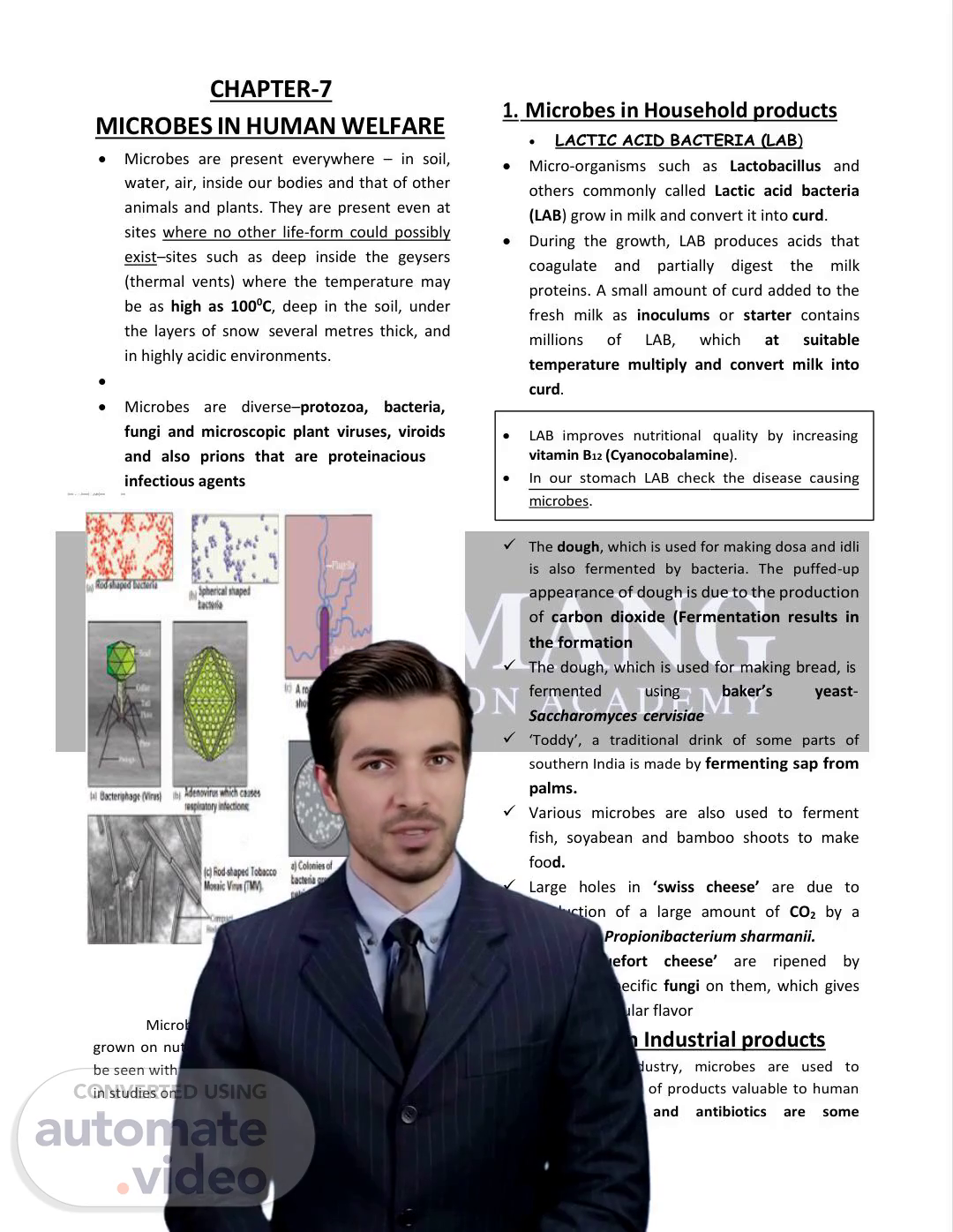
[Virtual Presenter] Microbes are present everywhere – in soil, in milk, and in the human body. Micro-organisms such as Lactobacillus and others commonly called Lactic acid bacteria (LAB) grow in milk and convert it into curd. During the growth, LAB produces acids that coagulate and partially digest the milk proteins. A small amount of curd added to fresh milk serves as an inoculum or starter containing millions of LAB, which at suitable temperatures and conditions, thrive in various environments including those found within our bodies and those of other animals and plants. They are present even in extreme environments such as deep inside geysers, deep in the soil, under layers of snow several meters thick, and in highly acidic environments. Microbes are diverse - protozoa, bacteria, fungi, and microscopic plant viruses, viroids. LAB improves nutritional quality by increasing vitamin B12 (Cyanocobalamine) and also prions that are proteinaceous infectious agents. In our stomachs, LAB checks for disease-causing microbes. The dough used for making dosas and idlis is also fermented by bacteria, resulting in its puffed-up appearance due to the production of carbon dioxide. Similarly, the dough used for making bread is fermented using baker's yeast - Saccharomyces cerevisiae. Toddy, a traditional drink of some parts of southern India, is made by fermenting sap from palms. Various microbes are used to ferment fish, soybean, and bamboo shoots to make food. Large holes in Swiss cheese are due to the production of a large amount of CO2 by a bacterium Propionibacterium shermanii. The Roquefort cheese is ripened by growing a specific fungus on them, giving them a particular flavor. Microbes like bacteria and many fungi can be found in almost every environment, including those that would seem inhospitable to life..
Scene 2 (2m 13s)
[Audio] The microbes used in fermentors have a 'pro life' role, playing a crucial part in various industrial processes. They convert milk into curd, improve nutritional quality, and ferment dough and drinks in industries. Microbes like Saccharomyces cervisiae are used to produce fermented beverages such as wine, beer, whisky, brandy, and rum. This yeast ferments malted cereals and fruit juices, producing ethanol which gives these drinks their characteristic alcoholic content. The discovery of penicillin by Alexander Fleming was a result of serendipity, or an unexpected chance discovery. Fleming, along with Ernest Chain and Howard Florey, was awarded the Nobel Prize in 1945 for their groundbreaking work on penicillin. Today, antibiotics are widely used to combat deadly infections caused by bacteria. The type of raw material used for fermentation and the type of processing determines the type of alcoholic drink produced. For example, wine and beer are produced without distillation, while whisky requires distillation of the fermented broth. The full potential and effectiveness of penicillin were established through extensive use during World War II..
Scene 3 (3m 31s)
[Audio] The microbes used in these applications have been shown to be effective in removing pollutants and toxins from the environment. The use of microbes in bioremediation has been increasing over time due to its potential to clean up contaminated sites. The microbes involved in this process are typically microorganisms such as bacteria, fungi, and yeast. They work together with other organisms to break down complex organic compounds into simpler substances. This process can also help reduce greenhouse gas emissions by breaking down carbon-based compounds. Furthermore, microbes can be engineered to perform specific tasks, such as cleaning up oil spills or removing heavy metals from soil. The benefits of using microbes in bioremediation include improved air quality, reduced pollution, and increased efficiency in waste management..
Scene 4 (4m 27s)
[Audio] The primary treatment involves a physical process where the small sized organic matter is removed from the effluent. This process removes both grits and large pieces of organic matter from the wastewater. On the other hand, the secondary treatment is a biological process where the microbes consume the organic matter and reduce the BOD of the effluent. This process involves aeration, filtration, microbial activity, and sedimentation of organic matter. The main difference between primary and secondary treatment is that primary treatment does not require aeration, whereas secondary treatment requires aeration to facilitate the growth of aerobic microbes. Additionally, primary treatment mainly involves the removal of grits and large pieces of organic matter, whereas secondary treatment involves the digestion of organic matter by microbes. The overall goal of both processes is to reduce the BOD of the effluent, making it suitable for discharge into natural water bodies..
Scene 5 (5m 40s)
[Audio] Microorganisms are used in various ways, including converting milk into curd, improving nutritional quality, fermenting dough and drinks, and synthesizing products like antibiotics and beverages in industry. The biogas plant produces rising gas as it is produced in the tank due to microbial activity, which has an outlet connected to a pipe leading to a nearby house. The slurry used to supply nutrients to plants comes from trees, where insect larvae eat them. Some microorganisms produce toxins that kill certain insects, while others are harmless. Microorganisms are also used as fertilizers, and scientists have introduced genes from certain microorganisms into plants to make them resistant to insect attacks. For example, Bt-cotton has been developed, which is resistant to certain insect pests. Trichoderma, a fungus, is used to treat plant diseases. Additionally, microorganisms like Baculoviruses are used as a form of biological control, attacking specific insects without harming plants or other animals. These microorganisms play a crucial role in integrated pest management programs. Furthermore, microorganisms are used as biofertilizers, enriching the nutrient quality of the soil. Biofertilizers come from bacteria, fungi, and cyanobacteria, and are often used commercially in agriculture. Ladybirds and dragonflies are examples of beneficial insects that help control pests, reducing the need for chemical pesticides..
Scene 6 (7m 21s)
[Audio] Microbes play a vital role in the ecosystem as they form organic compounds which are used by plants as nutrients. These microbes include Azospirillum and azobacter, which are free-living bacteria in the soil that can fix atmospheric nitrogen. Certain fungi, such as mycorrhizal fungi, form symbiotic associations with plants, helping them absorb phosphorus from the soil and resisting root-borne pathogens, salinity, and drought. Additionally, cyanobacteria, including species like Anabaena, Nostoc, and Oscilatoria, are autotrophic microbes widely distributed in aquatic and terrestrial environments, capable of fixing atmospheric nitrogen. In paddy fields, cyanobacteria act as biofertilizers, adding organic matter to the soil and increasing its fertility. Many countries now offer commercial biofertilizers, which farmers use to replenish soil nutrients and reduce dependence on chemical fertilizers. However, there is a difference between biofertilizers and chemical fertilizers. Biofertilizers are microorganisms, whereas chemical fertilizers are chemicals. While biofertilizers do not cause pollution and are cheaper, chemical fertilizers can destroy soil structure and functions, making them more expensive. Furthermore, biofertilizers improve soil structure and functions, whereas chemical fertilizers have negative effects..