Scene 1 (0s)
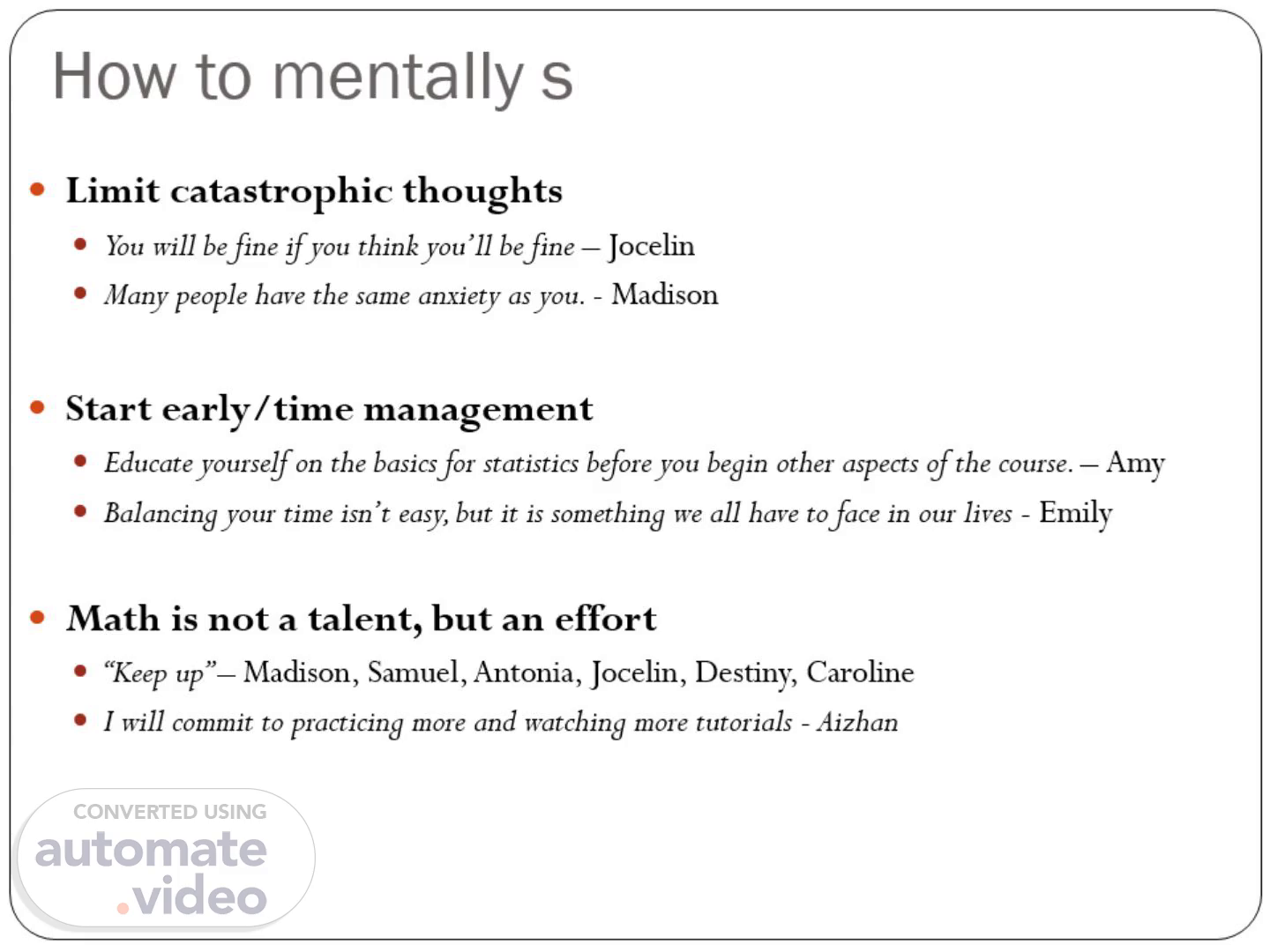
How to mentally succeed in this course.. Limit catastrophic thoughts You will be fine if you think you’ll be fine – Jocelin Many people have the same anxiety as you. - Madison Start early/time management Educate yourself on the basics for statistics before you begin other aspects of the course. – Amy Balancing your time isn’t easy, but it is something we all have to face in our lives - Emily Math is not a talent, but an effort “Keep up” – Madison, Samuel, Antonia, Jocelin, Destiny, Caroline I will commit to practicing more and watching more tutorials - Aizhan.
Scene 2 (26s)
PSY330 Statistics for the Behavioral and natural sciences.
Scene 3 (35s)
To gain a better understanding of: Measures of Central Tendency (Mean, Median Mode) Standard Deviation Normal Distributions.
Scene 4 (45s)
Some tricky things about central tendency…. Measures of Central Tendency.
Scene 5 (56s)
This is NOT the mode!!. This is the mode. Mode. *Note: The mode will always be on the x-axis..
Scene 6 (1m 19s)
Median. Median - the value that is the mid-point of a variable. Half the values are smaller than the median and half the values are bigger.
Scene 7 (1m 34s)
Median. Median - the value that is the mid-point of a variable. Half the values are smaller than the median and half the values are bigger.
Scene 8 (1m 42s)
Mean is the average data point of all the variables in your data set. Can only be used to describe interval and ratio data (not ordinal or nominal) ∑xi N Simply add up the data points and divide by the total number of data points..
Scene 9 (2m 1s)
∑xi N. = (20 + 21+ 24+22+26) = 22.6 5. Mean. x̅ = 22.6.
Scene 10 (2m 13s)
∑xi N. = (20 + 23+ 29+23+35) = 26 5. Mean. ȳ = 26.
Scene 11 (2m 26s)
Age (xi) 1 2 2 2 2 2 3 3 3 100. Age (yi) 10 10 11 11 12 12 13 13 14 14.
Scene 12 (2m 49s)
Standard Deviation (Sx) - the average distance between the mean and the scores in the data set The larger the difference between individual scores, the higher your standard deviation (Sx).
Scene 13 (3m 1s)
Lets describe what these symbols mean: Sx = Standard Deviation ∑ = “the sum of” Xi = the specific data point in the sample X = mean of the sample n = # of data points in the data set.
Scene 14 (3m 15s)
Income (xi) 20 23 29 23 35. X̄ = 26. Income (xi) Xi - X̄ 20 20-26 = -6 23 23-26 = -3 29 29-26 = 3 23 23-26 = -3 35 35-26 = 9.
Scene 15 (3m 39s)
[image] M = 52 SD = 12 M -52 SD -24 4 16 28 40 52 64 76 88 100.
Scene 16 (3m 51s)
Image:Standard deviation diagram.svg. Image:Standard deviation diagram.svg.
Scene 17 (4m 11s)
[image] 34.1% 2.1% 13.6% 34.1% 2.1% 0.1% 13.6% |.
Scene 18 (4m 32s)
They help us estimate how much of the population falls within certain scores. X̄ ± 2 S = Range of scores that 95% of the population will be in If the X̄ = 100 and the S = 15, then 95% of the population falls between two scores? 100 – (15 x 2) = 70 100 + (15 x 2) = 130 THEREFORE, 95% of the population falls between 70 and 130.
Scene 19 (4m 51s)
If the X̄ = 200 and the S = 45, then 95% of the population falls between two scores? 200 – (45 x 2) = 110 200 + (45 x 2) = 290 THEREFORE, 95% of the population falls between 110 and 290..
Scene 20 (5m 4s)
If the X̄ = 10 and the S = 2, then 68% of the population falls between two scores? 10 – (2 x 1) = 8 10 + (2 x 1) = 12 THEREFORE, 68% of the population falls between 8 and 12. And 95% of the population falls between ___ and ___?.
Scene 21 (5m 19s)
55 70 85 100 115 130 145. The Normal Distribution.